
Calculating finance charges on auto loans is a critical step for both individual car buyers and auto dealerships aiming to make informed financial decisions. For prospective car buyers, understanding these charges provides clarity on the true cost of financing a vehicle beyond the sticker price. It reveals how interest rates and additional fees impact monthly payments and the total amount paid over the lifespan of the loan. For dealerships, accurately calculating and transparently communicating finance charges builds trust with customers and helps avoid misunderstandings that can lead to disputes or lost sales. Common pitfalls in this process include misunderstanding how interest rates are applied, overlooking hidden fees such as documentation or service charges, and failing to consider the comprehensive cost of loan ownership. By grasping how finance charges are calculated and what they include, car buyers and dealerships can better negotiate loan terms, plan budgets, and avoid overpaying. This foundational financial knowledge empowers stakeholders to navigate auto financing with confidence and achieve better economic outcomes. To deepen your understanding of managing vehicle-related finances, consider exploring insights on managing truck ownership finances, which share useful principles applicable to all auto financing scenarios.
Understanding Finance Charges in Auto Loans
Finance charges are a crucial aspect of auto loans that determine the total cost of borrowing money to purchase a vehicle. These charges encompass the interest and any additional fees associated with the loan, and they can significantly impact the amount you pay over time. Understanding how finance charges are calculated can help you make informed decisions when financing your vehicle.
What Are Finance Charges?
In the context of auto loans, finance charges refer to the total cost of borrowing expressed as a monetary amount. This includes both the interest and any other costs linked to the loan, such as loan origination fees, late payment fees, and optional add-ons like gap insurance. The total finance charge is critical because it affects the monthly payment and the overall price of the vehicle, making it essential for borrowers to grasp how these charges are structured.
How Are Finance Charges Calculated?
Finance charges are generally calculated based on the principal amount borrowed, the interest rate (annual percentage rate, or APR), and the loan term (the duration for which you borrow the money). The simple formula for calculating finance charges is:
Finance Charge = (Loan Amount × Interest Rate × Loan Term) / 100
For example, if you take out a $20,000 loan with a 6% APR for 5 years:
- Calculate the interest amount:
- Finance Charge = ($20,000 × 6% × 5) / 100 = $6,000
- Thus, the total amount to repay would be $20,000 (principal) + $6,000 (interest) = $26,000.
Factors Affecting Finance Charges
Several variables influence finance charges, including:
- Credit Score: A higher credit score often leads to lower interest rates. As of August 2023, new car interest rates range from 5.25% for excellent credit to 15.77% for those with poor credit.
- Loan Amount: The more borrowed, the higher the potential finance charges. Consider this during the shopping phase to reduce overall costs.
- Loan Term: Longer loan terms can reduce monthly payments, but they often increase the total finance charges due to extended interest accumulation.
- Fees: Additional fees associated with the loan can impact the final financial product significantly. Always read the fine print in loan agreements.
- Market Conditions: When the economy faces inflation or significant changes in interest rates, the cost of borrowing might fluctuate drastically. As per recent data, the average interest rates for new car loans reached 7.4% in the third quarter of 2023 due to rising economic pressures.
Understanding these components will not only help you estimate your potential finance charges but also aid in making better financial choices regarding your auto loan. For more detailed calculations and strategies, learn more about calculating auto loan finance charge.
Conclusion
In conclusion, finance charges play a pivotal role in auto loans and can significantly affect your financial position. By understanding how these charges are calculated and what factors influence them, you can better navigate the world of auto financing and ultimately save money in the long run.
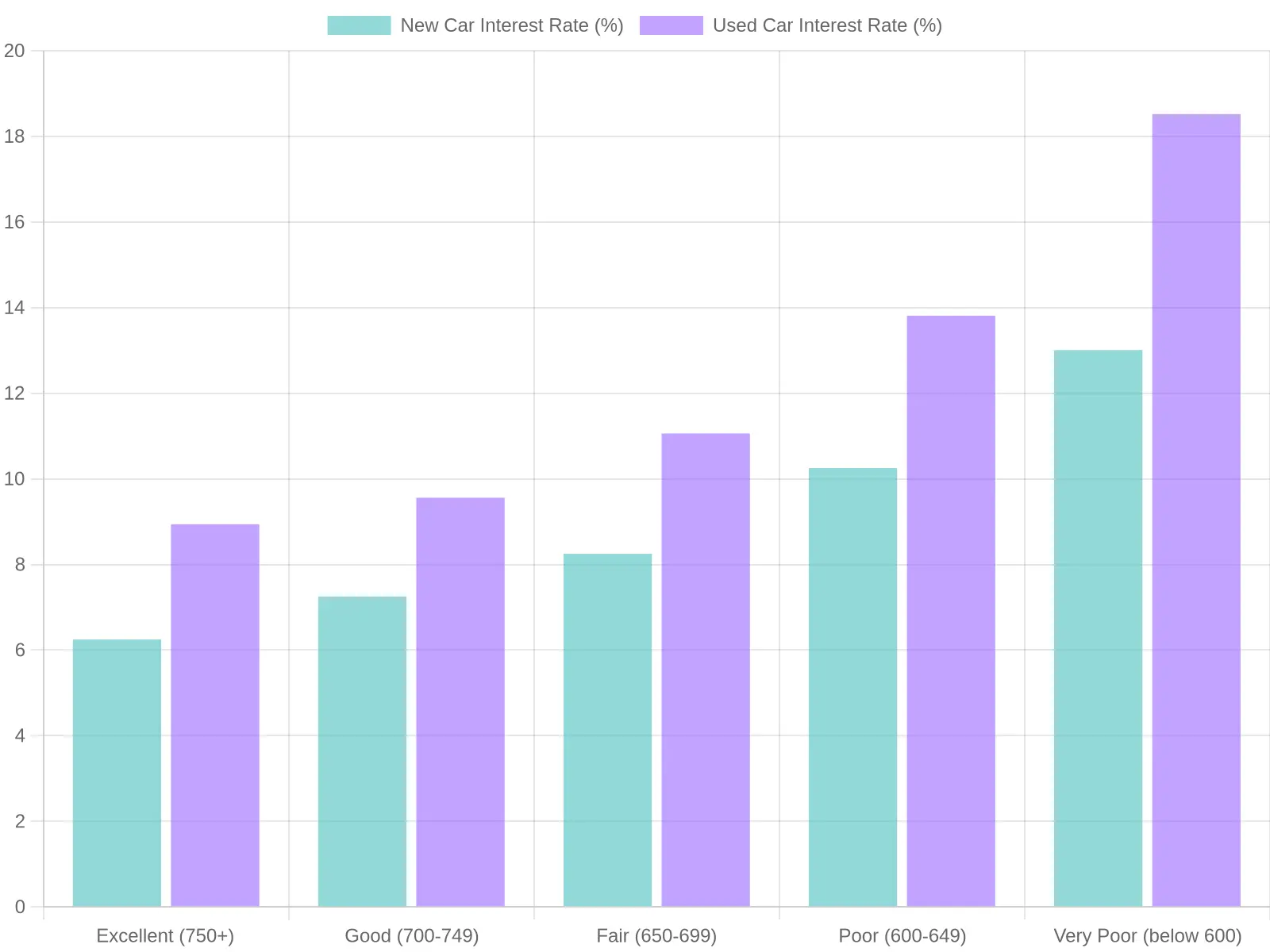
| Credit Score Range | New Car Interest Rate (%) | Used Car Interest Rate (%) |
|---|---|---|
| Excellent (750+) | 5.25 – 7.25 | 7.13 – 9.75 |
| Good (700-749) | 6.25 – 8.25 | 8.13 – 11.00 |
| Fair (650-699) | 7.25 – 10.25 | 9.13 – 13.00 |
| Poor (600-649) | 9.25 – 12.25 | 11.13 – 15.50 |
| Very Poor (below 600) | 12.25 – 15.77 | 15.50 – 21.55 |
| Scenario | Principal Amount | Interest Rate | Loan Term (Months) | Total Finance Charge | Total Repayment Amount |
|---|---|---|---|---|---|
| Scenario 1 | $20,000 | 5.00% | 36 | $1,000 | $21,000 |
| Scenario 2 | $25,000 | 7.00% | 48 | $1,800 | $26,800 |
| Scenario 3 | $30,000 | 10.00% | 60 | $4,500 | $34,500 |
Total Finance Charge Calculation Breakdown:
- Scenario 1:
- Total payment for a $20,000 loan at 5% over 36 months results in a total finance charge of $1,000.
- Scenario 2:
- For a $25,000 loan at 7% over 48 months, the finance charge increases due to higher interest leading to a total of $1,800.
- Scenario 3:
- A $30,000 loan at 10% for 60 months incurs a higher finance charge of $4,500, illustrating how higher rates and longer terms affect payments.
This table illustrates how the finance charge can significantly vary based on the loan amount, interest rate, and repayment duration. To explore more about managing auto finances, check out our detailed guide on managing truck ownership finances.
For further insights, you could explore current average auto loan interest rates and their impact on your overall financing strategy.
Common Mistakes in Calculating Finance Charges for Auto Loans
When purchasing a vehicle, many car buyers overlook the complexities of calculating finance charges on their auto loans. Understanding these charges can help avoid costly mistakes. Here’s a list of common errors along with tips on how to prevent them:
-
Ignoring the Annual Percentage Rate (APR): Many buyers focus on the monthly payment rather than the APR, which can lead to miscalculations of total loan costs.
-
Tip: Always request an APR breakdown from lenders; compare it to other offers to ensure you’re getting the best rate. Learn more about auto finance solutions.
-
Misunderstanding Finance Charge Structures: Finance charges can be calculated using different methods such as average daily balance or adjusted balance. Not knowing this leads to incorrect calculations.
-
Tip: Familiarize yourself with how your lender calculates finance charges, and don’t hesitate to ask questions if it’s unclear. Consult resources on calculating finance charges for further assistance.
-
Not Accounting for Additional Fees: Maintenance, warranty, and insurance costs can add to the overall expense.
-
Tip: Include all potential fees in your calculations to get a clearer picture of what you’re actually paying for the loan.
-
Overlooking Loan Terms: Buyers often neglect reading the fine print regarding prepayment penalties or conditions that affect finance charges.
-
Tip: Carefully read and understand the entire loan agreement before signing. Ensure you know all terms and conditions.
-
Not Using Amortization Calculators: Calculating your monthly payments manually can be prone to errors.
-
Tip: Use reliable online amortization calculators to get a clear picture of your payment schedule and total finance charges.
By being aware of these common mistakes and following the tips provided, car buyers can improve their chances of securing a more favorable loan agreement. For more insights into managing finances as a first-time truck owner, check out our guide on financial management for first-time truck owners.
Staying informed will empower you as an auto buyer, helping you to navigate the complexities of auto loans confidently.
“Understanding the intricacies of finance charges on auto loans is vital for any borrower; it lays the foundation for informed decision-making and effective financial planning. Transparency in these charges not only helps consumers avoid overpayment but also reveals the hidden costs associated with borrowing. Accurate calculation can empower borrowers to make confident choices that align with their financial goals.”
- Financial Expert from Davis Financial Advisors
Calculating finance charges is not just about numbers; it’s about understanding the overall cost of borrowing. For more insights on effective financing strategies, you can learn more about managing truck ownership finances.
Accurate calculations can lead to significant savings over the loan term, making it essential for both individual car buyers and small business fleet buyers to understand how these charges impact their overall expenses.
Tools for Calculating Finance Charges on Auto Loans
Calculating finance charges on auto loans can be a daunting task for both individual car buyers and dealerships. However, various tools can simplify this process significantly, allowing users to understand loan costs better and make informed financial decisions.
Online Calculators
-
Loan Calculator
Calculator.net offers a user-friendly interface that helps users find repayment plans, interest costs, and amortization schedules for different types of loans, including auto loans. It allows you to input loan details such as amount, interest rate, and term, providing a clear breakdown of what to expect financially. -
Finance Charge Calculator – Symbolab
The Symbolab Finance Charge Calculator enables users to determine the costs associated with borrowing for loans, credit cards, and mortgages. This practical tool makes calculating estimated borrowing expenses much easier, ensuring users can plan their budgets more effectively. -
Finance Charge Calculator
This tool on Online Calculator assists users in calculating finance charges on various loans. It clearly illustrates how to derive finance charges based on the loan amount, helping users gauge total payments over time. -
Auto Finance Charge Calculator
Found at Dash Calculator, this specialized tool explains the total interest paid over the life of an auto loan. It offers insights into monthly payment calculations and the overall cost of the loan, thus assisting car buyers and dealerships alike in optimizing their financial planning.
Benefits of Using These Tools
- Simplifies Complex Calculations: Automates difficult financial math, allowing users to focus on making the right purchasing decisions.
- Transparency in Costs: Provides a clear view of total costs associated with loans, which can help avoid unforeseen expenses down the line.
- Supports Informed Decision-Making: Equips users with information to evaluate different loan options effectively.
By utilizing these online calculators, car buyers and auto dealerships can take the guesswork out of finance charges, enhancing their understanding of loan agreements and improving overall financial management. For more insights on managing finances, learn more about financial management for first-time truck owners.
Impact of Loan Terms on Finance Charges
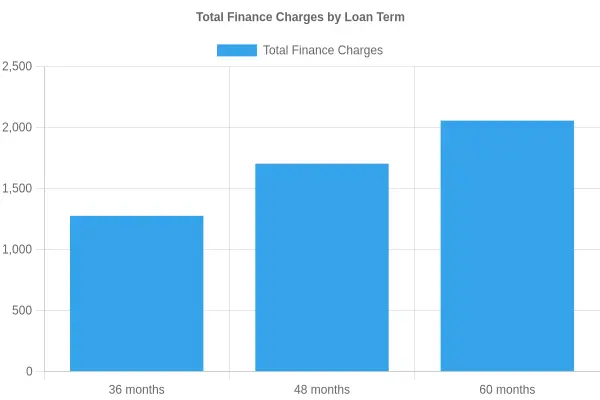
Understanding how different loan terms affect the total finance charges is crucial for individuals considering auto loans. Longer loan terms often reduce monthly payments but increase overall finance costs. The bar chart below illustrates this relationship clearly.
| Loan Term (Months) | Total Finance Charges ($) |
|---|---|
| 36 | 1,276 |
| 48 | 1,703 |
| 60 | 2,056 |
In this example, with a fixed interest rate of 6% on a $20,000 auto loan:
- 36 Months: Total finance charges amount to $1,276.
- 48 Months: Total finance charges increase to $1,703.
- 60 Months: Total finance charges rise to $2,056.
This data shows that while longer loan durations might seem tempting due to lower monthly payments, they come with significantly higher finance charges, impacting the long-term cost of the vehicle purchase. For further insights, you can learn more about finance charges on auto loans.
This information is important for potential car buyers to make informed decisions regarding their financing options.
Conclusion: Actionable Insights for Auto Loan Financing
Calculating finance charges on auto loans is not just a mere arithmetic exercise; it is an essential component of making informed purchasing decisions. Understanding the intricacies of these charges-such as interest rates, loan tenure, and how they blend to impact your overall payment-empowers you as a consumer.
Importance of Understanding Finance Charges
Finance charges can significantly affect the total cost of owning a vehicle. Higher charges mean you will pay more over the life of the loan, which could strain your budget. By utilizing resources such as NerdWallet’s auto loan calculator or Bankrate’s calculator, you can more accurately estimate your potential monthly payments and better plan your financial commitments.
Additionally, insights from articles like How Interest Rates Affect the Auto Loan Market highlight the critical nature of rates and their impact on your auto financing options. With this knowledge, you are in a better position to negotiate terms or explore other financing solutions, such as those provided by Davis Financial Advisors.
Call to Action
We encourage you to take a proactive approach to your financing options. Explore various auto loan calculators, understand finance charges, and consider how different factors will influence your purchasing choices. Making informed decisions today can save you money and stress tomorrow. Start by evaluating your financing options now and see how you can make smarter, more impactful automotive financial decisions!
Stay informed and take control of your auto financing journey!
Understanding How to Calculate Finance Charges on Auto Loans
Calculating finance charges on an auto loan is essential for individual car buyers, auto dealerships, and small business fleet buyers. Finance charges are the costs incurred for borrowing money, typically represented by interest fees. Here’s a clear and structured guide on how to effectively calculate these charges and why they matter.
The Formula for Calculating Finance Charges
To determine the finance charge on an auto loan, you need to understand the following formula:
Finance Charge = (Principal Amount x Interest Rate x Loan Term) / 100
Where:
- Principal Amount is the borrowed sum or vehicle price.
- Interest Rate is the annual percentage rate (APR) expressed as a number (not a percentage).
- Loan Term is the duration in years for which the money is borrowed.
Components of Finance Charges
- Interest Rate: The percentage charged on the principal amount of the loan.
- Loan Amount: The total amount borrowed for the vehicle purchase.
- Loan Duration: The length of the loan term in months or years, which affects the total amount paid in interest.
- Additional Fees: These may include processing fees or insurance costs that can be added to the initial finance charge.
Example Calculation
For a deeper understanding, let’s consider an example:
If you take an auto loan of $20,000 at an interest rate of 5% for a term of 5 years, the calculation would go as follows:
- Principal = $20,000
- Interest Rate = 5
- Loan Term = 5 years
Finance Charge = (20000 * 5 * 5) / 100 = $5,000
Thus, your total repayment amount would be $20,000 + $5,000 = $25,000.
Importance of Understanding Finance Charges
Being aware of how finance charges work helps in budgeting for monthly payments and understanding overall loan costs. This knowledge can lead to better decision-making, resulting in potentially significant savings over time.
For those looking to improve their auto financing knowledge, check out our articles on managing truck ownership finances and navigating auto finance solutions here.
Conclusion
Calculating finance charges is a relatively straightforward process, but it requires careful consideration of various factors. By understanding these components, borrowers can make informed choices and potentially save money, leading to a more advantageous financial situation.
By using reputable online calculators or seeking financial advice, you can ensure the calculated finance charge aligns with your financial planning needs.