
OneMain Financial makes auto purchase loans through participating dealerships, and the car has to clear a collateral review before anything else happens. The rule OneMain publishes is narrow: larger secured loans require a first lien on a vehicle no more than ten years old that meets OneMain’s value requirements, is titled in your name, and carries valid insurance. OneMain does not publish a mileage cutoff. The table below collects the age and mileage ranges that come up most often in used-car lending so you can size up a car before you talk to a dealer. These are market benchmarks, not OneMain’s published limits.
| Vehicle Category | New or Used | Typical Age Limit | Typical Mileage Limit |
|---|---|---|---|
| New cars | New | Current or prior model year | Under 100 miles (delivery/demo) |
| Used cars from franchised dealers | Used | 10 years or newer | Under 150,000 miles |
| Older high-mileage used cars | Used | 11 to 15 years | 150,000 to 200,000 miles |
| Private-party purchases | Used | 10 years or newer | Under 150,000 miles |
| Motorcycles and powersports vehicles | New or used | 10 years or newer | Under 75,000 miles |
Treat the ranges as a starting point, not an approval guarantee. OneMain weighs your credit profile and income along with the vehicle, and a lender’s actual cutoffs can be tighter than the table above. OneMain also does not lend for a business or commercial purpose, so a vehicle bought to run a business sits outside the program. Active-duty service members, their spouses, and dependents covered by the Military Lending Act may not pledge a vehicle as collateral at all.
Core Vehicle Qualification Criteria: What Really Decides Approval
Your Vehicle Gets Underwritten Almost Like a Second Applicant
Most borrowers assume the credit score decides an auto loan. With a secured loan, the car matters too: a strong applicant can be turned down because the vehicle fails a basic test, and a borderline applicant can get through when the car is solid. Four things usually decide that outcome — the vehicle age limit, the mileage cap, the clean title requirement, and how the lender treats salvage or branded titles.
The Four Criteria, One by One
The Vehicle Age Limit
Lenders set a maximum vehicle age for the loan, and some also look at how old the car will be when the last payment comes due. A car that qualifies today can fall outside the window partway through the term. At OneMain, the published threshold for larger secured loans is a vehicle no more than ten years old. Older cars lose value faster — see this look at how vehicle lifetimes shape depreciation and resale value — and that erodes the collateral behind the loan.
The Mileage Cap
High mileage can disqualify an otherwise new car. Lenders use a mileage cap to keep the vehicle inside a normal usage band, and they read it together with age rather than on its own: a three-year-old car with 150,000 miles looks like heavy commercial or rideshare use, while the same model with 40,000 miles looks ordinary. OneMain does not publish a mileage cutoff, so if a car sits near a typical limit, ask before you assume it qualifies.
The Clean Title Requirement
A clean title is the requirement borrowers tend to discover last. It confirms the vehicle has never been declared a total loss, rebuilt, flooded, or bought back under lemon law. Without it, a lender cannot reliably value or insure the collateral, so funding usually stops at the paperwork.
Salvage and Branded Titles
Salvage, rebuilt, flood, and “lemon” branded titles are usually declined. A few lenders will consider a rebuilt title once it has been re-inspected and re-titled, but OneMain’s published requirement is a first lien on a qualifying vehicle, which rules most branded titles out. Dealers tend to know which channels accept them; private sellers often do not.
Direct Loans vs. Dealer-Arranged Loans
The criteria rarely change; who applies them does. OneMain runs both paths: at a participating dealership the dealer submits your application to OneMain and you can close there, while a purchase from a private seller goes through a OneMain personal loan.
| Criterion | Direct Loan | Dealer-Arranged Loan |
|---|---|---|
| Vehicle age limit | Fixed by the lender’s own underwriting | Varies by whichever lender the dealer places the deal with |
| Mileage cap | A single set ceiling | Can loosen or tighten across a lender panel |
| Clean title requirement | Verified before funds are released | Enforced at contract; branded titles rarely funded |
| Salvage/branded titles | Generally declined | Occasionally accepted as rebuilt with proof of re-inspection |
With a direct loan, you deal with one lender and its rules apply throughout. With dealer-arranged financing in the broad market, the dealership shops your contract across several lenders, so approval can depend on which one takes it. OneMain’s dealer program works differently: the participating dealer submits your application to OneMain alone.
Before You Fall for a Car
The vehicle is not a bystander in a loan application; it is part of what gets approved. Before you commit to a car, check its age, odometer, and title status against the lender’s limits. Get those three right and you remove most of the reasons a workable application dies at the end.
Estimated Auto Loan Approval Rates by Credit Tier
OneMain says it works with a wide range of credit scores, which is where its reputation with subprime borrowers comes from. The chart below is our own estimate of how approval odds shift across six credit tiers, from deep subprime to super prime. OneMain does not publish approval rates, and the chart’s methodology is not published either, so read it as a rough shape rather than a forecast.
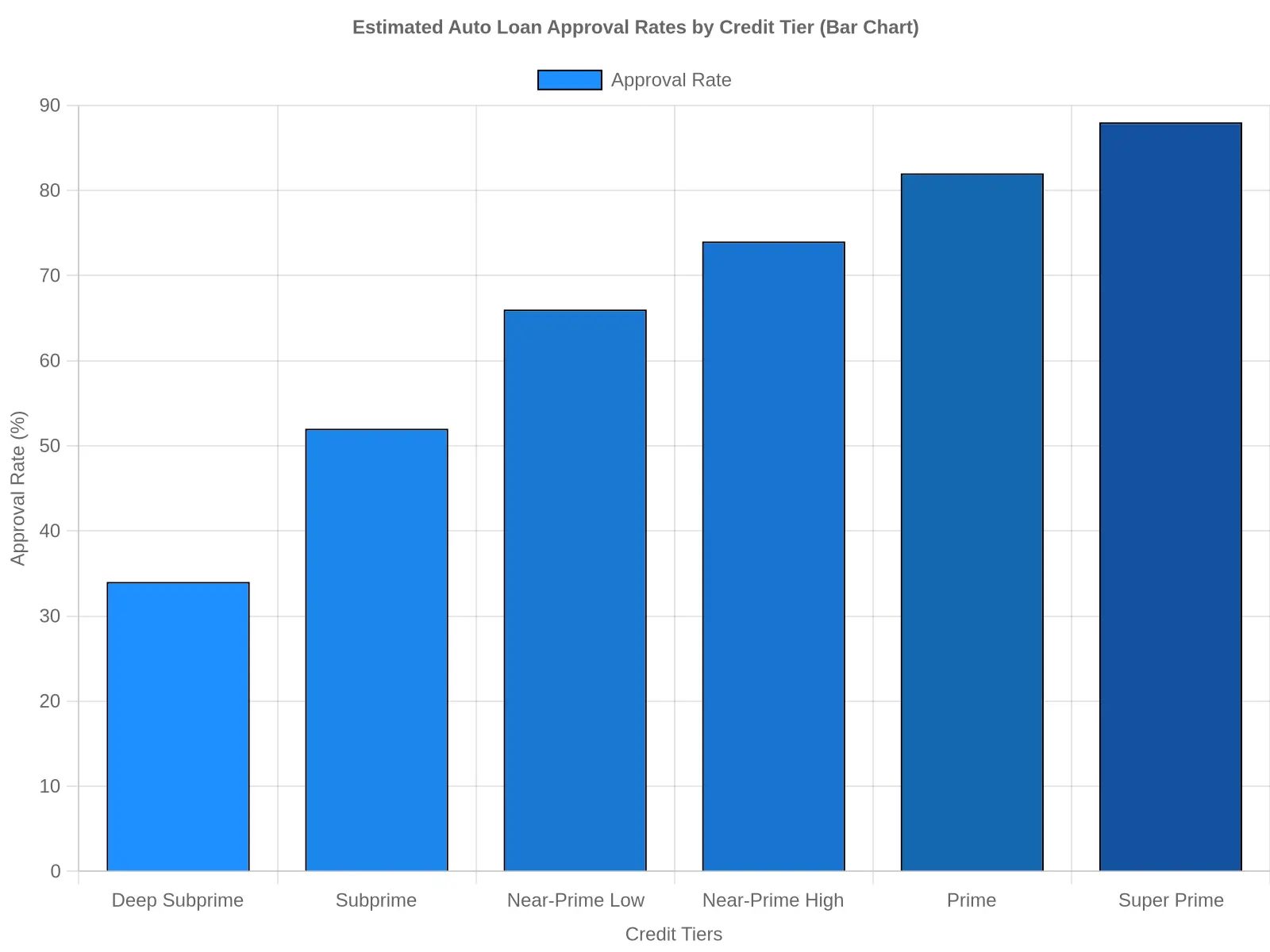
Even the lowest credit tiers get approved at rates a conventional bank rarely matches, but these are estimates, not OneMain figures.
Reading the Estimates
- Deep subprime (300-500): roughly a 1-in-3 chance of approval – rare at a conventional bank, but realistic for a lender built around this segment.
- Subprime (501-600): approval odds jump above 50%, which lines up with OneMain’s core customer base.
- Near-prime (601-700): rates climb into the mid-60s to mid-70s as risk narrows.
- Prime and super prime (701-850): approvals approach 8 or 9 in 10, though these borrowers often qualify for cheaper rates elsewhere.
If you are comparing options, it helps to set these estimates against what dealership financing and banks typically offer. For the full picture of how OneMain structures its decisions, review these OneMain Financial auto loan details before applying.
Vehicle Age and Mileage Constraints in OneMain Auto Loans
OneMain’s published rule ties the largest secured loans to a vehicle no more than ten years old. The reason is collateral: the car backs the loan, and older, higher-mileage cars lose value faster than the balance comes down. If a borrower defaults, the lender has to repossess and resell the car to recover what it is owed, and a car worth less than the balance leaves a gap. Age and mileage caps keep that gap from growing.
OneMain does not publish a mileage cutoff, but market norms for used-car lending often land between 100,000 and 150,000 miles. Go past that and the car may stop qualifying regardless of your credit or income, which can leave you with a higher rate, a smaller loan, or a decline. As a car ages, its market value drops while the balance stays high, and that pushes the loan-to-value (LTV) ratio upward. A high LTV means thinner collateral coverage, and lenders may answer with a larger down payment or a shorter term.
How LTV Rises With Vehicle Age
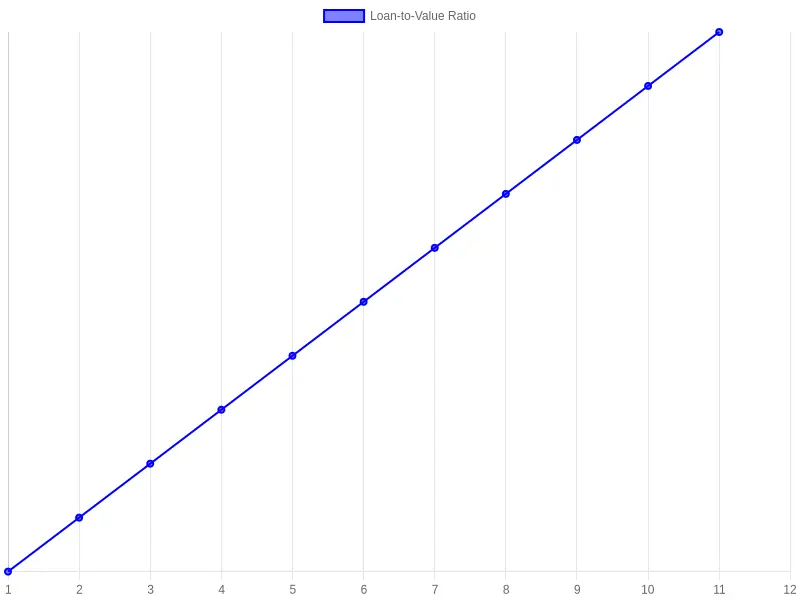
The chart tracks a familiar pattern: LTV sits near or below the 100% collateral line on newer vehicles, then climbs as the odometer rolls up. Past 100%, the balance is larger than the car is worth, and lenders price the deal as higher risk. The figures are illustrative; your own LTV depends on the appraisal, the amount financed, and the term.
Before applying, compare the car’s age and odometer against the lender’s limits. A newer, lower-mileage vehicle keeps LTV in a healthier range and tends to produce better terms on programs such as OneMain Financial auto loans.
Loan-to-Value and Vehicle Value Limits in OneMain Financial Auto Loans
LTV compares what you borrow with what the car is worth. Borrow $12,000 against a car appraised at $10,000, and your LTV is 120%. A high LTV tells the lender that the collateral covers less of the balance, so OneMain uses LTV along with the vehicle’s appraised value to set a ceiling on how much it will advance.
OneMain accepts a wider range of vehicles than prime banks do, but it offsets that by capping the loan against the vehicle’s value. The financed amount generally has to stay within a set percentage of a recognized value guide. The relationship is direct: a higher appraised value supports a larger loan, while a low-value or hard-to-price car pulls the ceiling down. OneMain does not publish an LTV matrix; the numbers below show how the arithmetic works, not a rate card.
| Vehicle Appraised Value | Illustrative Max LTV | Approx. Maximum Loan |
|---|---|---|
| $8,000 | 100% | $8,000 |
| $12,000 | 110% | $13,200 |
| $20,000 | 120% | $24,000 |
Illustrative ranges only; actual terms depend on credit profile, income, and lender guidelines.
Before applying, get a realistic valuation and run your own LTV. A larger down payment or a car that holds its value keeps you under the cap, which helps approval odds. For a side-by-side view of how another lender structures refinancing limits, see this comparison of GM Financial refinance auto loans.
Where Approvals Stall Due to Credit
For a OneMain applicant, the car is rarely the thing that kills the deal. More often the application stalls on how the credit history reads against the lender’s standards. Four issues come up most.
Thin Credit Files
A short or empty credit history can limit you as much as a damaged one. A thin file gives an underwriter almost no payment behavior to score, so they cannot tell whether you repay on time. You may be asked to add a cosigner, document more income, or build a few months of history before the file moves forward.
Recent Delinquencies
Recent late payments carry outsized weight. A delinquency inside the past 12 months tells the lender the repayment risk is current, not historical, which can push the file toward the bottom of the queue or a decline. Clearing overdue accounts and waiting a few billing cycles usually helps more than reapplying right away.
High Credit Utilization
Maxed-out accounts suggest you are already stretched. When utilization rises above roughly 30 to 50 percent, the lender sees little room in your monthly budget even if every payment has arrived on time. Paying balances down before you apply can move you from a marginal applicant to a stronger one.
Multiple Recent Inquiries
A burst of applications looks like financial distress. Several hard inquiries in a short window suggest you were turned down elsewhere or are scrambling for cash, and each one can cost a few points. Spacing out applications and pausing new credit requests gives the profile time to settle.
Once you can see the credit issues behind a stall, you can fix them instead of guessing. Reviewing the full OneMain Financial auto loan process before you apply helps you line up the documents and set realistic expectations.
Income, Employment, and Debt-to-Income Stalls
The next set of stalls is about money rather than metal. When income, job history, or existing debts do not line up cleanly on paper, a conditional approval can turn into a waiting game.
The first hurdle is income verification requirements. Lenders want stable, provable earnings, not a healthy-looking paycheck. Gaps here are a leading reason decisions slow down.
What debt-to-income actually means
The debt-to-income ratio for auto loans is your total monthly debt payments divided by your gross monthly income. Earn $5,000 a month and owe $1,750 across all debts, and your DTI is 35%. It is the clearest single snapshot of how much room you have left for a car payment.
Here is how the usual thresholds break down:
| DTI Range | What It Usually Signals |
|---|---|
| Below 36% | Comfortable; strongest approval odds |
| 36% – 45% | Workable, often with conditions |
| 45% – 50% | Strained; higher scrutiny and rates |
| Above 50% | Frequently a stall or denial point |
How documentation gaps delay decisions
Even a solid DTI can stall when the paperwork does not match the story. Self-employment income, a recent job change, or irregular gig pay all force a manual review.
A missing pay stub, unverifiable side income, or a move between jobs can leave a file in “pending” for days. Each round of back-and-forth adds time.
If timing worries you, it helps to understand how payment schedules interact with approval windows, as explored in this guide on managing auto loan grace periods.
What Clears the Hurdle
Income stability, verifiable earnings, and a DTI under roughly 45% do most of the work in a OneMain auto approval. Get the documentation in order before you apply and you remove the most common reason a decision stalls.
OneMain Financial Versus Competitors: Reading the Auto Loan Lender Comparison
An auto loan lender comparison comes down to tolerance: which lenders stretch to say yes, and what they charge for it. OneMain’s reputation rests on cases many prime lenders decline — older, higher-mileage cars and borrowers with subprime or near-prime scores.
Ally Financial goes the other way, favoring newer models and stronger credit, though its refinance offers are worth a look if you already own a recent vehicle; you can review how Ally’s refinance auto loan terms stack up for rate-sensitive owners. Westlake Financial sits between them and is unusual in accepting private-party purchases, which is why its private-party auto loan programs deserve their own read. GM Financial stays tied to dealerships and newer franchise inventory.
Credit unions and community banks round out the field: they usually offer the lowest rates and the largest loan amounts, but they underwrite more strictly and move more slowly. On speed, OneMain can decide the same day after prequalification, while traditional banks often take a few days and credit unions can take a week. Those timelines are general market norms, not published commitments.
No single lender wins the comparison outright. If your credit is spotty or the car is older, OneMain usually wins on access. If your credit is strong and you want the cheapest money, a credit union usually wins. Match the lender to the situation.
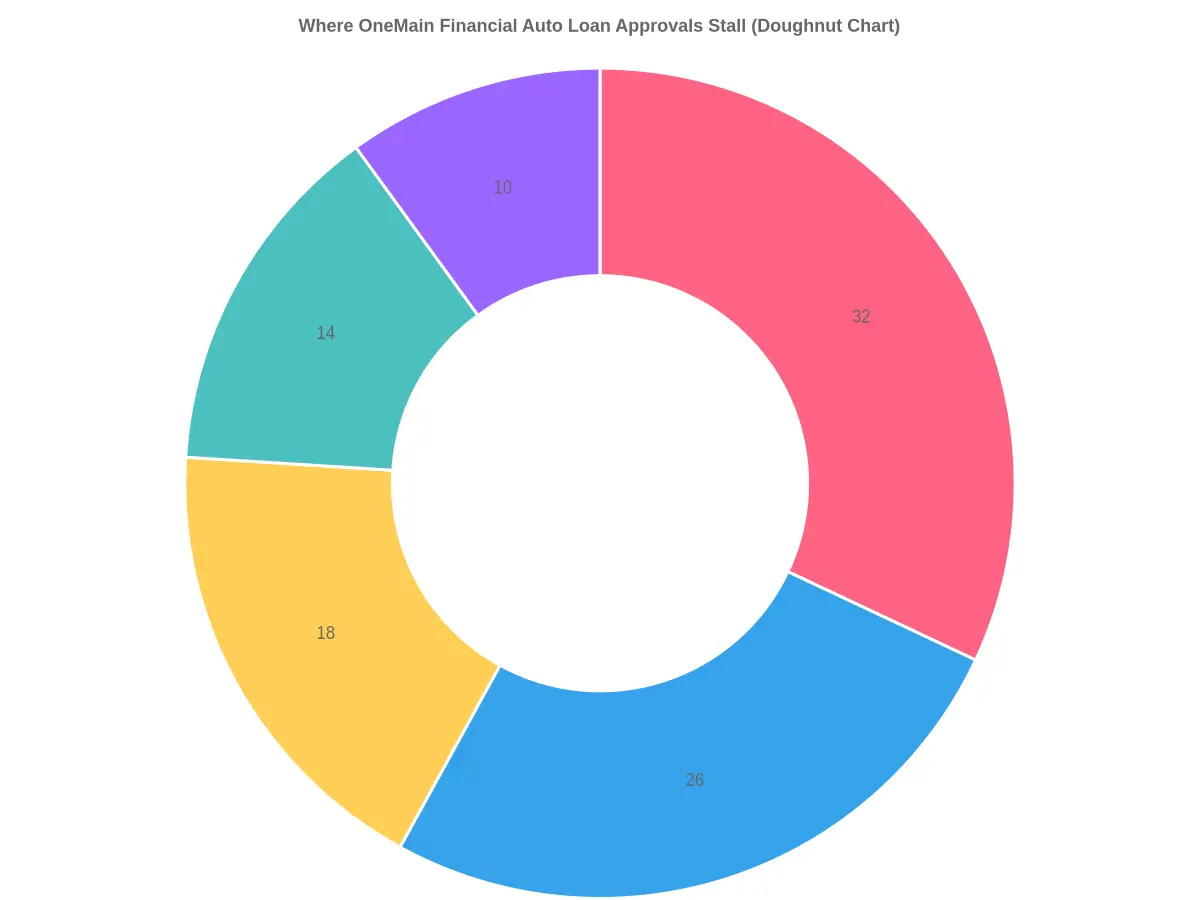
An OneMain auto loan application rarely moves in a single step. Applications pause for a handful of recurring reasons, and the chart breaks down the estimated share of each. Incomplete documentation leads at 32 percent, followed by credit concerns at 26 percent. Vehicle eligibility accounts for 18 percent of delays, with title or lien problems at 14 percent and income verification gaps at 10 percent. These percentages are our estimates, not OneMain data.
Knowing how OneMain Financial auto loans are reviewed can help you prepare the right paperwork and answer credit questions up front, which may shorten the wait between application and funding.
Caption: Together, documentation and credit issues account for the largest share of delays, nearly 6 in 10 stalled approvals.
Tips to Improve Your OneMain Financial Auto Loan Approval Odds
Approval usually comes down to preparation. OneMain weighs your income, your credit profile, and the car, so knowing what moves the needle helps before you apply.
Prepare your documentation in advance. Gather recent pay stubs, two months of bank statements, a valid driver’s license, proof of residence, and a short list of personal references before you apply. Missing paperwork is one of the most common reasons a file stalls, so a complete file keeps things moving from the first click.
Strengthen your credit indicators. Pull your credit reports and dispute any errors you spot. Pay down revolving balances to lower your utilization, and avoid opening new accounts in the months before you apply. Even modest improvements can shift how a lender reads your overall risk.
Prioritize qualifying vehicle selection. OneMain’s larger secured loans require a vehicle no more than ten years old, so an older, high-mileage car can stall an otherwise strong application. A newer, lower-mileage model inside the guidelines keeps you in range. If you are comparing lenders across markets, this multilingual guide to auto financing can help you weigh your options.
Manage your debt-to-income ratio. Your DTI compares monthly debt payments to gross income. Lenders generally prefer it below roughly 40 to 45 percent, so paying down existing loans or credit cards before applying can meaningfully improve your auto loan approval odds.
None of these factors works alone. A complete file, a healthier credit profile, a financeable car, and a workable debt-to-income ratio together give you the best shot at a yes.
Caption: The logic flows top to bottom – a vehicle first passes the age check, then the mileage check, then the title status check, and only a clean run through all three conditions lands on the qualifying outcome; a failure at any branch diverts it to the non-qualifying path.
OneMain Financial Auto Loan FAQ
These are the questions readers ask most about OneMain vehicle qualification and approval requirements.
What vehicles qualify for a OneMain Financial auto loan?
Through participating dealers, OneMain finances new and used cars and trucks, motorcycles, and other vehicles such as ATVs, side-by-sides, off-road bikes, crossovers, horse and utility trailers, and lawn equipment. It also refinances an existing auto loan. Qualification depends on the model year, mileage, condition, and title rather than the brand. Larger secured loans require a vehicle no more than ten years old with a clean title, valid insurance, and a value that meets OneMain’s requirements.
Are high-mileage cars eligible?
They can be, but they face tighter rules than low-mileage cars. OneMain does not publish a mileage cutoff; it applies a model-year floor and a value requirement. A well-maintained car that clears both is easier to approve than one that does not. Near the edge of the range, the loan amount or term may be adjusted.
What minimum credit score do I need?
OneMain does not publish a single minimum credit score, and its standards are looser than many prime lenders’. Borrowers with fair or limited credit are considered, especially when they show steady income and a manageable debt load. A higher score can improve your rate and may increase the amount you are offered.
How much can I borrow with a OneMain auto loan?
OneMain’s personal and auto loans run from $1,500 to $30,000, and the amount depends on your state, the vehicle’s value, and your income. Larger secured loans require a first lien on a vehicle no more than ten years old. State limits apply as well: North Carolina caps unsecured loans at $11,000, Maine at $7,000, and West Virginia at $13,500, with minimum loan sizes in several states. Confirm the figure for your state before you shop.
Can I buy from a private seller?
Yes, but not as a dealer auto loan. For a private seller, OneMain uses a personal loan for auto purchase, which you can apply for online or at a branch. You will typically need the seller’s information, the title, and documentation of the agreed price, and the title is handled carefully so both sides are protected.
How long does approval take?
Prequalification can return an offer in minutes, and many applicants get a decision the same day. Once the loan closes, OneMain can send funds as fast as an hour through SpeedFunds to a bank-issued debit card; by check or ACH, allow one to two business days. In most states you can close at the dealership, but residents of Hawaii, Nebraska, New Jersey, Nevada, North Dakota, Oregon, Texas, Virginia, and West Virginia close at a OneMain branch instead.
For a deeper walkthrough of terms, eligibility, and how these loans compare with other options, see this guide to OneMain Financial auto loans.