
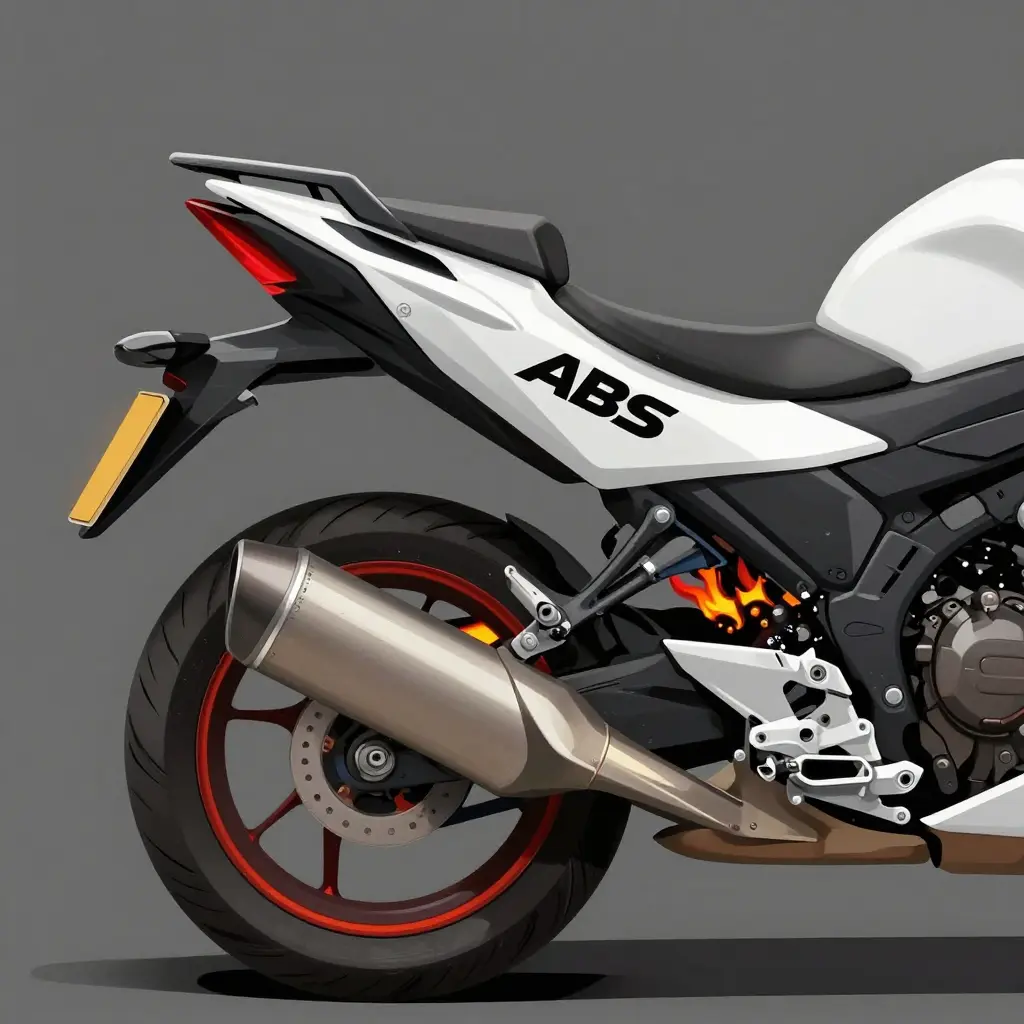
Heat Warp Near the Exhaust Header: ABS vs Fiberglass Fairings
Heat warp is the permanent deformation of a motorcycle fairing caused by radiant and convective heat from the exhaust header. It is not a scuff or a crack. Nothing strikes the panel. The plastic simply sags, curls, or blisters after enough hours next to a heat source it was never built to tolerate.
Two materials cover most of this ground. ABS fairings are molded from acrylonitrile butadiene styrene, a thermoplastic that softens as it warms. Fiberglass fairings are hand-laid composites of glass fiber held in a cured resin. The two have different comfort zones, different failure mechanisms, and different weak points.
How Heat Actually Warps a Fairing
Three mechanisms drive heat warp, and in practice they stack on top of one another.
1. Radiant Heat Transfer
Radiant heat crosses empty space as invisible infrared energy, the same warmth you feel from a campfire without touching the flames. A glowing exhaust header radiates that energy across the air gap and into the fairing. The closer the panel sits, the more it absorbs.
2. Convective Hot-Air Exposure
Convection moves heat with air. On the move, airflow keeps the fairing cool. Stopped at a light, hot air rises off the header and collects in the pocket behind the panel, where it keeps transferring heat with nowhere to escape.
3. Heat Deflection Temperature (HDT)
Heat deflection temperature is the point where a plastic softens enough to bend under a normal load. Below it the material stays rigid. Approaching it, stiffness drains away and the panel stops holding its own shape against gravity and vibration.
Thermal Cycling, Creep, and Expansion
Every ride heats the panel, and every cooldown reverses it. Over hundreds of cycles, that repeated push toward the HDT causes creep: a slow, permanent stretch under steady load, so the fairing sags and never springs back. Expansion works alongside it. As the panel grows with heat, a bolt or mount tightened rigidly holds its position while the plastic moves, concentrating stress at the fastener hole until it cracks or warps.
Radiant and convective heat push the material toward its HDT, thermal cycling locks the damage in through creep, and fixed fasteners turn ordinary expansion into distortion. Any fix has to work against all three. If you change mounting points or add a new heat source, it also helps to know how vehicle modifications affect safety.
ABS Fairings Under Exhaust Heat
ABS (acrylonitrile butadiene styrene) is a thermoplastic, and that one property explains most of its behavior near a hot pipe. It does not char or burst into flame the moment temperatures climb. It softens gradually. That slow softening is easy to misread, which is why heat warp often goes unnoticed until the panel is visibly bent.
Where ABS Starts to Move
Heat deflection temperature is measured under a fixed load, and the result depends on that load. Most bodywork grades of ABS fall in a narrow band:
| Test load | Typical ABS heat deflection temperature |
|---|---|
| 0.45 MPa (66 psi) | 85-100 C (185-212 F) |
| 1.82 MPa (264 psi) | 75-90 C (167-194 F) |
Those figures describe a material that holds its shape comfortably in normal riding and loses stiffness well before anything visibly burns. A sustained warm environment is enough. It does not need a flame.
Radiant Heat From the Exhaust Header
A working exhaust header can run between roughly 400 and 800 C (750-1,470 F). The fairing never touches it, but radiant energy still crosses the air gap. Over a long ride, that steady exposure can raise an inner panel surface into the 80-110 C range, which sits inside the softening window. Idling in traffic, where airflow drops, makes it worse.
Why It Sags Instead of Cracking
ABS has a glass transition temperature near 105 C and no cross-linked molecular network. Past that threshold, the polymer chains slide against one another and the part creeps under its own weight or the stress from its mounts. The result is heat warp: a bowed, drooping, or wavy panel rather than a sharp crack. Thermosets such as fiberglass fail differently, going brittle and crazing or delaminating instead of flowing.
For enthusiasts and repair professionals, the practical steps are the same: measure clearance, add reflective shielding, and inspect panels after long, hot rides. Before you change mounting points or route a new heat source, it is worth reviewing how vehicle modifications can affect safety.
Fiberglass Fairings Under Exhaust Heat
Fiberglass fairings are a thermoset composite, which shapes everything about how they behave next to a hot header. A thermoset does not melt and reflow. Its resin matrix, usually polyester, vinyl ester, or epoxy, cures into a permanently cross-linked, three-dimensional network. Once that reaction finishes, the material stays rigid. That is why fiberglass holds its shape at temperatures that would already have an ABS panel sagging.
It is not immune to heat warp near the header. It simply fails differently.
How Fiberglass Degrades Instead of Softening
When heat overwhelms a thermoset, you rarely see the slow, rubbery droop of a melting ABS panel. Damage arrives in more distinct stages:
- Resin breakdown – the cross-linked matrix decomposes past its degradation threshold, turning chalky, brittle, or gummy to the touch.
- Blistering – trapped moisture and volatiles expand just under the surface and push the resin away from the reinforcement in visible bubbles.
- Resin starvation – resin burns or flows away, exposing dry glass fibers with nothing left to bond to.
- Localized delamination – the resin-to-fiber bond fails in patches and layers separate near the hottest zone, usually the header-side panel.
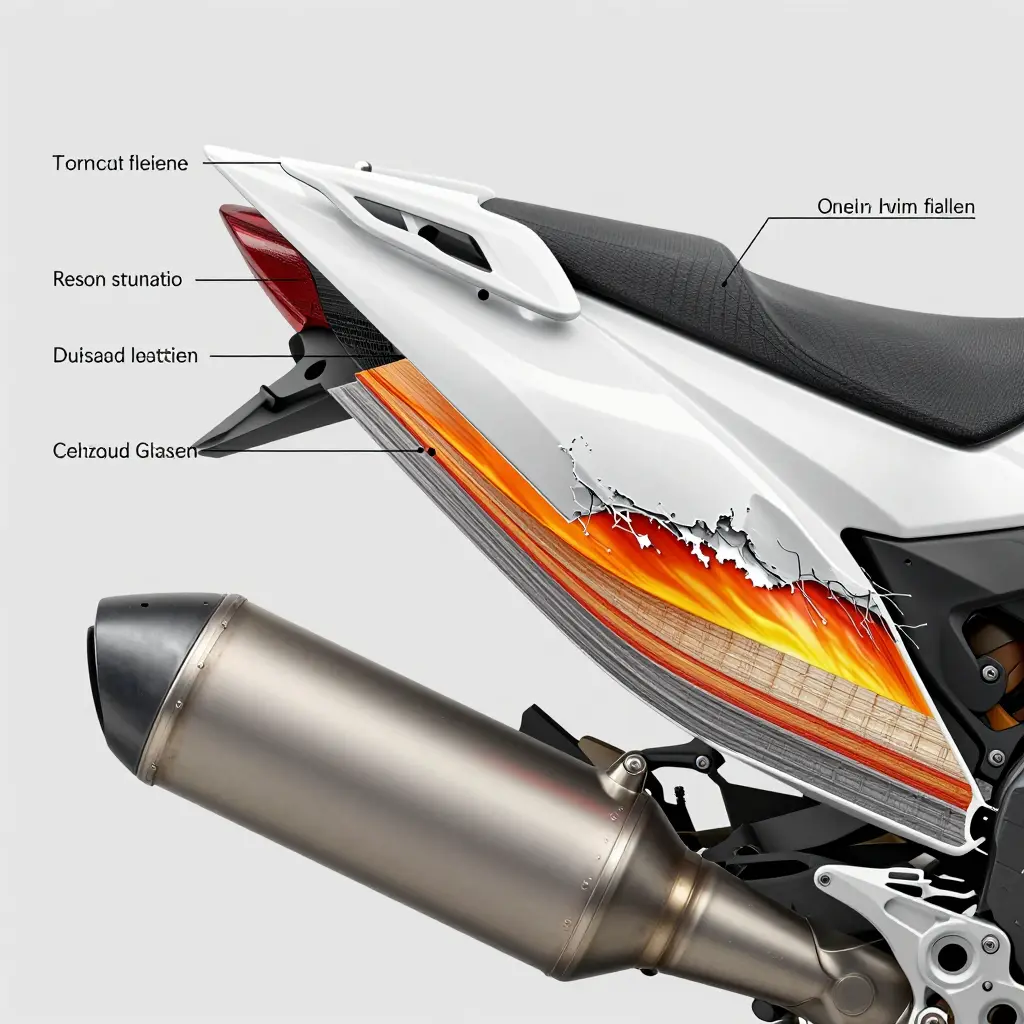
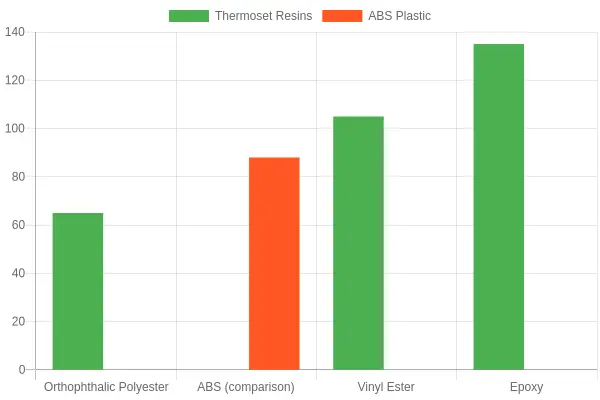
Typical Heat Deflection Behavior by Resin
The resin system, not the broad word “fiberglass,” decides how long a fairing keeps its form. Here is how the common matrices compare, with ABS for reference:
| Resin Matrix | Approx. Heat Deflection Temp (1.82 MPa) | Weakest Point Near Exhaust |
|---|---|---|
| Orthophthalic polyester | 60-70 C | Earliest blistering and resin starvation |
| ABS (for comparison) | 80-95 C | Gradual softening and sag |
| Vinyl ester | 100-110 C | Good resistance, slow delamination |
| Epoxy | 120-150 C | Highest rigidity, mild surface scorch |
Note the trade-off: a budget polyester fairing can deflect at a lower temperature than a decent ABS panel, while a vinyl ester or epoxy layup outperforms it by a wide margin. A buyer who asks only for “fiberglass” may end up with the weakest option in the shop.
How the Reinforcement Layer Adds Stiffness
The glass fiber is not filler; it carries the structural load. Even after the resin softens or scorches, the woven or chopped-strand glass keeps the panel from collapsing. That is why a fairing can still feel rigid long after the surface resin has started to degrade.
Thermal Cycling and Long-Term Resin Fatigue
Every heat-up and cool-down cycle stresses the interface between resin and fiber, because the two expand at different rates. Over hundreds of cycles, microcracks form, moisture works into the matrix, and the bond slowly loses its grip. A fairing that survives one blazing-hot ride can still fail after a season of stop-and-go traffic.
For buyers and manufacturers, the resin system and layup quality matter more than the generic label on the box. If you are judging how any aftermarket component affects the whole bike, it is worth reviewing how vehicle modifications influence real-world safety before you commit.
The table below lines up the two materials across the temperature ranges and failure points that matter most in the hot zone near an exhaust header.
| Material Type | Heat Deflection Temperature (Typical Range) | Primary Thermal Failure Mode | First Area to Fail Near the Header | Rigidity as Temperature Rises | Repair Difficulty After Warp | Relative Cost |
|---|---|---|---|---|---|---|
| ABS (thermoplastic) | ~88-105 C (190-221 F) | Gradual softening, sagging, and loss of shape as the material nears its glass transition | Lower/side panel closest to the header pipe sags and warps first | Falls sharply; the panel turns rubbery and loses structural support | High – heat reshaping is possible but the panel rarely returns to its original contours, so replacement is usually the practical fix | Lower |
| Fiberglass (FRP with thermoset resin) | ~120-150 C (250-300 F) for vinyl ester and epoxy, as low as 60-70 C for orthophthalic polyester | Resin degradation, gel-coat blistering, and delamination rather than softening | Gel-coat discoloration and resin charring near the header before any structural loss | Stays rigid until the resin breaks down, then fails suddenly rather than gradually | Moderate – localized char can be sanded, re-glassed, and re-resined, though badly burned areas need rebuilding | Higher |
ABS costs less and is easier to handle. A quality fiberglass layup trades extra dollars for roughly 30-50 C more thermal headroom before the header finally wins.
Where ABS Fairings Fail First
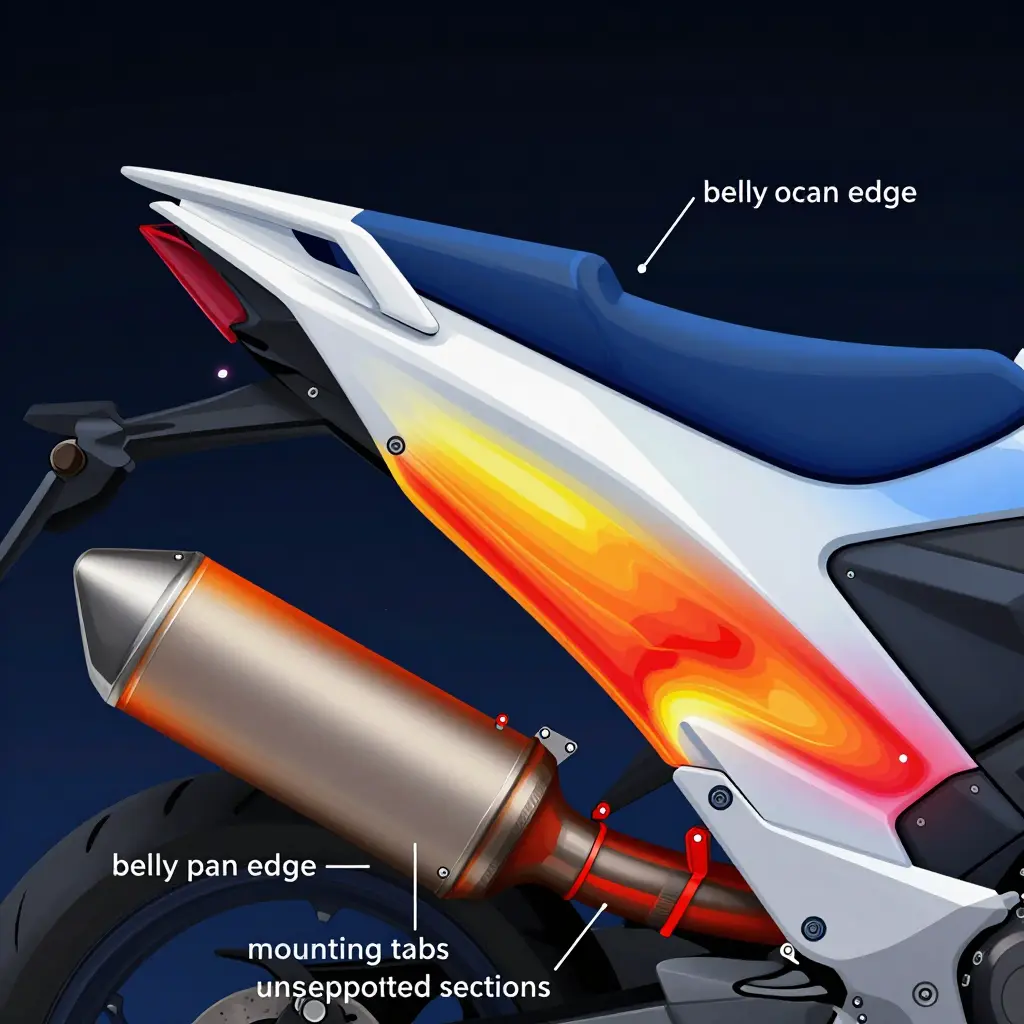
An ABS fairing does not cook evenly. Heat from the exhaust header reaches the panel in a fairly focused cone, so the first signs of heat warp show up in the same three zones, in the same order.
The lower belly pan edge
The belly pan lip closest to the header pipe takes the most radiant heat. It is also usually one of the thinnest, least reinforced parts of the panel, so ABS fairings soften there first. A faint ripple or a slight wave along the edge is often the first clue.
Mounting tabs and clip points
Mounting tabs carry concentrated mechanical stress. As the surrounding plastic softens, these small contact points keep holding the panel in place, so tension builds exactly where the material can least stretch.
Thin unsupported sections
Between the fasteners, the panel spans open space with nothing behind it. With no backing to spread load, these sections bow and sag before reinforced areas do.
The failure sequence
- Softening. Heat pushes the ABS above its glass transition point, and the panel turns pliable.
- Sagging. Gravity and airflow pull the softened belly pan edge down into visible waviness.
- Tab elongation. Mounting tabs stretch as they fight to stay clipped, and fastener holes begin to oval out.
- Stress-cracking. Repeated heat cycles and vibration finally crack the panel at the fastener holes.
Catching the first ripple early is the difference between a small adjustment and a cracked panel that has to be replaced. The same logic applies to keeping vehicle modifications safe and roadworthy.
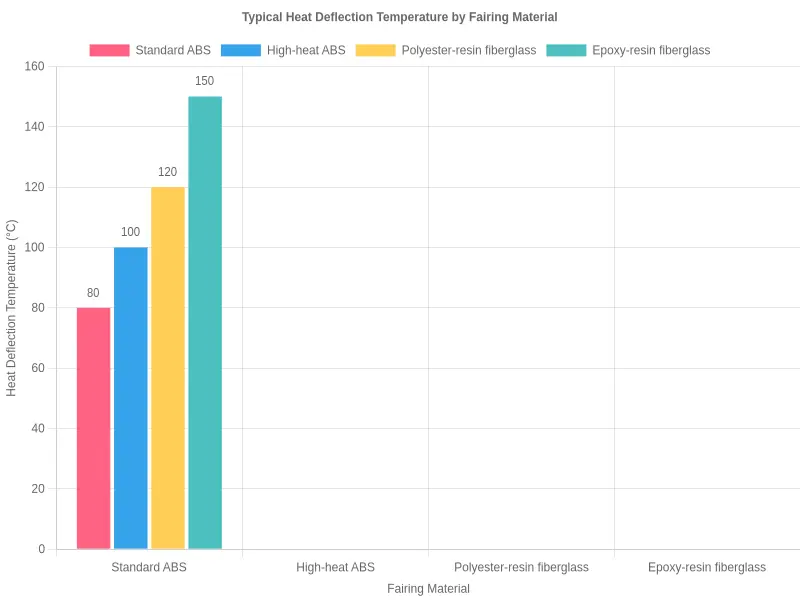
Typical Heat Deflection Temperature by Fairing Material.
Chart details
| Fairing Material | Heat Deflection Temperature (°C) |
|---|---|
| Standard ABS | 80 |
| High-heat ABS | 100 |
| Polyester-resin fiberglass | 120 |
| Epoxy-resin fiberglass | 150 |
Axis labels: X-axis = Fairing Material, Y-axis = Heat Deflection Temperature (°C).
Caption: Higher bars indicate greater resistance to deformation near the exhaust header, where radiant heat is most intense.
Where Fiberglass Fairings Fail First
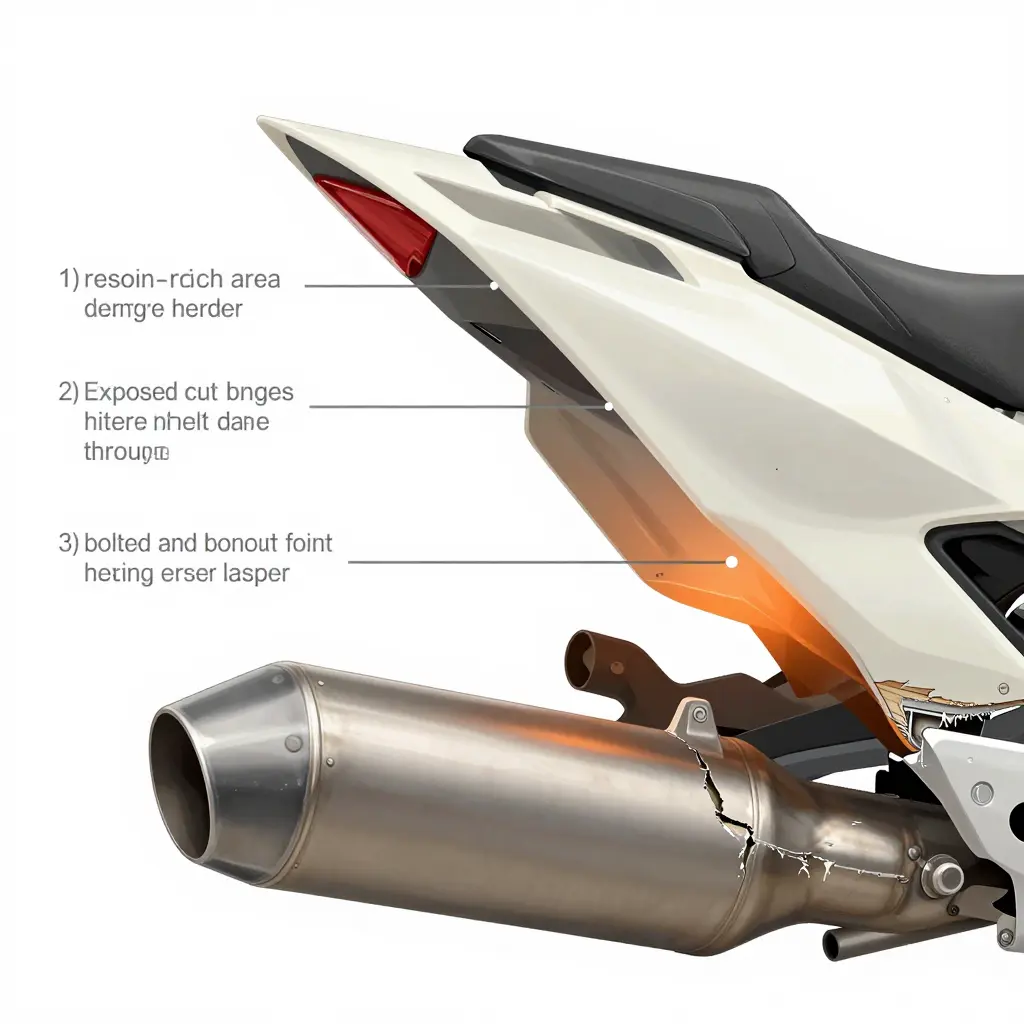
Fiberglass fails less abruptly than ABS, but it still gives up in predictable places close to the hottest part of the bike. A small blister caught early is a repair; left alone, it becomes a structural problem.
The Heat-Facing, Resin-Rich Zones
The first area to suffer is the panel directly opposite the exhaust header. It is often resin-rich, carrying more matrix than reinforcing glass. Resin tolerates far less heat than the fibers it binds, so it softens first; the panel loses stiffness and shape control while it still looks intact.
Exposed Edges and Cut Lines
Trimmed edges and cut lines are another early failure point. Cutting a panel slices straight through fibers and leaves them bare. With no resin matrix sealing them, these edges take in heat, moisture, and vibration, and they fray and crack well before the protected surfaces do.
Bonded and Bolted Joints
Joints concentrate stress. Bolted fasteners and bonded seams transfer load across tiny contact areas, and once heat softens the surrounding resin, the joint loosens and cracks radiate outward along the seam.
The Failure Sequence
Fiberglass usually follows a set order as heat climbs:
- Resin softening
- Surface blistering
- Fiber print-through (glass texture showing through the surface)
- Delamination (layers separating internally)
- Edge cracking
Fiberglass resists sagging longer than ABS and holds its shape while an ABS panel would already droop. But once the resin matrix breaks down, the degradation turns structural. Delamination spreads beneath a surface that still looks fine, so the fairing can keep its form while quietly losing its strength. If you run custom panels, it pays to understand the safety implications of vehicle modifications before assuming a good-looking fairing is a sound one.
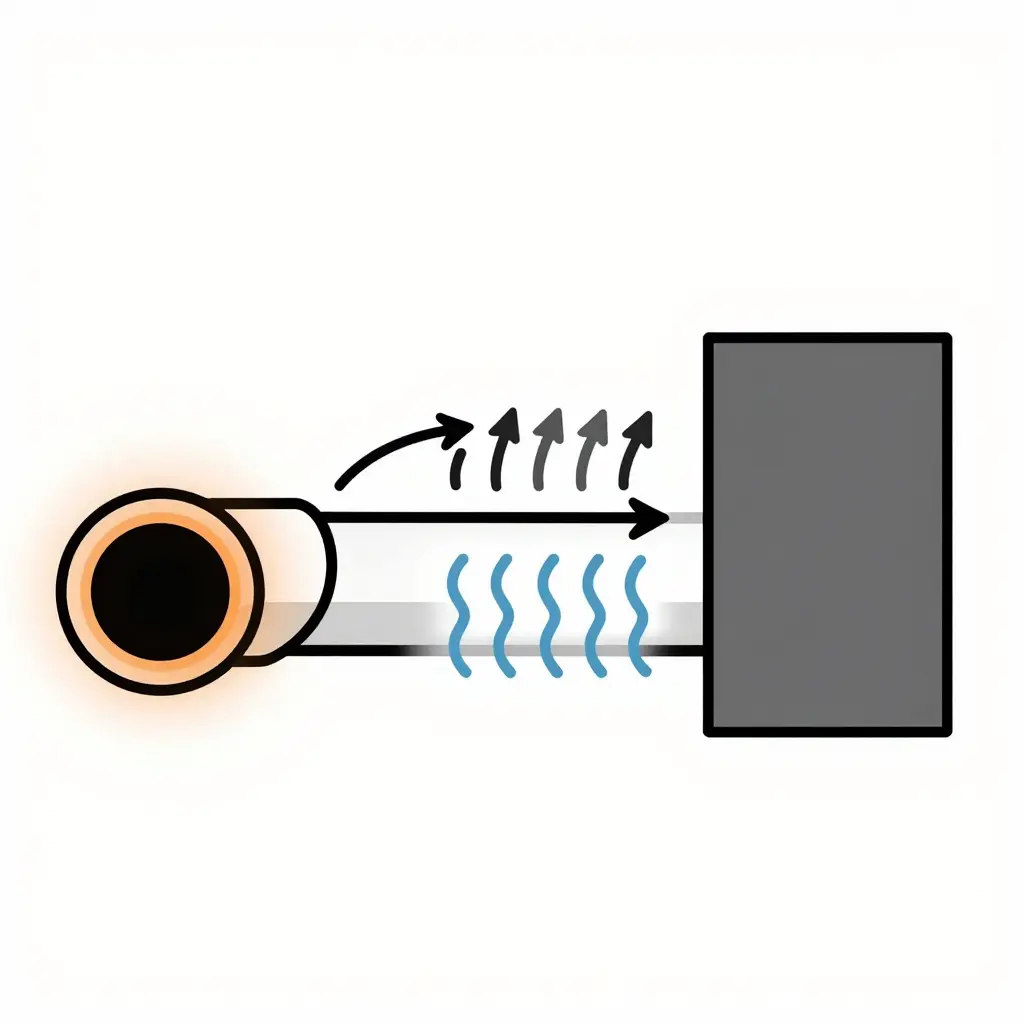
Two heat paths run from the header to the panel. On the left, the circular header pipe is the source. Straight arrows crossing the air gap are radiant heat, traveling line-of-sight from the hot pipe to the fairing surface. The curved, wavy arrows are convective heat, hot air rising and circulating around the pipe before washing over the panel. When the fairing cannot shed that combined thermal load fast enough, the material softens and distorts.
Practical Ways to Reduce Heat Warp Near the Exhaust Header
- Wrap the exhaust header with heat-reflective tape or fit a formed metal heat shield to block radiant energy before it reaches the panel.
- Keep an intentional air gap, ideally 12 to 25 mm, between the exhaust header and the fairing so moving air carries heat away instead of soaking it into the panel.
- Install heat-resistant gaskets and ceramic standoff mounts to break the conduction path, because heat creeping through the bolts softens panels long before they visibly deform.
- Choose a material with a higher heat deflection temperature (HDT) whenever you can; higher-HDT plastics resist heat warp far better than standard grades of ABS.
- Add louvered vents or directed ducts to ventilate trapped hot air, which otherwise raises local temperatures and pushes both materials toward their failure points.
- Weigh the trade-off: ABS fairings tend to blister and sag early because they soften at lower temperatures, while fiberglass fairings usually hold their shape longer but can crack or delaminate as the resin breaks down.
- Reinforce and inspect mounting tabs after every thermal cycle, since loosened tabs let panels drift closer to the exhaust header and a wobbling panel accelerates heat warp.
- Reduce idle heat soak by rerouting the exhaust path or adding a mid-pipe shield wherever clearance is tight, and review how aftermarket modifications affect safety before committing to a layout change.
- Coat the inner fairing surface with a reflective or ceramic thermal barrier to add a second line of defense against radiant heat.
- Track panel temperatures with a simple infrared thermometer after rides so you catch creeping heat warp before it becomes permanent and expensive to fix.
Frequently Asked Questions About Heat Warp and Fairing Materials
Does ABS or fiberglass warp first near the exhaust header?
ABS almost always warps first. It is a thermoplastic with a heat deflection temperature of roughly 80 to 100°C (176 to 212°F), and radiant heat from a hot exhaust header can push a nearby panel past that threshold within minutes of hard riding. Fiberglass, as a thermoset composite, tolerates sustained temperatures well above that range, so it typically holds its shape long after an ABS panel has softened and sagged.
Can a warped ABS fairing be repaired or must it be replaced?
Because ABS is a thermoplastic, mild heat warp can sometimes be reversed by gently reheating the panel and pressing it back into shape, a technique many body shops use successfully. Once the plastic has deformed badly, developed stress cracks, or lost its original mounting geometry, though, replacement is the smarter choice. A repaired panel that keeps warping is a sign the underlying heat source still needs attention.
Can a warped fiberglass fairing be repaired?
Yes, and this is one of fiberglass’s advantages. A warped or heat-damaged fiberglass fairing is usually repaired by grinding out the affected area, re-laminating with fresh resin and glass cloth, then sanding and repainting the surface. Because the material is molded rather than melted, a good repair can restore both the shape and the structural strength of the original panel.
Does heat wrapping the exhaust header prevent heat warp?
Wrapping an exhaust header with insulating wrap is one of the most effective and affordable ways to reduce heat warp, since it lowers the radiant heat reaching nearby panels by a meaningful margin. It does not eliminate the heat entirely, though, so it works best as part of a broader strategy that also includes air gaps, heat shields, and reflective barrier material. On a poorly ventilated bike, wrap alone will slow warping but rarely stop it.
Which material resists heat deflection better over time?
Over the long haul, fiberglass fairings handle heat deflection far better than ABS. Fiberglass keeps its rigidity at continuous temperatures that would cause ABS to creep, distort, and eventually crack, which makes it the preferred choice for track bikes, tourers, and any setup where the fairing sits close to the exhaust header. ABS performs adequately in cooler, better-ventilated positions, but it degrades faster when repeatedly exposed to high radiant heat.
Does aftermarket fitment change how quickly a fairing warps?
Yes, and it is often overlooked. Aftermarket fairings are frequently molded with slightly tighter tolerances or thinner panels, which can push plastic closer to the exhaust header and accelerate heat warp compared with the factory original. If you are weighing a low-clearance kit and how it affects long-term reliability, learn how aftermarket changes can compromise safety before committing.
Choosing Between ABS and Fiberglass for Heat Exposed Fairings
Near an exhaust header, ABS softens and sags first: radiant heat climbs toward its glass-transition point, and the panel slowly loses rigidity and droops out of shape. Fiberglass resists sagging far longer, but it degrades through resin breakdown, turning chalky, brittle, and crack-prone once the binder begins to cook. On ABS, heat warp announces itself early and gently; on fiberglass, it arrives late and permanently.
Matching Material to Heat Exposure
Choosing well comes down to who you are and where the heat actually lands:
- Motorcycle enthusiasts: If your exhaust runs tight and tucked, expect ABS to give first, and plan for repositioning, extra heat shielding, or an upgrade. Riders who prize long-term shape stability should lean toward fiberglass.
- Repair professionals: Inspect ABS panels for soft, wavy edges and fiberglass panels for discolored, cracking resin. Each tells a different failure story and demands a different fix.
- Fairing manufacturers: Match resin systems and wall thickness to real-world heat exposure, and be transparent about where each material succeeds and where it eventually gives out.
| Rider Goal | Better Match | Watch For |
|---|---|---|
| Quick, budget-friendly repair | ABS | Softening and sagging near the header |
| Long-term shape retention | Fiberglass | Resin breakdown and brittleness |
Sourcing Replacement Bodywork
For anyone replacing heat-damaged panels, Summitfairings lists more than 3,000 fairing styles covering most motorcycle models, and advertises prices 10-40% below other sites with questions answered within six hours.
Whatever you ride, the fix is the same: keep the header’s heat away from the plastic, and check that your modifications are safe and compliant rather than letting heat quietly win the long game.