

In today’s dynamic automotive market, auto lease financing stands at the forefront of vehicle acquisition for individual buyers, auto dealerships, and small businesses. This financing option not only provides a pathway for individuals seeking to drive new cars without the burden of full ownership costs but also enables auto dealerships to maintain a competitive edge by offering affordable leasing alternatives. For small business fleet buyers, auto lease financing presents a strategic avenue to manage expenditures while ensuring a modern and efficient fleet. As leasing typically requires lower monthly payments compared to buying, it empowers consumers and businesses alike to invest their capital elsewhere, making it an attractive option. With comprehensive auto finance solutions available, understanding how this financing method works can enhance one’s vehicle acquisition strategy, optimizing both cash flow and budget management. Navigating the landscape of auto lease financing unfolds a realm of possibilities tailored to meet diverse mobility needs, rendering it a crucial consideration in automotive financing decisions.
Basics of Auto Lease Financing
Auto lease financing is a financial arrangement where you (the lessee) pay for the use of a vehicle over a specified period, usually ranging from two to three years. It differs from traditional purchasing as you do not own the vehicle outright; instead, you essentially rent it for an agreed timeframe. Upon contract completion, you may have the option to buy the vehicle or return it.
Key Terms and Concepts
To navigate auto leasing effectively, it’s essential to understand several key terms:
| Term | Definition | Source |
|---|---|---|
| Residual Value | The vehicle’s estimated value at the end of the lease, affecting monthly payments. | Car Leasing Basics |
| Capitalized Cost | The total price of the vehicle, which can include negotiated price and additional costs. | Should I Lease or Buy A New Car? |
| Lease Term | The duration over which the lease payments will be made, usually expressed in months. | Noreast Capital Lease Payments |
| Money Factor | A decimal number that represents the interest rate for the lease, used to calculate financing costs. | Mastering the Art of Car Leasing |
How It Works
When entering into an auto lease, you will need to agree on the capitalized cost, available incentives, and the residual value of the car. It’s vital to calculate monthly payments based not just on the vehicle’s price but also on the money factor, which indicates your financing cost. Note that the lower the money factor, the lesser your total lease cost.
Leasing can often lead to lower monthly payments compared to financing a purchase, benefiting those who prefer a new vehicle every few years without dealing with resale complications. For additional guidance on managing vehicle financing, you can learn more about the impact of diesel price fluctuations on trucking or explore financial management for first-time truck owners.
Advantages of Auto Lease Financing for Buyers
Auto lease financing has become an increasingly popular choice for both individual car buyers and small business fleet owners. Here are some of the key benefits:
For Individual Car Buyers:
- Lower Monthly Payments: Leasing often translates to significantly lower monthly payments compared to buying a vehicle outright. This can help individuals manage their budget more effectively.
- Newer Models: Leasing allows buyers to drive the latest car models without the long-term commitment of ownership. This can provide access to the latest technology, safety features, and fuel efficiency.
- Warranty Coverage: Most lease agreements come with warranty coverage, which can minimize repair costs during the lease term. This relief from unexpected expenses is a big advantage for many drivers.
- Tax Benefits: For those who use the vehicle for business purposes, lease payments can often be deducted as a business expense, easing the financial burden (learn more about tax implications).
- Flexibility: At the end of the lease term, individuals can choose to buy the car, lease a new one, or simply return it. This flexibility can be advantageous for those who value change and variety in their vehicles.
For Small Business Fleet Buyers:
- Tax Deductions: Leasing can provide significant tax benefits to business owners. Monthly lease payments can often be written off as a business expense, potentially saving thousands annually (discover more about managing finances).
- Cash Flow Management: Lower upfront costs and monthly payments help businesses manage cash flow more effectively, enabling them to invest in other essential areas such as inventory or operational improvements.
- Maintaining Liquidity: Leasing rather than purchasing vehicles frees up capital for other investments, allowing for sustained liquidity in business operations.
- Fleet Upgrades: Businesses can regularly update their fleet without significant financial strain, ensuring that their vehicles meet the latest compliance and operational standards.
- Reduced Depreciation Risks: Since most lease terms are shorter than the typical ownership duration, businesses are less affected by the depreciation of vehicle value (learn more about fleet tax benefits).
In summary, whether you are an individual seeking a reliable vehicle or a business looking to manage a fleet efficiently, auto lease financing offers a variety of benefits that can help both parties achieve their goals while optimizing costs and resources.
Related Keywords:
- Car leasing benefits
- Leasing vs buying a car
- Business vehicle leasing advantages
Tax Benefits of Auto Leasing for Businesses
Leasing vehicles often presents significant tax advantages for small business fleet buyers. One of the primary benefits is that lease payments can be deducted as business expenses, thereby reducing taxable income. This means that businesses can lower their overall federal and state tax liabilities simply by leasing rather than buying. For example, if a business spends $1,000 per month on a leased vehicle, that entire amount can typically be deducted from its taxable income.
Additionally, businesses have the option to choose between two different methods of deduction when using leased vehicles:
- Standard Mileage Rate: A simplified method where the IRS allows businesses to deduct a specific rate for every mile driven for business purposes,
- Actual Expenses: This involves calculating all expenses incurred, including the lease payment, maintenance, insurance, and gas. Under this method, leased vehicles are not depreciated like purchased vehicles, but the actual business portion of the lease can be deducted.
Moreover, businesses can claim back a portion of the VAT on lease payments if the vehicle is used for business, further enhancing cash flow management. By understanding these tax benefits, small businesses can improve their financial management and make more strategic decisions regarding their vehicle fleets. For more details on managing fleet finances, see our guide on managing truck ownership finances.
Considering all these factors, leasing vehicles allows businesses not only to manage their operations more efficiently but also to maximize their financial benefits.
Leasing vs Purchasing Vehicle Comparison
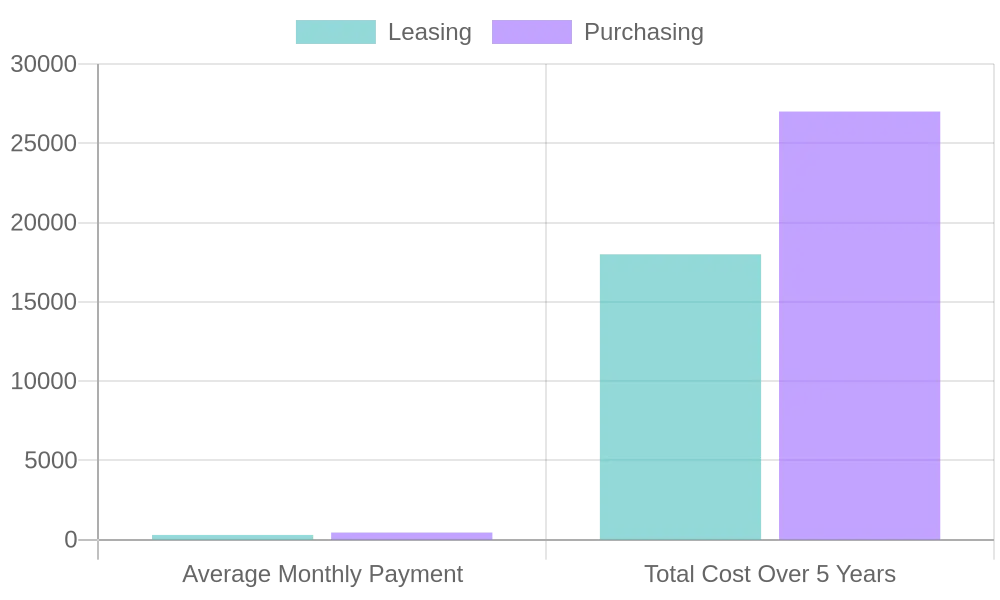
Choosing between leasing and purchasing a vehicle often involves deep financial analysis. The chart below illustrates the financial implications related to each option, particularly focusing on costs over a typical five-year term.
Financial Overview:
| Category | Leasing | Purchasing |
|---|---|---|
| Average Monthly Payment | $300 | $450 |
| Total Cost Over 5 Years | $18,000 | $27,000 |
| Financial Implications | Lower payments; covers depreciation only | Higher payments; includes full cost of the vehicle |
Sources
- Buying vs. Leasing | WOW Toyota of Wallingford
- Buying vs. Leasing a Kia in Las Vegas | Jim Marsh Kia
- Should I Lease or Buy a Mercedes-Benz in Torrance?
- Car leasing: Costs to lease a car vs ownership | AA Lease
- Car Leasing Costs: Taxes and Fees | U.S. News
Common Misconceptions About Auto Leasing
Auto leasing can be a confusing process, especially with various misconceptions that often circulate. Here’s a list of the most common myths about auto leasing, along with clear explanations to debunk them:
-
Leasing is always more expensive than buying.
Many people believe that leasing will cost them more in the long run compared to purchasing a vehicle. While leases often feature lower monthly payments, they do not include the asset’s resale value, making it essential to evaluate your specific financial situation. -
You will never own the car.
Though leasing means you don’t own the vehicle outright, you can have the option to buy at the end of the lease term. This flexibility allows lessees who fall in love with their leased vehicle to make it their own. -
Leases come with hidden fees.
While there may be fees associated with leasing, such as for excessive mileage or wear and tear, it’s crucial to review the lease agreement thoroughly. Transparency in terms and conditions can prevent any surprises. -
Mileage limits ruin leasing.
Many potential lessees fear mileage limits, but these can often be negotiated at the outset. Additionally, most leases come with mileage options that reflect your driving habits. -
You can’t modify a leased vehicle.
While most leases prohibit significant alterations, minor modifications may still be permissible, especially if you discuss these changes upfront with the leasing company.
For further insights, learn more about auto finance solutions and how they impact decisions on leasing versus buying.
Expert Opinion on Auto Leasing
“Leasing a vehicle provides drivers with lower monthly payments and reduced repair costs, allowing them access to newer models without the long-term commitment that comes with ownership. This flexibility makes leasing an attractive option for many, particularly for those who prefer to keep up with the latest vehicles.” – Consumer Reports
This expert insight reinforces the appeal of auto leasing, highlighting its financial benefits and flexibility for individual car buyers and businesses alike.
Understanding the Auto Leasing Process
Leasing a vehicle can be a smart alternative to purchasing one outright, especially for those who enjoy upgrading their vehicles every few years. The leasing process typically involves several key steps that potential lessees should understand to make informed decisions and secure favorable terms.
Steps Before Signing a Lease
- Assess Your Needs: Consider what type of vehicle suits your lifestyle and budget. Take into account factors like the size, mileage requirements, and anticipated usage.
- Set a Budget: Calculate how much you can afford monthly without straining your finances. Include all potential costs, such as insurance and maintenance, in your calculations.
- Research Dealerships: Look for reputable dealerships known for their lease offerings. Reviews and dealer ratings can provide insights into their reliability and customer service.
- Understand the Terms: Familiarize yourself with lease terms, including residual value, money factor, and mileage limits. Knowledge of these terms will better prepare you for negotiations.
Required Documents
To proceed with leasing, you will need several essential documents:
- Identification: A valid driver’s license and Social Security number.
- Proof of Income: Recent pay stubs or tax returns to verify your ability to make monthly payments.
- Credit Information: Many dealers will perform a credit check, so having your credit score accessible can help you understand your leasing options better
(CarGuy NY).
Negotiating Lease Terms
Negotiation is a critical part of the leasing process. Here are some tips:
-
Do Your Research: Before entering negotiations, know the fair market value and pricing for the vehicle you wish to lease. Being informed will strengthen your bargaining position.
-
Focus on Total Cost: Rather than getting fixated on monthly payments, consider negotiating the total cost of the lease, including fees, down payments, and end-of-lease conditions.
-
Mileage and Wear Terms: Understand how excess mileage and wear will be assessed. Discussing these terms can ensure you’re not caught off guard at the end of the lease (Cars2Buy).
-
Be Prepared to Walk Away: If the terms don’t meet your expectations, be willing to leave. There are many options, and a good dealer will negotiate to retain your business.
Conclusion
Understanding the leasing process helps individuals make informed decisions that align with their financial capabilities. By assessing needs, gathering necessary documentation, and negotiating effectively, prospective lessees can navigate the lease agreement confidently, ensuring they secure the best deal possible.
Conclusion
In summary, auto lease financing presents a viable option for individual car buyers, auto dealerships, and small business fleet buyers. The key benefits of leasing include lower monthly payments and the ability to drive newer vehicles without a long-term commitment. This flexibility allows consumers to upgrade their cars more frequently, which is particularly appealing in today’s fast-paced automotive market. For businesses, leasing can also simplify fleet management, eliminating concerns related to ownership responsibilities such as insurance and maintenance. Furthermore, for self-employed individuals, leasing costs may even be tax-deductible as business expenses, adding an additional layer of financial advantage.
However, it is also critical to consider certain aspects when entering a lease agreement. Typical mileage limits usually range from 10,000 to 15,000 miles per year, with potential charges for exceeding these limits. Additionally, individuals should assess if leasing aligns with their personal financial strategy, as the primary downside is that lessees never own the vehicle but continuously pay for its use.
For those looking for streamlined financing solutions, consider partnering with experts like Summit Fairings. They offer comprehensive services tailored to meet your needs, ensuring that your leasing process is efficient and beneficial. Don’t hesitate to explore how auto lease financing can fit into your transportation plans-it’s not only about getting a vehicle; it’s about making a smart financial choice that drives success.