

Understanding the finance charge on auto loans is essential for individual car buyers, dealerships, and small business fleet buyers. It plays a pivotal role in determining the overall cost of financing a vehicle. This article delves into the core components of finance charges, breaking down how interest is calculated, the impact of additional fees, and best practices that ensure clarity and accuracy in the calculation process. Each chapter builds towards a comprehensive understanding, guiding readers through both conceptual frameworks and practical calculations that are crucial for making informed financial decisions.
The True Cost Equation: How to Accurately Calculate the Finance Charge on Auto Loans
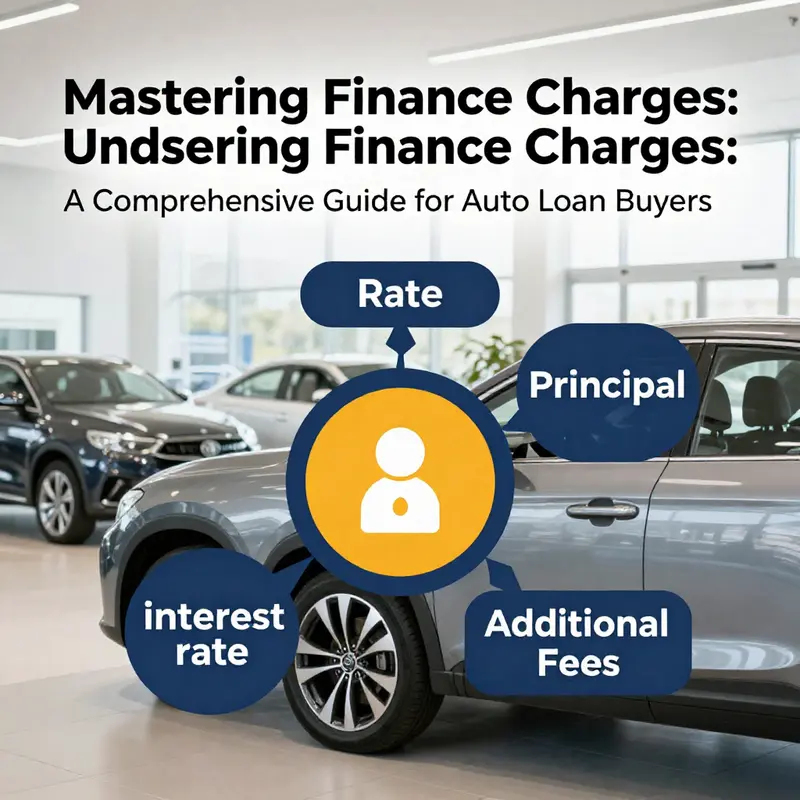
When you walk into a dealership or sit with a lender to discuss financing a vehicle, you will hear about the monthly payment, the interest rate, and the length of the loan. Yet the figure that truly defines the cost of borrowing is not a single number like a price tag. It is the finance charge—the total amount paid for the use of money over the life of the loan. The finance charge blends interest and fees into a single, comprehensible sum that reveals how much you will spend beyond the principal you borrowed. To navigate this landscape with clarity, it helps to understand how each component works, how they interact, and how different repayment structures can change the shape of your total cost. The core idea is simple: the longer you borrow and the higher the rate you pay, the more expensive the loan becomes. But the mechanics behind that truth can feel opaque if you don’t unpack the math and the contract language behind the figures you see on the screen or in the fine print of a loan agreement.
At the heart of the finance charge is the loan principal—the amount borrowed to buy the car. The annual percentage rate, or APR, is the annual cost of credit expressed as a percentage, and it matters because it compresses into a single snap-shot what would otherwise be a complex blend of interest and fees over time. APR is designed to help you compare offers because it reflects, to a useful degree, the true cost of credit including certain upfront or ongoing charges. Yet APR is not a perfect mirror of every fee that might show up across different lenders or loan structures. Some fees can be added to the finance charge directly, while others may appear as separate line items on your contract. Understanding where the APR ends and where additional charges begin is essential for comparing apples to apples across financing choices.
A common source of confusion stems from the way interest is calculated. Auto loans almost always use an amortization approach, which means each monthly payment contains both principal and interest. The total finance charge in this case equals the sum of all monthly interest payments over the life of the loan plus any fees that lenders have included in the charge. There are different amortization methods that can alter the pattern of payments and, spread out across the term, the total amount paid. Two widely discussed methods are the Equal Monthly Installments, or EMI, and the Declining Balance method. Each method produces the same end result in terms of total payments under a fixed rate, but the monthly cash flow and the distribution of payments between principal and interest differ in meaningful ways. The EMI approach keeps the monthly payment constant, while the declining balance approach front-loads more of the payment into principal in the early months and reduces the interest portion as the loan balance declines.
To illuminate these ideas with numbers, consider a straightforward scenario. If you borrow $30,000 at a 5 percent annual interest rate for four years, the simple-interest calculation would estimate interest as Principal times Rate times Time, which would be $30,000 × 0.05 × 4 = $6,000. That simple estimate, however, does not reflect what you actually pay when the loan is amortized with monthly installments over 48 months. In the Equal Monthly Installments framework, the monthly payment can be computed with a standard formula: Monthly Payment = [P × r × (1 + r)^n] / [(1 + r)^n − 1], where P is the principal, r is the monthly interest rate (annual rate divided by 12), and n is the total number of payments. With P = 30,000, r = 0.05/12 ≈ 0.004167, and n = 48, the resulting monthly payment is about $691.48. Over 48 months, the total of all payments would be roughly $33,191.04. Subtracting the original loan principal shows a total finance charge of approximately $3,191.04. This figure represents the portion of the loan that is the cost of borrowing, captured through interest in an amortized schedule.
Still, the landscape rarely stays that clean in real life. Many auto loans include upfront fees, service charges, or processing costs that are added directly to the finance charge. A service fee, for instance, might be quoted as a percentage of the loan amount—for example, 3 percent of $30,000, which comes to $900. That $900 would be included in the total finance charge, increasing the amount you effectively pay beyond the interest portion alone. Other fees that sometimes appear in loan agreements—as application fees, prepayment penalties, or mandatory add-ons—further complicate the tally. When you tally the total finance charge, you must account for both the interest that accrues over the term and any fees rolled into the loan.
A contrasting payment structure helps demonstrate how the timing of payments can affect the experience of paying for a car loan. In a declining balance or equal principal method, you would pay a fixed portion of the principal each month. For a $30,000 loan over 48 months at 5 percent annual interest, the first month’s principal payment would be $30,000 ÷ 48 ≈ $625. The first month’s interest would be $30,000 × (0.05/12) ≈ $125, making the first month’s total payment about $750. In month two, the principal remaining is $29,375, so the interest portion shrinks slightly to roughly $122.71, and the total payment would adjust accordingly. Over the term, this approach typically yields a lower total interest paid than EMI in some scenarios, though the monthly payments start higher and gradually drop in relative size as the outstanding balance declines. Either method, when paired with fees, converges toward the same result: the finance charge is the sum of all interest payments plus any fees that have been added to the loan.
The role of fees is particularly important when you are comparing offers. An advertised low interest rate may be offset by high origination fees or service charges, resulting in a higher overall cost than a loan with a modest rate and lower upfront costs. The true cost of credit is not the monthly payment alone; it is the comprehensive tally across the life of the loan. In practice, lenders often combine the rate with a set of fees into the APR to provide a single comparative measure, but even APR can be imperfect. It is essential to read the loan agreement closely to identify which charges are included in the APR and which may be added separately or applied conditionally, such as in the event of late payments or early payoff.
Understanding the practical impact of APR, fees, and term length becomes especially important when you try to compare offers from different lenders. A longer loan term tends to reduce monthly payments, which can make the loan feel affordable month to month but increases the total finance charge because the interest accrues over more payments. Conversely, a shorter term usually lowers the total interest paid but raises monthly payments. For example, a five-year loan at 6 percent APR on $30,000 might generate approximately $4,790 in total finance charges, when taking into account not just interest but the various fees lenders may roll into the loan. This illustrative figure captures the idea that the cost of credit rises with both rate and term, even if monthly payments look more manageable at first glance. The takeaway is clear: to obtain a realistic sense of affordability, you must examine both the monthly payment and the total finance charge.
This leads to a practical approach to shopping for auto financing. Start with the lowest possible APR you can secure, but not at the expense of substantially higher fees. A larger down payment reduces the loan principal, which in turn reduces both interest and the total finance charge. Shorter terms may increase monthly payments, but they reduce the cumulative cost. The key is to align the loan design with your budget and long-term financial goals. When you compare offers, simulate the full amortization schedule for each option and track the total payments, the outstanding balance over time, and the exact sum of finance charges. Some lenders provide an explicit amortization schedule in an online calculator, while others may require you to request it. In either case, the resulting clarity helps you avoid surprises and gives you a solid basis for negotiation.
For those who want to see how different repayment strategies influence the shape of the bill, a simple starting point is to run through two parallel scenarios with the same principal and APR but different repayment structures. In the EMI arrangement, you will observe a constant monthly payment while the interest portion gradually declines as principal declines. In the equal principal approach, you will see a higher first payment that gradually declines, with the total interest sometimes lower than in EMI depending on the balance trajectory and the fee structure. The bottom line remains consistent: the finance charge is the total cost of credit over the term, including both interest and any fees that have been embedded in the loan. When you review a loan offer, it is worthwhile to pull an amortization schedule or use a loan calculator to visualize those payments month by month. This is where a practical tool can make the abstract concrete and transform how you assess the true cost of financing.
If you want a concise path to broader context about personal finance and how to approach borrowing with discipline, consider exploring additional resources that frame knowledge in a practical, real-world setting. The knowledge hub linked here knowledge hub offers broader guidance on making informed financial decisions, including how to compare loan terms and interpret various cost components. Remember, each car financing decision is a negotiation of future cash flows. The more you understand the anatomy of those cash flows, the better you can align the terms with your budget and goals.
In addition to careful analysis of APR and fees, remember to factor in potential prepayment penalties, if any are specified in the contract. While modern practice has shifted away from aggressive prepayment penalties, a minority of lenders may impose fees if you pay off early or refinance. Such penalties, though infrequent, can alter the economics of paying off a loan ahead of schedule. A borrower who intends to finish a loan early should confirm whether any penalties apply and how they affect the overall finance charge. Likewise, mandatory insurance requirements or add-ons can increase the amount financed or the ongoing monthly obligation. These elements subtly influence the total cost and should be weighed in your comparison.
To summarize, calculating the finance charge on an auto loan requires more than multiplying principal by a percentage. It demands a careful synthesis of the loan’s interest accrual under the chosen repayment method, the term length, and all fees embedded in the transaction. The finance charge is the aggregate of those costs over the life of the loan. When you use a loan calculator or consult the loan contract, you obtain a precise figure that empowers you to compare offers responsibly and to avoid overpaying for credit. The process becomes less intimidating once you separate the headline rate from the true cost, and once you understand how the amortization schedule translates into real dollars in your monthly budget. For those who want to explore this topic further, the path of inquiry remains practical: learn the formulas, audit the numbers that appear in your loan documents, and compare offers with a clear sense of the total financing commitment you are taking on. The goal is straightforward—choose a financing plan that respects your financial horizon while delivering the vehicle you want, at a price you can justify against your longer-term financial stability. And if you need a broader framework for cost-aware decision making, visit the resource mentioned above and consider how foundational knowledge can translate into smarter choices across transportation and beyond. Finally, when you’re ready to verify these concepts with official guidance, consult the Consumer Financial Protection Bureau’s auto loan resources, which provide authoritative information about rights and options as you navigate financing decisions. https://www.consumerfinance.gov/owning-a-home/auto-loans/
Beyond the Sticker Price: Calculating the True Auto Loan Finance Charge

When shopping for a car, the sticker price and the monthly payment grab attention, but the true cost of borrowing goes beyond the rate. The finance charge is the total amount paid to use someone else’s money, including interest and any fees tied to the loan. Understanding it helps you compare offers on a like-for-like basis and avoid surprises at payoff. The core idea is simple: the finance charge is the sum of interest over the life of the loan plus any fees that are financed or charged upfront.
Most auto loans are amortized, meaning each payment covers both interest and principal. Early payments are interest-heavy, and the balance declines over time, so the total interest paid depends on the term and the rate. For a quick estimate, you can use a simple interest approach, which ignores principal repayment, but the real world typically uses amortization. In an equal monthly payments (also called level payment) loan, the monthly payment remains constant, and the formula factors the loan amount, the monthly rate, and the number of payments. A shorter term reduces total interest but increases monthly cost, while a longer term lowers payments but raises the total finance charge.
Fees can be upfront or financed. Examples include origination fees, processing fees, and any service charges. When fees are rolled into the loan balance, they increase the principal and thus the interest you pay over time. The APR (annual percentage rate) matters because it consolidates the impact of interest and most fees into a single percentage, making it easier to compare lenders. A lower rate with higher fees can cost more than a higher rate with lower fees.
To compare offers, request the APR and review the full amortization schedule. A reputable loan calculator can show monthly payments, total interest, and a month-by-month breakdown of principal versus interest. If you anticipate paying early, check for prepayment penalties, which can erode potential savings. Finally, down payment and term length both influence the finance charge: more down reduces financing and lowers interest, while a shorter term reduces total interest but increases monthly payment. By translating quotes into the true finance charge, you can choose the option that aligns with your budget and long-term financial goals.
The Hidden Cost: Accounting for Fees in Auto Loan Finance Charges
When you buy a car and sign a loan agreement, the price you see on the contract is only part of the story. The finance charge—the total cost of borrowing—extends beyond the interest rate and includes a range of fees tied to obtaining and financing the vehicle. Understanding how these fees are accounted for is essential if you want to compare offers accurately and avoid paying more than you expect over the life of the loan. This chapter follows a single, steady thread: finance charges are not merely a simple product of rate and principal. They are the accumulation of interest plus a lineup of fees that lenders layer into the agreement, and those fees can shift the true cost of money in tangible ways. By tracing the components, the calculation methods, and the practical steps you can take to verify what you are being charged, you can approach auto financing with clarity and confidence.
The first idea to grasp is deceptively simple: a loan’s finance charge is the total amount paid for borrowing, not just what you owe in interest each year. Interest is the primary cost of money, but it is rarely the sole contribution to the total. Fees such as origination, processing, documentation, or service charges live alongside interest and become part of the aggregate amount that the borrower ultimately pays. In the realm of federal disclosure requirements, these fees are not hidden; they are often included in the finance charge disclosed to the borrower under the Truth in Lending Act. The practical effect is that two loans with the same nominal interest rate can have different APRs if one carries more fees. The annual percentage rate thus serves as a standardized yardstick, converting both the interest and the fees into a single percentage that makes it easier to compare offers. But to apply this insight effectively, you need to understand which figures walk into that APR and how they are calculated across different repayment structures.
At the core of finance charges lies interest, the charge for the use of money. When your loan amortizes, you do not pay a single interest amount up front. Instead, each payment covers both a portion of the principal and a slice of interest, with the interest portion calculated on the outstanding balance. In an equal monthly installment EMI scenario, the monthly payment remains constant because the interest portion declines as the principal is paid down and the principal portion rises. The total interest paid over the life of the loan is the sum of all those monthly interest payments. This pathway—interest calculated on the remaining balance and distributed across the term—was designed to be predictable for borrowers who prefer stable monthly budgets. It is a robust method for auto loans because it aligns with typical consumer needs: known payment every month, over a fixed period.
The mathematics behind EMI is well known but worth revisiting for a practical understanding. The monthly payment is computed as P × r × (1 + r)^n divided by [(1 + r)^n − 1], where P is the loan principal, r is the monthly interest rate (the annual rate divided by 12), and n is the total number of payments. The total payments then exceed the principal by the amount of interest, and the difference captures the finance charge stemming from interest. If your loan uses a declining balance method, where you pay a fixed portion of the principal each month, the calculation shifts. The monthly payment comprises a fixed principal portion plus the interest on the remaining balance. The first month carries the highest interest because the balance is at its maximum, and as the balance declines, the interest portion shrinks. The total interest paid in a declining balance plan tends to be lower than in an EMI plan when the same rate and term are used, though the monthly payments are heavier at the outset. These distinctions are not academic; they have real consequences for cash flow and for the total cost of the loan.
Yet the dialogue does not end with interest alone. Fees introduced at various points of the loan life can alter the finance charge in meaningful, sometimes surprising ways. Origination fees, application fees, processing fees, and documentation fees are common examples. A lender might assess a service charge as a percentage of the loan amount or as a flat fee. Prepaid finance charges or balloon payments—potentially part of certain financing arrangements—also find their way into the total finance charge. The sum of all these fees, when added to the total interest paid over the life of the loan, constitutes what lenders disclose as the finance charge. The implication is simple but important: two borrowers could face different total costs not just because of different APRs, but because the fee structure attached to each loan differs. When you read a loan estimate or a closing disclosure, these fees are the pieces that bring the headline rate to life. They are the practical reality behind the abstract number.
To illustrate how fees integrate into the finance charge, consider a straightforward example. Suppose you borrow $25,000 at 5% APR for five years. If the loan carries a $300 origination fee and a $400 processing fee, those fees amount to $700 of upfront charges. In an EMI structure, you would calculate the monthly payment using the standard formula based on the principal, rate, and term, arriving at a fixed monthly amount. Over the five-year period, you then add the total of all monthly payments and subtract the original loan principal to determine the total interest paid. The finance charge is that interest total plus the $700 in fees. The result is a higher APR that reflects not only the rate itself but the impact of the included fees. The same loan terms with a different fee structure—say a $1,000 documentation fee instead of $300 origination—would produce a distinct APR, even if the listed interest rate remained the same. This is why the APR is the consumer-facing metric designed to capture the effect of fees on the cost of borrowing.
The truth in lending landscape emphasizes transparency about these costs, but it also imposes a responsibility on borrowers to review the full picture. In practice, understanding the finance charge means looking beyond the apparent interest rate and examining how fees are disclosed and allocated. Some fees may be negotiable or avoidable, while others are nearly universal. The difference between a lender that offers a relatively low rate with steep processing fees and another that pairs a modest rate with a higher set of upfront charges can be meaningful. The decision involves not just the monthly payment but the total cost over the term. It also means considering how the fees affect the effective rate you pay if you plan to refinance or pay off early. Prepayment penalties, if present, can further complicate the cost calculus. In a declining balance scheme, the timing of principal repayments interacts with fees in nuanced ways, potentially altering the economic appeal of one repayment trajectory over another.
From a practical standpoint, the most reliable way to gauge the true cost is to work with a loan calculator that accounts for principal, interest, term, and every disclosed fee. In the hands-on world, tools that simulate amortization schedules can reveal how much of each payment goes to interest, how quickly the principal is reduced, and how fees accumulate in the top-line finance charge. This capability is especially valuable when you are evaluating multiple offers with different fee schedules. It is not enough to ask for the lowest stated interest rate; you must compare the total cost including these fees, because the long view can be quite different from the first-year budget. The APR serves as the bridge between the two; it translates the whole package into a single percentage, enabling borrowers to compare apples to apples. The calculation, however, remains sensitive to the exact composition of fees, their timing, and whether any fees are rolled into the loan balance or paid upfront. Each choice changes the effective cost of credit.
The accounting of these fees has implications that extend beyond personal budgeting. When consumers understand how fees are folded into the finance charge, they can better navigate negotiation rooms with dealers and lenders. They can ask pointed questions about the necessity and meaning of each fee, inquire about potential waivers, or seek alternative loan structures that minimize upfront charges while preserving favorable rate terms. The edge here is not only about reducing one line item but about calibrating the loan to fit personal financial goals. For example, in a scenario where the finance charge grows primarily due to a high origination fee, a borrower might look for lenders who offer a reduced or waived origination charge in exchange for a slightly higher rate or different repayment conditions. Conversely, if the fee structure is front-loaded and burdens monthly budgets, it may be worth prioritizing a plan with a different balance between upfront costs and ongoing interest. These decisions hinge on understanding the math behind the finance charge and recognizing that fee structure matters almost as much as the rate itself.
Education plays a critical role in this process. Borrowers should request a detailed breakdown of the finance charge from the outset, including a line-by-line listing of all applicable fees and the manner in which they are included in the total. The lender’s disclosures document how the APR is calculated and how the finance charge relates to the agreed-upon terms. The U.S. Consumer Financial Protection Bureau offers consumer-focused resources that illuminate how auto loans work, the meaning of finance charges, and how to interpret disclosures. Engaging with these resources can provide a reliable reference point as you compare offers and ask for clarifications. The CFPB guidance emphasizes transparency and education, helping borrowers recognize when a seemingly attractive rate hides a heavier fee burden elsewhere in the contract. For readers seeking a deeper, consumer-centric explanation of the cost structure in auto financing, the CFPB overview is a recommended reference point that complements the practical calculations discussed here.
In thinking about how to integrate what you’ve learned into a real-world decision, consider adopting a three-step approach when evaluating auto loan offers. First, isolate the headline rate and the amount of each fee. Second, perform a cash-flow test that projects payments under the EMI schedule (or your preferred repayment method) and adds the fees to the total cost. Third, convert the results into a typical consumer metric—the APR—and use that figure to compare alternatives on a like-for-like basis. This approach helps reveal trade-offs between rate and fees and clarifies how the life-of-loan cost changes if you adjust down payment, loan term, or prepayment plans. The aim is not to punish a lender for simple arithmetic but to empower the borrower to make a choice that aligns with personal financial priorities, liquidity, and risk tolerance. The budgetary impact of a higher upfront fee may be offset by a lower monthly payment, or it may not. Only a careful, formula-informed examination can reveal which path makes the most sense.
To weave these threads into a cohesive decision framework, you can view the finance charge as an integrated tapestry rather than a sum of isolated numbers. The interest portion is the price of borrowing money over time, but the fees stitch that price into a shape that reflects the lender’s process, policy, and profit structure. The APR then compresses that shape into a single, comparable number that you can cross-check against other offers. As you move from theory to practice, your aim is to extract the truth behind the numbers: how much you will actually pay in the end, and how sensitive that total is to changes in fees, terms, or down payment. The more you align your expectations with the actual cash flows and the true cost of credit, the more confident you will be in choosing an auto loan that serves your financial well-being rather than simply ticking a box on the contract.
For readers who want a compact reference point to their ongoing journey through auto financing, consider bookmarking a trusted knowledge resource that captures the broader landscape of lending costs and borrower rights. The following internal resource can serve as a useful adjunct to the concepts discussed here: our knowledge base. This hub provides ongoing explanations and clarifications about financing options, helping you maintain a clear view as you compare offers, read disclosures, and navigate the practicalities of car ownership. If you are exploring the structural dynamics of finance charges across different loan products, this internal resource can help you connect the dots between theory and real-world practice. External resource: https://davisfinancialadvisors.net/knowledge/
The journey toward transparent auto financing continues with mindful reading and careful calculation. As you incorporate fees into the finance charge, you gain a more accurate sense of the true cost of credit, the role of APR as a comparison tool, and the practical implications for your monthly budget and long-term financial goals. The chapter has traced how fees enter the equation, how they interact with interest under various amortization schemes, and how to translate that understanding into actionable decision-making. The path is not just about cramming numbers into a calculator; it is about recognizing how the structure of a loan—the combination of rate, term, down payment, and fees—shapes the total economic burden of financing a vehicle. With this perspective, you can approach the financing stage with discipline, ask the right questions, and choose a loan that aligns with your financial trajectory rather than simply ticking a box on the contract.
External resources can augment your understanding and lend practical guidance as you apply these ideas. For a consumer-facing explanation of how finance charges, interest, and fees intersect—and how they inform the APR—consult a reputable external resource like the CFPB Understanding Auto Loans page. This resource offers concise explanations of common loan terms, the disclosures you should expect, and tips for comparing offers. It complements the detailed, numerically focused discussion in this chapter by anchoring your understanding in consumer rights and regulatory context. External links point you toward authoritative, user-friendly guidance that supports responsible borrowing decisions. https://www.consumerfinance.gov/owning-a-car/understanding-auto-loans/
null

null
Final thoughts
Grasping how to accurately calculate finance charges on an auto loan is crucial for any buyer in today’s automotive market. This knowledge empowers individuals, dealerships, and small business fleet purchasers alike to make informed decisions that reflect their financial capacity and goals. By comprehensively understanding the components of finance charges, from interest calculations to additional fees and effective strategies, buyers can navigate the complexities of auto financing with confidence, securing the best possible terms for their vehicle financing.