

Navigating the world of auto loans requires an understanding of various terms and costs that can significantly impact your financial decision-making. One of the crucial terms you will encounter is the finance charge, which encompasses the overall cost of borrowing money for a vehicle. This charge is not limited to the interest rate alone; it also includes fees and additional costs that can vary by lender and loan structure. In this guide, we will explore the key components of finance charges, how to calculate them, and their implications for both individual car buyers and dealerships. Each chapter aims to equip you with knowledge that clarifies your auto financing journey.
Beyond the Sticker Price: Unraveling the Hidden Cost of Auto Financing
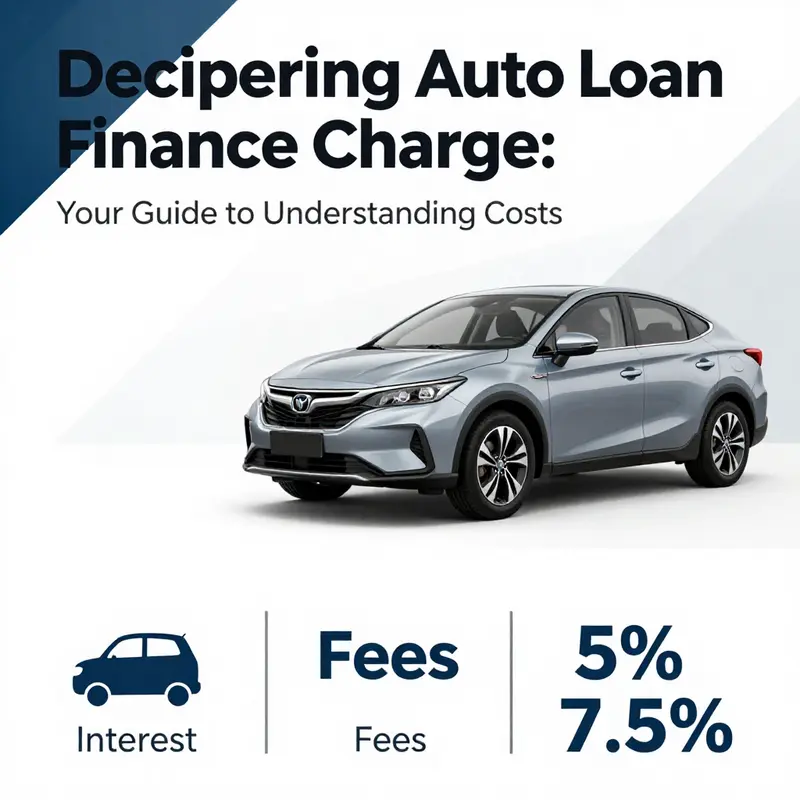
When you walk into a dealership or shop online for a car, the sticker price pulls your attention first. Yet the price you ultimately pay for that vehicle stretches beyond the number printed on the tag. The broader conversation around car buying must include a careful look at what lenders call the finance charge—the total cost of borrowing money to buy the car. This figure includes more than the interest rate. It is the complete price tag of financing, captured in dollars rather than just a percentage, and it can be surprisingly hard to spot at a glance. A clear understanding of the finance charge helps you compare offers more accurately, plan your budget, and avoid unpleasant surprises when the contract arrives in your mailbox or on your screen. In this sense, the finance charge is not merely an abstract accounting line; it is the real-money consequence of financing a vehicle and a major determinant of how affordable your car really is over the life of the loan.
At its core, a finance charge represents the total cost of borrowing beyond the principal amount you borrow to buy the car. It is the sum of several components that together describe how much you will pay to finance the vehicle across the term of the loan. The most familiar component is interest—the price lenders charge for the use of money. Interest is computed from the loan amount, the annual percentage rate (APR), and the length of the loan. The APR is intended to reflect the cost of borrowing per year and is expressed as a single percentage. But the finance charge is the actual dollar amount you will pay over the life of the loan, not just the yearly rate. In other words, the APR helps you compare rates, while the finance charge tells you the total dollars you will ultimately hand over to the lender.
Beyond interest, the finance charge often includes origination fees. These are one-time charges assessed by the lender for processing the loan. They can appear as a fixed dollar amount or as a percentage of the loan; either way, they increase the amount you owe. Origination fees are part of the economic cost of obtaining credit and, when bundled into the finance charge, provide a more complete picture of affordability. Some borrowers may encounter prepaid finance charges as well, including points paid to obtain a lower interest rate or upfront application fees. These upfront payments reduce the loan’s rate at the outset but raise the total amount paid over time, once again increasing the finance charge. Even routine administrative fees or document preparation charges can end up folded into the total cost of financing, depending on how the loan is structured and how the lender presents the loan terms.
When you look at a car loan contract, the finance charge is often presented as a single, bottom-line number. It can be easy to overlook this line amid the dozens of figures on the disclosure, especially if the focus is mainly on the monthly payment. Yet that single number is precisely what determines how the loan feels in the long run. If you borrow $30,000 at 5 percent APR over five years, the math of amortization tells you that the monthly payment includes both principal and interest, spreading the cost of borrowing over 60 monthly installments. The total of those payments will be significantly higher than the original $30,000 borrowed, reflecting the interest paid over the life of the loan. The finance charge in this scenario would typically include the interest portion accumulated over 60 months, and it might also include any origination or prepaid charges that the lender attaches to the loan. In practical terms, you could see roughly $4,000 in interest over the life of the loan, with additional fees pushing the total finance charge higher depending on the exact terms and any upfront costs. The precise figures depend on the borrower’s credit profile, the loan term, the amount financed, and the lender’s fee structure, but the general pattern is clear: longer repayment periods tend to pulsate the total interest upward, while heavier upfront costs push the finance charge higher from the start.
The distinctions among the elements of the finance charge matter precisely because they affect how different loan offers compare. Some lenders advertise remarkably low interest rates to attract buyers, but those rates can be paired with higher origination fees or additional charges that end up inflating the finance charge. In other words, a tempting low APR does not automatically translate into the most affordable financing once you account for all the fees the lender layers into the loan. A comprehensive approach to evaluating auto financing requires looking at the entire package—the finance charge in dollars, the APR, and the loan’s amortization schedule—so you can see how much you will pay in total and how that payment will evolve month by month.
Another nuance that buyers frequently encounter is the possibility of a dealership-added or service-related fee that appears as part of the financing package. Terms such as a vehicle financing service fee, if present, may not be clearly explained in the contract or disclosures. The presence of such fees can subtly inflate the finance charge and, by extension, the total cost of the loan. The risk here is not merely a higher price; it is the potential for information asymmetry at the point of sale, where a buyer might accept a deal without fully understanding all items included in the finance charge. As a result, one of the most important steps in the car-financing process is to request a complete, line-by-line breakdown of all elements that contribute to the finance charge. Ask for an amortization schedule that shows each month’s payment, how much goes to interest, and how much reduces the principal, as well as a separate line item for every loan-related fee. This clarity makes it possible to isolate what portion of the cost stems from interest versus the fees, which, in turn, helps you negotiate or shop more effectively.
Regulatory frameworks exist precisely to promote this kind of transparency. Under the Truth in Lending Act (TILA), lenders are required to disclose the finance charge and the APR before you sign a loan agreement. The aim is straightforward: give consumers a clear, side-by-side basis for comparing offers. The idea is not to erase the complexity of financing but to illuminate it so you can see how the numbers interact over time. In practice, you should expect a disclosure that separates the amount financed, the finance charge, the APR, and the total of payments over the life of the loan. If any item seems ambiguous or missing, you have a legitimate reason to ask for clarification. The Consumer Financial Protection Bureau (CFPB) provides authoritative guidance on these concepts and the kinds of disclosures you should expect when you read a car loan contract. For a detailed explanation, you can consult resources such as the CFPB’s What Is a Finance Charge? overview, which outlines the components and the rationale behind the disclosures.
To translate these ideas into practical action, consider the following approach when you’re evaluating auto loan offers. First, request a complete, itemized disclosure from each lender. This should include the finance charge, the APR, and a full breakdown of all fees and charges that are part of the loan. Second, review the amortization schedule for each offer. This schedule reveals how each monthly payment is allocated, how the principal declines over time, and how much interest you will pay before the loan is fully repaid. Third, compare offers on the basis of the finance charge in dollars, not just the APR. A lower APR can be offset by higher origination fees or service charges, resulting in a higher total cost. Fourth, be mindful of the term length. While a longer term can reduce monthly payments, it also increases the total interest paid over the life of the loan, lifting the finance charge. Conversely, a shorter term may raise monthly payments but can lower the total cost if you can afford the higher monthly outlay. Fifth, scrutinize any nonstandard charges that might be added to the loan. Some dealers or lenders might attach fees labeled vaguely as administrative charges, processing costs, or financing service fees. If a fee seems optional or unnecessary, push back and negotiate its removal or reduction. If a lender refuses to eliminate or explain a fee, that is a red flag and a sign to compare other offers more aggressively.
Your creditworthiness, the loan term you choose, and the amount you finance all influence the size of the finance charge. A borrower with a higher credit score typically secures a lower APR, which helps reduce the finance charge even if fees stay the same. A larger down payment lowers the amount financed, which also reduces the base on which interest accrues and can shrink the overall finance charge. Meanwhile, extending the loan term can increase the finance charge, even if the monthly payment looks affordable. The math here is not a trick; it is the straightforward consequence of how interest accrues over time. Lenders apply interest to the outstanding balance, so the longer you owe money, the more interest accrues. That reality underscores why a quick, down-payment-backed purchase can be financially healthier in the long run than a longer, more deferred financing strategy.
An essential part of navigating these decisions is being comfortable with the terminology and how the pieces fit together. The finance charge is not a mysterious phantom cost that appears after you sign; it is the sum of the costs associated with obtaining credit for the vehicle. It includes, but is not limited to, the interest you pay for the privilege of borrowing, any origination charges that lenders levy for processing the loan, and any prepaid or service-related charges that the contract embeds. When you see a total finance charge, you are looking at one tangible number that captures the total price of borrowing over the term of the loan. The APR is the annualized rate that helps you compare the cost of credit across offers, accounting for the interest and many of the fees, but it does not stand alone as the complete picture. The finance charge is the actual dollar amount that will leave your budget by the time you finish paying off the loan.
To support informed decision-making, it is useful to anchor these concepts in a practical frame. Suppose you are negotiating a loan for a car priced at $30,000 with a five-year term. The lender quotes 5 percent APR and lists a modest origination fee, plus a small application fee. The monthly payment, calculated from the amortization formula, will be the amount you pay every month, but the real question is how much of that payment is attributed to interest and how much to reducing the principal. In this scenario, you would likely see the total of all payments hovering around the $34,000 mark, with roughly $4,000 representing interest over the life of the loan. If the lender tacks on a higher origination fee or a larger service charge, that extra money increases the finance charge, even if the stated APR looks appealing at first glance. The bottom line is that the finance charge embodies the true cost of borrowing, while the APR provides a standardized yardstick for comparing how expensive the loan is on an annual basis.
The importance of transparency and understanding cannot be overstated. When you make financing choices, you are entering a long-term financial agreement that will shape your budget for years. Reading the disclosures with care, asking pointed questions, and requesting a full breakdown of all components empower you to avoid surprises later. If you want to explore more about the topic, the knowledge hub at the Davis Financial Advisors site offers additional context and practical guidance on financing choices and cost calculations. It can serve as a helpful companion as you compare offers, build your amortization schedule, and think through how different terms, down payments, and fee structures will affect your overall cost of ownership. knowledge hub
Ultimately, the finance charge is about more than the loan’s headline rate. It is the comprehensive measure of what you will pay to borrow money for the car, including interest and every fee embedded in the contract. It is the number that reflects how much car you can actually afford in the long run and how much you will give back to the lender beyond the vehicle’s principal price. The better you are at understanding this figure, the more effectively you can negotiate, compare offers, and protect your long-term financial health. When you walk away from a financing discussion with a clear sense of the finance charge and how it came to be, you have gained a powerful tool in the decision-making toolkit for purchasing a vehicle.
For readers seeking authoritative external guidance on finance charges and related disclosures, consider the Consumer Financial Protection Bureau’s authoritative explanations on how these numbers are calculated and presented. You can find detailed information at https://www.consumerfinance.gov/ask-cfpb/what-is-a-finance-charge-en-1728/.
Cracking the Finance Charge: Calculating the True Cost of an Auto Loan
When you buy a car and decide to finance part of the purchase, the sticker price isn’t the only number that matters. The finance charge is the overall price you pay to borrow money for that vehicle, and it stretches beyond the monthly payment you see in the contract. In plain terms, the finance charge is the total cost of borrowing over the life of the loan. It includes interest, which is the price lenders charge for the use of their money, and a bundle of fees that can creep into the deal if you’re not careful. Understanding this total cost matters because it shapes your budget long after the keys are handed to you. It affects your ability to save, to plan for other expenses, and—crucially—to compare competing offers without getting misled by low monthly payments or flashy APRs that mask bigger charges later on. A clear grasp of the finance charge empowers you to negotiate more effectively and avoid paying more than you have to for the privilege of driving a new or used vehicle.
To appreciate what counts as a finance charge, it helps to break down its components. The most familiar part is the interest itself, calculated as a percentage of the amount financed and applied over the term of the loan. This interest is typically expressed as the annual percentage rate, or APR, which blends the interest rate with certain fees that lenders must disclose. But the APR is not the total sum you will hand over to the lender over the life of the loan. The finance charge expands to include origination fees, which are one-time charges assessed for processing the loan; prepaid finance charges, such as points paid up front or application fees; and other loan-related fees that can appear as document preparation fees, administrative charges, or service charges. Some car buyers encounter a dealership-specific item sometimes called a vehicle financing service fee, which is not always clearly explained in the contract. Because these items pile up, the line item labeled “finance charge” or the total cost of financing on your contract can look deceptively small if you focus only on the monthly payment or the advertised APR.
For a borrower navigating a loan offer, the most practical starting point is to recognize that the finance charge is a function of three interacting factors: how much you borrow (the principal), the price of borrowing (the APR), and how long you borrow for (the loan term). Each factor reshapes the total cost. If you borrow more money, the finance charge tends to rise because more principal is subject to interest and fees. If the rate is higher, or if lenders tack on more fees, the cost climbs accordingly. And if you stretch the term longer, you may lower the monthly payment, but you can end up paying more in interest over the life of the loan, because the balance remains outstanding for a longer period. These dynamics mean that two loans with the same principal and the same APR can still yield different total financing costs depending on how the payments are structured and what fees are included in the deal. A concise primer on these terms is available on the knowledge page knowledge.
To illustrate how the finance charge comes together, consider the two common methods lenders use to determine the total cost. The first method is the simple interest approach. In its most straightforward form, the finance charge equals the principal multiplied by the annual interest rate and by the loan term expressed in years. So, if you borrow $25,000 at a 5 percent annual interest rate for five years, the simple-interest calculation would yield a finance charge of $25,000 × 0.05 × 5 = $6,250. That figure represents the total interest you would pay if the entire principal remained outstanding for the full term without any amortization or schedule shifting. It’s a clean, easy-to-understand calculation that helps you get a rough sense of how expensive the loan could be at a glance. Yet most auto loans today do not follow this simplified path, because lenders typically use amortization to calculate payments.
The more realistic approach for many auto loans is amortization. With amortized payments, the monthly payment stays constant over the life of the loan, but the portion of each payment that goes toward interest declines as the outstanding balance shrinks. In our example of $25,000 at 5 percent over five years, the monthly payment would be around $471.78. Over 60 months, the total amount paid would be about $28,306.80. Subtract the original principal of $25,000, and the total finance charge, under this amortized schedule, comes to roughly $3,306.80. This figure is notably smaller than the simple-interest estimate, and that discrepancy highlights why understanding the loan’s actual amortization schedule matters. The amortized approach accounts for the fact that each payment reduces the principal, so interest is assessed on a gradually shrinking balance rather than on the full amount for the entire term. In practice, the total finance charge you pay will depend on your exact terms, including the precise interest rate, the length of the term, and any upfront or ongoing fees the lender imposes. This is why the calculator you use to plan your payments should reflect the amortization logic rather than rely solely on a basic multiplicative formula. For readers who want hands-on numbers, a reputable auto loan calculator can translate your terms into a monthly payment, a total payment, and the resulting finance charge with crisp precision.
A useful way to think about this is to picture the loan as a staircase: each monthly payment reduces the balance a little, and a portion of that payment pays the lender for the service of borrowing. Early on, a larger slice of the payment covers interest because the balance is still high. Later, more of the payment goes toward reducing the principal. The total finance charge, in other words, is the sum of all the interest that accrues across those monthly steps, plus any ancillary fees that your contract confirms as part of the financing. This is why a loan with the same APR but a shorter term can yield a smaller total finance charge than a longer-term loan—the balance is paid down more quickly, so interest accrues on a smaller average balance over time. It also explains why the bright, enticing monthly payment is not a complete measure of cost: a seemingly low payment can mask a larger total price if the term is extended or if the loan carries a heavy set of fees.
Beyond these core mechanics, there is a practical, real-world layer to the conversation about finance charges that often starts with the contract itself. The finance charge is typically disclosed as a dollar amount on the loan agreement, and it is closely tied to the APR, which is intended to reflect the true annualized cost of borrowing. Federal law requires lenders to disclose both the finance charge and the APR before you sign, making it possible to compare offers on a consistent basis. When you compare two loan offers, the finance charge gives you a sense of the overall cost, while the APR provides a standardized measure that includes certain fees in addition to the interest rate. Taken together, they enable you to judge whether a lower monthly payment is worth the higher total cost or whether a seemingly higher APR is justified by a lower overall price because it comes with fewer upfront fees.
The landscape of fees, however, is not always transparent. Some lenders and dealerships may present a deceptively attractive APR while layering in additional charges that inflate the finance charge but are not always obvious at first glance. One common source of confusion is the vehicle financing service fee, which may be described as a dealership administrative cost or a processing fee and can be built into the total financed amount or listed as an upfront charge. It can be omitted from the advertised rate, only to reappear in the contract as a line item that barely gets noticed when the monthly payment is calculated in isolation. Savvy buyers know to ask for a full breakdown of every fee and to verify how each item affects the total cost of financing. This is where careful read-through of the loan documents becomes essential, along with side-by-side comparisons of the loan terms.
A straightforward step in the preparation process is to request a detailed disclosure from any lender or dealer, including the explicit finance charge, the APR, the amount financed, and a complete list of fees. Even better, ask for the amortization schedule that shows how each monthly payment is allocated between interest and principal across the term. Seeing the schedule helps you understand not just the total cost but also how quickly you are paying down the loan. It can reveal whether a larger initial interest portion is masking a favorable payoff structure or whether the balance is being eroded steadily enough to justify a particular term length. If the numbers look puzzling, don’t hesitate to pause the process and run several scenarios. A small shift in the term or the amount financed can yield meaningful differences in the total finance charge, and the best choice is often the one that minimizes the amount you ultimately pay, not just the monthly burden.
When it comes to budgeting, the practical takeaway is simple: do not treat the finance charge as a side note. It is a central driver of your total cost and your long-term financial plan around the vehicle. A higher finance charge can ripple into your household budgets for years, especially if you carry the loan for the longer term or choose to trade in the vehicle before paying off the loan’s principal. To make meaningful, apples-to-apples comparisons, you should consider several scenarios: the same loan amount with different terms; the same term with different down payments or trade-ins; and the impact of paying points up front versus financing them. Use the amortization view to decide whether a shorter term with a slightly higher monthly payment truly yields a better long-run deal because the total interest and fees paid are lower. This kind of analysis helps you separate marketing rhetoric from arithmetic and prevents you from overpaying in pursuit of a lower monthly bill.
Before you sign, take advantage of the federal requirement for disclosure and pressure-test the contract against offers from competing lenders. Ask questions about any line items that look ambiguous or unfamiliar. If a lender cannot clearly explain the purpose of a fee or why a particular amount is included in the finance charge, that is a red flag. Remind yourself that you are negotiating a borrowing arrangement, not a product sale, and that a car loan is a financial instrument with consequences far beyond the immediate purchase. A disciplined approach to review—paired with a willingness to walk away from terms that inflate the cost—often yields a better outcome than accepting the first offer that arrives with an attractive monthly payment. For those who want a practical tool to estimate the cost quickly, online calculators that simulate amortized loans can translate your inputs into a monthly payment, a total repayment figure, and the resulting finance charge, helping you compare offers side by side before you step into a showroom.
To connect theory with practice, remember that the total financing cost you see on your contract is not a single static price. It is the culmination of your chosen principal, the APR you negotiate or are offered, any fees you cannot avoid, and the way the lender applies those costs over the term of the loan. The same principal and APR can yield different outcomes if fees are treated differently or if a dealer pushes a longer term to reduce the monthly payment—even though the longer term raises the overall cost. A disciplined buyer evaluates the entire package, not just a single figure. In that sense, the finance charge becomes a guidepost for responsible borrowing and a tool for informed decision-making, rather than a marketing line that makes a loan seem cheaper than it truly is.
For readers who want to explore the mechanics further or test their own numbers, there are reliable calculators that can model the amortization process using your exact terms. These tools account for how much you borrow, the interest rate, the term, and any upfront or ongoing fees, and they present a transparent view of how much you will pay in total over the life of the loan. In practice, taking a few minutes to run scenarios with a calculator can save hours of confusion and prevent overpaying. It is also a good habit to revisit your assumptions if you ever consider refinancing in the future, since interest rates, loan terms, and fees can change and alter the total cost of financing.
The journey from sticker price to true cost is rarely linear, but the payoff is straightforward: knowing how to calculate and interpret the finance charge puts you in a better position to secure a loan that aligns with your financial goals. It is a habit worth cultivating whenever you buy a vehicle, whether new or used, and it becomes even more critical if you plan to keep the car for a long time or carry high mileage, where small differences in financing terms can compound into meaningful savings or costs over the life of the loan. By anchoring your decisions in a complete understanding of the finance charge, you move beyond the superficial appeal of monthly payments and toward a more robust, long-term plan for vehicle ownership.
If you’d like a concise primer on these terms or want to explore definitions in more depth, you can visit the knowledge page linked here: knowledge. And when you’re ready to run real-world numbers, you’ll find that the math behind the finance charge—while sometimes nuanced—becomes a practical ally rather than a source of confusion. As you compare offers, remember that the number you should care about most is the total price of financing over the life of the loan, not just the monthly payment or the headline APR. The true cost of borrowing is the sum of the finance charge plus any up-front or ongoing fees, and understanding that sum is what ultimately helps you steer toward a vehicle that fits your budget and your broader financial plan. External resource: https://www.investopedia.com/articles/personal-finance/091113/how-to-calculate-your-auto-loan-payment.asp
Decoding the True Cost: The Finance Charge in Auto Lending

When you shop for a car, the sticker price draws your attention first. It is the number that signals value, desire, and negotiation leverage. Yet behind that price lies a more influential figure—the finance charge. The finance charge is the total cost of borrowing money to purchase the vehicle, not just the annual percentage rate (APR) you see quoted but a broader sum that includes interest and a suite of fees tacked onto the loan. For many buyers, this single figure determines how affordable the car feels over time and whether the monthly payments fit into a sensible budget. Understanding the finance charge is not a matter of pedantic math; it is about grasping the full price you will actually pay and how that price shifts with every decision you make about the loan. The better you understand the components, the more informed your choices become, and the more you can avoid paying for features you do not need or simply cannot justify over the long haul.\n\nTo appreciate why the finance charge matters, imagine two buyers who both want to borrow the same amount for the same car, but one has a loan with a lower APR and higher upfront origination fees, while the other carries a higher APR but a leaner upfront fee structure. From the outside, the first loan might appear a bargain if the monthly payment looks smaller because the interest is spread across a shorter time frame or because fees are front-loaded. On the other hand, the second loan could result in a higher total cost over the life of the loan even if the monthly payments are similar or slightly higher. This contrast highlights a core truth: a low advertised rate does not automatically translate into the lowest overall cost. The finance charge reveals the true cost, unmasking how much money you will spend beyond the principal, and it serves as a more honest compass for comparing offers than rate alone.\n\nWhat the finance charge includes is both simple and complex, depending on how deeply you want to probe the loan terms. At its core, the finance charge covers the basic cost of credit—the interest calculated on the amount financed at the loan’s APR. But a full accounting of the charge also includes origination fees, which are one-time costs assessed for processing the loan and disbursing the funds. Some lenders bundle additional services into this category, aiming to cover the costs of underwriting and credit checks. Then there are prepaid finance charges—fees paid upfront that can include points or certain application costs. These prepaid items translate into a higher initial outlay and a larger total finance charge, even though they may lower your ongoing monthly payments if they are structured to buy down the rate. Beyond these, there can be a variety of other loan-related charges—document preparation fees, administrative charges, service charges, and more. Each of these pieces contributes to the total dollar amount you will repay beyond the principal.\n\nTo some readers, that catalog of charges might sound like small, technical details. Yet they accumulate, sometimes quietly. For example, a loan that appears to offer a modest interest rate may carry a higher overall finance charge because of higher origination fees or because the loan term is extended, effectively increasing the amount of interest paid over time. Conversely, a loan with a higher nominal rate but a lower overall charge can end up less costly in total if the fees and term structure align more favorably with your financial situation. That is why the finance charge serves as a more transparent signal about the true cost of credit than the interest rate alone. It is not just the price tag of the car but the price tag of credit that you are agreeing to for several years.\n\nThe arithmetic behind the finance charge is straightforward in principle but can be opaque in practice because the numbers braid together. If you borrow a certain principal amount, the APR tells you the annual cost of borrowing expressed as a percentage. The finance charge aggregates this cost over the life of the loan, adding the interest paid each year and all those one-time or periodic fees that accompany the loan. The result is a single dollar figure—the total amount you will pay over and above the amount financed. To a borrower, this is a watershed figure because it translates into how much of each monthly payment goes toward paying down the principal versus covering interest, and how much time it takes to pay off the loan. When you examine the finance charge, you also see the way in which the loan’s structure can shape long-term outcomes: higher charges often mean money that would otherwise reduce the balance goes to interest rather than to equity in the vehicle, prolonging the path to ownership and increasing the risk of being upside down if the car’s value declines faster than your balance shrinks.\n\nTwo consequences of this framing deserve particular emphasis. First, the finance charge affects budgeting and daily financial planning in a direct way. If your monthly payment is already a stretch for your income, a larger finance charge can push you into tighter corners, squeezing other essential expenses or saving goals. This is especially true for buyers with tighter credit profiles, where lenders might rely on higher charges to offset risk. Second, the finance charge is a key metric for comparing offers across lenders and dealer arrangements. When you stand the numbers side by side, you learn where the true leverage lies: sometimes a seemingly favorable rate comes with fee-heavy terms that erode the advantage, while another option may carry a slightly higher rate but a far smaller finance charge, which in practical terms means lower total repayment.\n\nA crucial aspect of this discussion centers on the legal framework designed to promote transparency. In the United States, lenders are required by law to disclose the finance charge and the APR before you sign a loan agreement. This requirement is part of the Truth in Lending Act, and its purpose is to empower borrowers to compare offers accurately and to prevent predatory practices that might hinge on confusing or undisclosed costs. The disclosure helps you answer a practical question: if two lenders present very similar monthly payments, which option will cost you more overall? The answer lies in how the finance charge stacks up across the loan term, taking into account every included fee and the way the interest accrues.\n\nYet even with formal disclosures, a misstep can occur when borrowers focus too narrowly on one number—the APR or the monthly payment—without accounting for the full texture of the finance charge. A lower APR can be alluring, but if a loan comes with high origination fees or a substantial prepaid charge, the total cost over the life of the loan might still be higher than a loan with a modest rate but leaner fees. Likewise, a longer loan term reduces monthly payments, which can ease immediate cash flow but expands the window of time over which interest accrues and can dramatically increase the total finance charge. This stock of trade—balancing rate, fees, and term—frames the decision in a way that aligns with your finances, priorities, and appetite for risk.\n\nUnderstanding these dynamics is not a passive exercise in number-crunching; it is a practical habit you can cultivate before you walk into a dealership or a bank. Start by distinguishing the principal from the finance charge. The principal is the amount you are borrowing to purchase the car; it is the number that reduces as you repay the loan. The finance charge is the extra cost you incur to borrow that amount over the term of the loan. The sum of the two is the total amount you will repay to the lender. If you want to put this into plain language, you are looking at the price tag of credit itself—the price you pay for the permission to drive the car before you own it outright. The greater the finance charge, the more your commitment to this vehicle extends in time and cost beyond its market value at the moment you sign.\n\nA practical test emerges when you compare offers. Suppose you are offered two financing paths: Path A with a lower APR but higher upfront fees, and Path B with a higher APR but minimal upfront costs. If you compute the total payments over the life of each loan, you may find that Path B, despite its higher rate, could yield a smaller total finance charge, simply because you are not paying a hefty sum at closing. Conversely, a low-fee arrangement may still end up more expensive if the rate is high enough and the term long enough. The takeaway is simple but powerful: do not fixate on the rate alone. Bring the entire package into view—the principal, the rate, the term, and every fee that arrives with the loan—and then ask a straightforward question: which combination of these elements delivers the lowest total cost over the full term?\n\nThis is where borrowers can become more strategic, and where the role of transparency becomes their ally. When lenders disclose the full scope of charges, borrowers can make apples-to-apples comparisons rather than being surprised by concealed costs later in the life of the loan. It is natural to want the lowest monthly payment, but the real bargain is the lowest total cost. If you find yourself juggling offers and unsure how to rank them, consider focusing on the finance charge as a central reference point. It is the umbrella figure that covers interest and the array of fees that could otherwise slip into the background of the decision-making process. A clear grasp of the finance charge can demystify the financing experience, turning what might feel like a fog of numbers into a coherent financial plan you can live with for years.\n\nOf course, the market presents other forces that influence the finance charge beyond your personal credit history. The length of the loan, for instance, is a primary driver. A longer term reduces the monthly burden but increases the total amount paid in interest and fees. Shorter terms tend to lift the monthly payment but can lower the overall cost if the interest compounds more slowly and the lender imposes fewer ancillary charges over time. The creditworthiness you bring to the table shapes the base rate you are offered, but it also interacts with the lender’s fee structure. A borrower with strong credit might secure a low APR with modest fees, while a borrower with a more challenged credit profile could see a higher APR accompanied by more substantial fees to offset perceived risk. In practice, the landscape is a mosaic: your credit history, down payment size, and the term you choose all contribute to the final finance charge in ways that are not always intuitive at the moment of signing.\n\nDown payments serve a dual purpose in this regard. A larger down payment reduces the amount financed, which in turn reduces both the principal on which interest accrues and the finance charge’s ultimate footprint. In a sense, the down payment acts as prepayment on credit; it reduces the amount you must borrow and thereby lowers the base cost of credit. The decision to put more money down early can be a wise hedge against a steeper finance charge later, particularly if the aim is to minimize interest costs or to shorten the loan’s life. On the other hand, there are strategic reasons to keep a larger cash reserve rather than deplete it on a down payment. If your money could earn a return elsewhere or be kept in reserve for emergencies, the calculation becomes more nuanced. The point remains, though: the down payment is a lever that can materially tilt the balance of costs, often in a direction that favors the borrower by reducing the amount financed and the subsequent finance charge.\n\nThe notion of transparency extends beyond the loan documents to the broader relationship you cultivate with your lender or dealer. In some instances, buyers encounter terms that feel opaque or that seem to lack precedent in other financing experiences. A common pitfall is the vehicle financing service fee—an external-fee-like assessment that is sometimes tacked onto the loan or included in the financing package. These charges can appear under various names and may not always be clearly explained in the contract at the outset. The risk is that the sticker price of credit, which you negotiate and feel confident about, masks additional costs that accumulate in the background and inflate the total finance charge. A vigilant buyer will ask precise questions about every fee, request an itemized breakdown of all charges, and seek explicit language in the contract that shows how each fee contributes to the total. If an item feels dubious or unnecessary, you have every right to negotiate or decline it. The ability to push back on extraneous charges is a core aspect of responsible borrowing and one of the practical benefits of understanding the finance charge in the first place.\n\nTo bridge theory with everyday action, consider the steps you can take to assess and manage your finance charge before you commit. Begin with a clear ledger: write down the principal you intend to borrow, the term you are comfortable with, and the range of APRs you have seen from credible sources. Then, request a full disclosure of all components that comprise the finance charge, including any origination fees, prepaid charges, service fees, and document preparation costs. Translate those numbers into a total you will repay beyond the principal, and compare that total across all offers. It is also helpful to calculate not only the total, but the impact on monthly payments. A lower monthly payment might seem attractive, but if it comes with a significantly higher total cost due to fees and a longer term, it is not a bargain for your long-term finances. Conversely, a slightly higher monthly payment may be acceptable if it trims the total cost by reducing the finance charge. The discipline of this comparison turns the financing decision from a reactive choice into a deliberate plan aligned with your financial goals.\n\nThis approach—seeing the full cost of credit, knowing where to look for every fee, and understanding how the loan’s structure pushes costs across time—also empowers you to avoid easy traps. Dealers and lenders may propose add-ons or services that look convenient or protective but ultimately inflate the finance charge. Some items may be legitimate and beneficial, while others are optional or redundant. Your job is to discern which components truly add value and which are simply there to pad the bottom line. In short, you want to strip the financing process to its essentials: the amount borrowed, the rate charged, the term of the loan, and the fees that accompany the loan. When you hold these elements in focus, you can navigate toward an agreement that reflects real costs rather than inflated promises.\n\nAs you become more adept at evaluating finance charges, you also gain a clearer sense of how credit conditions interact with broader financial health. A high finance charge over a long period can dampen your options for other goals, such as home improvements, education, or emergency savings. The cumulative burden of interest and fees means fewer dollars available for investments in the future, which can compound into a sizeable difference in lifetime financial security. By contrast, a thoughtful approach to financing—one that minimizes the total cost while preserving liquidity and flexibility—preserves options for the road ahead. The choices you make about financing do not exist in isolation; they influence your budget, your credit profile, and your resilience in the face of unexpected expenses. The finance charge, then, is not a mere line item on a contract; it is a lens through which you view the long-term affordability and practicality of owning a vehicle.\n\nFor readers seeking a practical, consolidated resource that helps illuminate these ideas, our knowledge base offers guidance on the fundamentals of personal finance and the mechanics of auto lending. It provides foundational explanations and tools you can use to expand your own understanding of how financial charges are constructed and how to compare offers reliably. If you want to explore how these concepts fit into broader financial planning and car-ownership strategies, this resource can be a useful companion as you prepare to engage with lenders and navigate the financing process with greater confidence. The broader takeaway remains straightforward: while the car’s price signals value, the finance charge reveals the true price of credit, and that truth should guide every decision you make as you move from interest to ownership. For further reading on the principle of finance charges and how disclosures function in practice, you can consult external resources that explain how these figures are calculated and presented to consumers, such as official explanations from consumer protection authorities. External resource: https://www.consumerfinance.gov/ask-cfpb/what-is-a-finance-charge-en-218/
Final thoughts
Understanding the finance charge on an auto loan is essential for making well-informed decisions when financing a vehicle. By exploring its various components, calculation methods, and the implications of associated fees, both individual car buyers and dealerships can better navigate the complexities of auto financing. Ultimately, gaining clarity on finance charges empowers borrowers to secure favorable loan terms and optimize their financial outcomes.