

Understanding the components of a finance charge is essential for both individual car buyers and businesses looking to optimize their auto loan decisions. Finance charges consist of interest and various fees that can significantly impact the overall cost of a loan. In this guide, we will delve into the intricacies of calculating the interest component of finance charges, explore the various additional fees that may apply to auto loans, and finally, combine these elements to arrive at the total finance charge. By breaking down these components, readers will be better equipped to make informed financing decisions and assess the true cost of borrowing for their vehicle needs.
Unraveling the True Cost: The Interest Component and Amortization Behind Auto Loan Finance Charges
When people borrow money to buy a car, the sticker price often seems like the main number to consider. Yet the most meaningful measure of what a loan will actually cost over its life is not just the monthly payment or the interest rate you see in bold on a disclosure. It is the finance charge—the total amount paid to borrow money—which comprises both interest and any fees tied to the loan. Within that total, the portion that represents interest—the cost of borrowing the principal over time—often dwarfs the fee line items, especially on longer terms or larger loan amounts. Understanding the arithmetic of that interest component is the key to making an informed comparison across offers and, more broadly, to grasping how the amortization of a loan shapes your financial trajectory for years into the future. The journey from principal to payment is not a single multiplication but a carefully staged sequence in which the balance, the interest, and the principal interact month by month. In the simplest terms, every payment you make on an amortized auto loan is a blend: a chunk goes to interest for the month, and the rest reduces the outstanding balance (the principal). The pattern is predictable, but the numbers require a reliable frame to make sense of the true cost you are committing to. To begin, fix your frame of reference around four core quantities: the loan principal (the amount you borrow, P), the annual percentage rate (APR) offered by the lender, the loan term measured in months (n), and the monthly interest rate (r), which is simply the APR divided by 12 when expressed as a decimal. For a standard, fixed-rate auto loan, the payment arrangement is described by the amortization formula, a standard calculator staple in any lending desk and in many consumer finance tools. The monthly payment M is determined by the classic expression M = P × [r(1 + r)^n] / [(1 + r)^n − 1]. Here, r is the monthly rate (APR divided by 12) and n is the total number of payments. This single number, M, compresses the life of the loan into a fixed cadence: every month you send in the same amount, and the loan is paid off at the end. But the meaning of M is not static. The way interest is charged against a balance that is steadily shrinking makes the first month’s interest larger than the last month’s, and it is this dynamic that creates the distinctive shape of an amortization schedule. If you could peek under the hood of your loan, you would see that in month one the balance at the start is P, so the interest portion is I1 = P × r. The remainder of the payment, M − I1, goes toward reducing the principal. As you proceed to month two, the balance is smaller, so the interest portion I2 = (P − (M − I1)) × r is a bit lower, and so on. Over the full term, the cumulative interest paid equals the total payments made minus the principal borrowed, or Total Interest = M × n − P. The elegance of the amortization approach is that it makes the timing of payments meaningful. It reveals how much you pay in interest during each month and how much of each payment actually chips away at the principal. This is not just academic arithmetic; it translates directly into real-world decisions about how long to borrow, how large a down payment to make, and whether extra payments are worth the effort. For those who want a concrete anchor, consider a representative example. Suppose you borrow $20,000 at an annual percentage rate of 5 percent, with a term of 60 months. The monthly rate r is 0.05 divided by 12, or about 0.0041667. Plugging into the amortization formula yields a fixed monthly payment M of roughly $377.42. Over 60 payments, you would remit about $22,645.20, and the difference between that total and the original $20,000 is the total finance charge attributable to interest, about $2,645.20. That figure aligns with standard loan calculators and illustrates how the amortization process translates a central rate into an actual cash flow pattern. It also clarifies a frequent point of confusion: the simple interest equation, Interest = Principal × Rate × Time, can give a rough sense of cost for the loan in isolation, but it does not capture the actual interest that accrues when the balance declines with each payment. The straightforward simple-interest calculation tends to overstate or understate true costs in an amortized loan depending on the structure, timing, and rounding employed by lenders. In other words, the annual rate on the loan is not a direct arithmetic multiplier of the funds you will eventually repay if the loan is amortized. The monthly payment formula folds all of that into a single, consistent payment across the life of the loan, and the resulting total interest reflects the reality of paying down the principal gradually instead of maintaining a constant balance. When you examine a loan offer, the APR can be a more informative number than the stated interest rate alone because the APR includes the fees that accompany the loan. However, for the purpose of isolating the cost of borrowing itself and understanding how the principal interacts with interest over time, the amortization method gives you the clean view: what portion of each payment is interest, and how the entire interest sum accrues as you proceed toward payoff. It is also worth noting that the exact distribution of interest across the months can be sensitive to rounding, to how the lender calculates the daily interest fraction, and to whether the loan uses a true amortization schedule or a slightly modified approach. Yet the general pattern remains robust: interest dominates early payments and gradually wanes as the principal shrinks. This is why the timing of extra payments matters so much. If you decide to make an additional payment in month one or month two, you reduce the principal immediately, which lowers the subsequent months’ interest charges. The effect compounds over the life of the loan, yielding a meaningful reduction in total interest paid and a shorter payoff horizon—an outcome that is especially valuable if you intend to own the car for many years or if your financial plan hinges on predictable cash outflows. To determine the finance charge carefully, you will often gather your P, APR, and term; you may also have to account for one-time fees that accompany the loan, such as origination or processing charges. The finance charge, as a whole, is the sum of the interest you pay over the term plus any recurring or one-time fees charged by the lender. If you are trying to disentangle the interest from the fees, start with the amortization-based calculation of the interest portion using the fixed monthly payment M. Then, separately add any non-interest fees to the total to arrive at the complete finance charge. In practice, this means that the pure cost of borrowing, exclusive of fees, is the total interest determined by the amortization schedule. The rest—fees such as origination or processing charges—are layered on top to form the total finance charge that borrowers see in disclosures. The distinction matters when comparing lending offers. Two loans with similar monthly payments and the same principal may deliver very different total costs if one includes higher upfront fees or more expensive processing costs. Read the disclosures with an eye toward three elements: the principal amount, the term, and the explicit interest rate used in the amortization calculation. Then, separate any listed fees and add them to the total interest calculated via M × n − P to obtain the true finance charge. Consider the implications for your decision-making. If your goal is to minimize the true cost over the life of the loan, you might trade a slightly higher monthly payment for a shorter term, or you might negotiate a loan with lower or no origination fees. The amortization framework gives you a transparent lens for evaluating these trade-offs. It is also a useful tool for financial planning beyond the loan itself. Knowing how the interest component unfolds helps you project how a payment schedule interacts with other financial goals—savings, investments, or large discretionary purchases. It can also inform decisions about whether to trade in a current vehicle earlier to refinance, or whether to structure a prepayment strategy that aligns with your broader financial plan. For those building an understanding of debt costs as part of broader financial literacy, a practical path is to work with an amortization schedule either by hand or through a calculator, then cross-check against the lender’s disclosure. A hands-on approach—computing M from P, r, and n, then simulating a few months to see the balance, interest, and principal split—builds intuition that the numbers alone cannot convey. It also invites a more productive dialogue with lenders, since you can reference a concrete schedule rather than relying on vague assurances about “the interest rate.” If you want to see a broader exploration of how financial concepts interlock with transportation and asset ownership, you can explore additional resources in the knowledge hub that curate practical explanations of money management concepts. knowledge hub. For those who want to experiment with the math on their own, a widely used online tool follows the same underlying principles described here and can provide a helpful cross-check as you compare offers. The essential point remains: the amortization framework exposes the true cost of borrowing and clarifies how the interest component behaves across the life of an auto loan. This transparency is what empowers you to make value-aligned choices about repayment strategies, term lengths, and how aggressively you tackle the principal. In the end, the goal is to align the numbers with your financial plan so that the loan you choose fits not just your budget today but your long-range objectives as well. While fees and the exact structure of the finance charge can vary across lenders and products, the core mechanics of amortization—how a consistent payment splits into interest and principal, and how the balance dwindles over time—remain remarkably stable. Grasping these mechanics helps you interpret disclosures, compare offers with precision, and decide on a path that minimizes the cost of financing your next vehicle. To reinforce this approach with practical tools, many readers benefit from using an amortization table or calculator to reproduce the example above with their own numbers, then adjusting for different term lengths or rates. This method converts a single rate into a living schedule that shows, month by month, where your dollars go and how the interest component evolves as you pay down the loan. In conclusion, the math behind the interest component of the finance charge is not a mystifying algebraic trap; it is a transparent, repeatable process that, once understood, demystifies the cost of financing a vehicle. By anchoring your analysis in the amortization framework, you can estimate how much of each payment is dedicated to interest, anticipate how much you’ll end up paying in total interest over the life of the loan, and—crucially—discern how extra payments and fees influence the true cost of borrowing. This insight not only sharpens your ability to compare offers but also strengthens your broader financial discipline by revealing the long-term implications of the choices you make when you sign that loan agreement. External resource: https://www.bankrate.com/loans/auto-loan/interest-rate-calculator/
Beyond the Sticker Price: Navigating Auto-Loan Fees That Shape Your Finance Charge
When buyers shop for a car, the sticker price and the advertised interest rate are the surface of a much larger financial portrait. The finance charge, the total cost of borrowing over the life of the loan, is rarely just a single number on a page; it is an accumulation of interest plus a suite of fees that lenders may attach to the loan process. Understanding how these fees behave, where they come from, and how they interact with the interest you pay is essential if you want to assess the true cost of financing a vehicle. This chapter explores the often overlooked pieces of the finance charge, explains how they are calculated, and offers practical guidance for borrowers trying to compare offers without being blindsided by hidden or negotiable costs. It is a connective thread in the larger conversation about financing a vehicle wisely, tying the behavior of fees to the broader question of what you ultimately pay over the term of the loan. For readers who want a starting point to deepen their understanding, a look at the resources in our knowledge hub can provide a broader context and more examples of how fees appear in real-world scenarios. our knowledge hub.
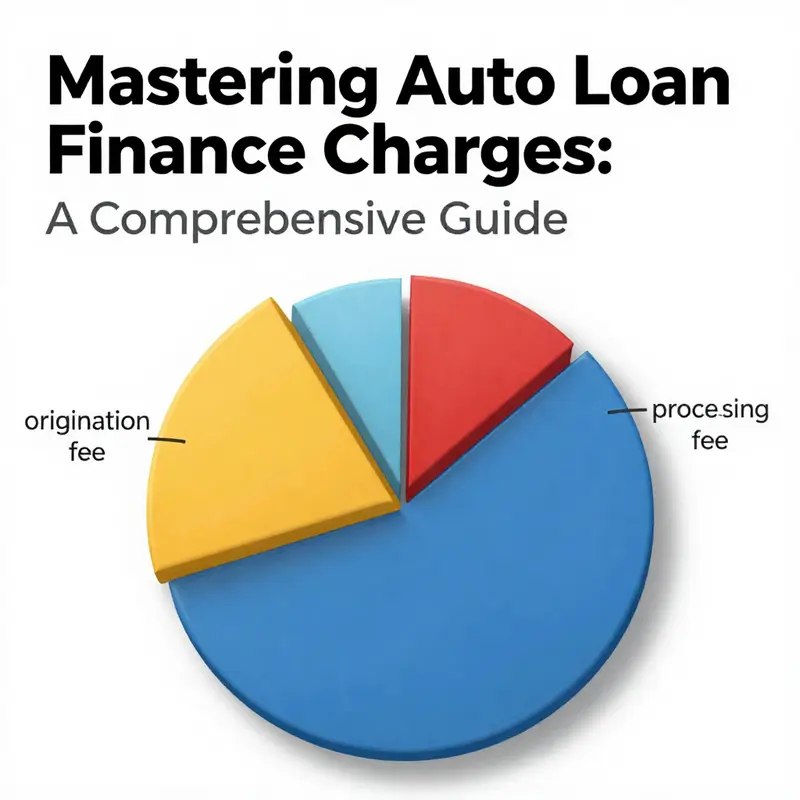
Fees are not merely incidental charges; they are a deliberate part of the lender’s pricing structure. Origination fees compensate the lender for processing and underwriting your loan, and they may be stated as a flat amount or as a percentage of the loan principal. When you see an origination fee disclosed, it is worth asking whether the amount is negotiable or if it can be waived in exchange for a slightly higher interest rate or a smaller loan amount. Processing or processing-related fees often cover administrative tasks that accompany the loan’s lifecycle, from document handling to verification of income and other supporting information. These fees might appear as separate line items or as a single combined “finance fee” on the loan disclosure.
Documentation fees, another common entry in auto loan paperwork, serve to cover the cost of preparing and recording legal documents tied to the loan agreement. They can be modest or substantial, depending on the lender and the market. Then there are application fees, charged early in the process for evaluating your creditworthiness and underwriting your loan. While some lenders may present these costs as standard, others may offer a promotion or waive certain fees for qualified borrowers. The key is to recognize that each of these fees, even when individually small, can add up to a nontrivial portion of the finance charge when they are totaled over the life of the loan.
Prepayment penalties, though less common in modern auto lending, deserve particular attention. A prepayment penalty is a scheduled charge that applies if you pay off the loan early or make large extra payments ahead of schedule. The rationale offered by lenders is that early payoff shortens the period during which they earn interest. In practice, prepayment penalties can distort the true cost picture in two ways: they discourage accelerating payoff, and they complicate the calculation of the true cost of financing if you are considering ways to reduce the loan’s exposure sooner than the term. If a lender includes any prepayment penalty, you should weigh it against your plans for potential early payoff and compare whether a lower interest rate or a cleaner freedom to pay early would better serve your finances.
The sum of these charges—origination, processing, documentation, application, and possibly prepayment penalties—forms the total finance charge, but it is the relationship between these fees and the interest rate that often trips up borrowers. In the classic sense of the simple interest formula, Interest = Principal × Rate × Time, the finance charge would be the arithmetic product of borrowed funds, rate, and term. Yet in auto lending, the payment stream is typically amortized, and the presence of fees can influence the overall cost in a more complex way than a straight multiplication would imply. The simple calculation gives you a rough sense of how much interest accrues, but it does not capture how fees are embedded into the loan’s economics if they are financed into the balance. When fees are financed, they become part of the loan principal, which in turn increases the interest over the life of the loan because you are now paying interest on a larger amount. This creates a compound effect: small fees rolled into the loan can end up costing more in interest than their face value. The practical takeaway is straightforward: keep an eye on the fees themselves, not just the rate, and consider whether to accept a higher rate with lower upfront fees or a lower rate with higher fees.
To illustrate, consider a hypothetical scenario that many borrowers face. Suppose you are purchasing a car for $25,000 and secure a five-year loan at an annual rate of 6 percent. If you were to calculate simply, the interest would be about $7,500 over the life of the loan, using the straightforward formula. Now add a $600 origination fee and a $300 processing fee. The total finance charge, in this simplified view, becomes $7,500 in interest plus $900 in fees, totaling $8,400. If, however, the lender were to roll those $900 into the loan principal, the new loan amount becomes $25,900. The interest would then accrue on this higher balance, adding several hundred dollars to the total interest paid over the term. The resulting finance charge would be higher than the $8,400 figure not just because of the higher principal, but also because the interest compounds on the added balance. This is a reminder that the manner in which fees are treated—whether paid upfront or financed—materially affects the true cost of borrowing. It also underscores why an itemized loan estimate is essential.
Even when the math is relatively transparent, the way fees are disclosed can influence your understanding. Some lenders present a single “finance fee” line item, lumping multiple charges into one, which can obscure the exact nature and amount of each cost. Others break out the components clearly, making it easier to identify how much is origination, how much is for processing, and how much, if any, is reserved for documentation or application. The clarity of disclosure matters: the more precise the breakdown, the easier it is to compare offers and to determine what you might negotiate or decline. A transparent estimate not only helps you assess the cost today but also frames your expectations for the long run as market terms shift and new offers become available.
From a borrower’s perspective, the value of the fee structure cannot be overstated when you weigh different financing offers. The difference between two quotes with identical interest rates can be dramatic if one carries higher upfront fees but a lower rate or if the other has lower fees but a higher rate. The annual percentage rate (APR) is designed to help with this comparison because it bundles the interest rate and fees into a single measure of the loan’s cost over its entire term. The APR can reveal how much the lender is truly charging for credit, beyond the nominal rate. For some buyers, a higher APR may be acceptable if it comes with lower or zero-fee upfront costs; for others, minimizing the total of both interest and fees will be the guiding principle. Either way, the APR should be evaluated in the context of the loan’s amortization schedule and the actual money you will pay each month.
To navigate this landscape, it is crucial to secure a detailed loan estimate from any lender you are considering. This estimate should itemize every fee and clearly show how much of the total finance charge is attributable to interest versus each category of fees. In doing so, you can test whether a lender’s marketing of a “low rate” is offset by onerous fees or whether a more modest rate comes with reasonable, predictable costs. This is not merely a theoretical exercise; it is a practical approach to avoiding surprises when the loan documents arrive and the payoff date draws closer. If you want a reliable starting point for interpreting these disclosures and for understanding the typical range of fees in auto lending, you can consult resources that explain the cost structure in plain terms and provide guidance on negotiating terms that align with your financial goals.
Beyond the numbers, the act of understanding these fees empowers you to negotiate with greater confidence. Knowing where the costs come from gives you leverage in two directions. First, you can request waivers or reductions for fees such as origination or processing, especially if you have strong credit or if you are willing to shorten the term of the loan. Second, you can push for a lower principal by offering a higher down payment, trading a portion of the fee for a slightly higher rate, or choosing a loan with a shorter term or a fixed rate that reduces the chance of cumulative deferred fees. The negotiation stance is not merely about extracting a discount on the sticker price; it is about shaping the entire pricing package so that the finance charge aligns with your budget and long-term financial plan.
Another layer of nuance emerges when you compare offers from different kinds of lenders. Banks, credit unions, and dealerships may structure fees differently, and some may bundle services that others itemize separately. In some contexts, what looks like a larger upfront fee might be offset by an equally lower interest rate, and in other cases, the opposite may hold true. The overarching principle remains: the true cost of borrowing is the sum of interest and the fees financed or paid over the term of the loan. The more you know about how to parse these components, the more effective your comparisons will be. This is where transparency matters even more. If a lender cannot or will not provide a transparent, itemized loan estimate, that should raise a red flag about potential hidden costs or opaque terms.
For readers who want to take a deeper look at official guidance and the language used to describe auto loan costs, consider consulting a reputable regulatory resource that explains how fees and APR interact in practice. Such resources emphasize that while the interest rate is the cost of borrowing, the fees associated with originating, processing, or administering the loan contribute to the overall expense and should be accounted for when planning a purchase. The consumer protection framework is designed to ensure that borrowers can compare apples to apples, even when different lenders use different terminology or marketing approaches. When in doubt, request a side-by-side comparison that shows the exact amount of each fee, the interest rate, the loan term, and the resulting monthly payment, then compute the total you will pay over the term.
In terms of practical habits, borrowers often find it useful to implement a simple checklist as they review offers. Start by asking for a detailed, itemized loan estimate from every lender. Verify the presence of each fee category—origination, processing, documentation, and application—and confirm whether any of these fees can be reduced, waived, or rolled into the loan. Next, compare the APRs across offers, recognizing that two loans with the same APR can differ in how their fees are structured, and thus in the total cost. Pay attention to whether any prepayment penalties exist and under what circumstances they apply. Then, decide whether you prefer a loan with a lower upfront cost but a higher ongoing interest burden, or one with a higher upfront cost and lower recurring charges. Your choice will depend on your cash flow preferences, your anticipated pace of repayment, and your tolerance for risk should interest rates move over the life of the loan.
If you want a framework to apply these concepts to your own situation, you can start with an honest assessment of your down payment, your budget for monthly payments, and your long-term financial objectives. A larger down payment reduces the principal and, consequently, the interest portion of the finance charge. It can also help you secure more favorable terms, including lower or waived fees that lenders reserve for preferred borrowers. On the other hand, a smaller down payment might place you in a position where you pay more over time due to a higher financed amount and the potential addition of fees into the loan balance. In any case, the goal is to arrive at a financing plan that minimizes the true cost, not merely the appearance of a low rate. As part of this effort, you can consult authoritative resources that explain how auto loan costs are calculated and how to interpret disclosures properly. For a reliable starting point on these topics, our knowledge hub offers practical explanations and examples that illuminate how fees contribute to the finance charge and how best to approach negotiations and comparisons. our knowledge hub.
In closing, the nuance of auto-loan fees is not a footnote to the financing conversation; it is central to understanding what you will pay over the life of the loan. The finance charge is not simply a function of the interest rate. It is the sum of interest plus the various fees that lenders may impose or allow borrowers to negotiate. By insisting on transparency, requesting itemized estimates, and comparing offers with a careful eye for both rate and fees, you can make decisions that align with your overall financial plan. The mechanics of the calculation matter less than the discipline of evaluating the full cost and the courage to ask questions. When you do this, you move beyond the sticker price to grasp the true price of borrowing, and you position yourself to choose financing terms that fit your long-term goals rather than the lender’s immediate transactional incentives.
External resource for further guidance: https://www.consumerfinance.gov/owning-a-home/auto-loans/
Unraveling the True Cost: How Interest, Fees, and APR Shape Auto Loan Finance Charges
Financing a vehicle involves more than the advertised rate. The finance charge combines interest and fees over the life of the loan. APR is designed to reflect the true annual cost and lets you compare offers. This chapter explains how interest accrues under amortization, how origination and processing fees affect total cost, and how to read disclosures and amortization schedules to compare offers. It also highlights practical steps to minimize costs, such as shopping for transparent itemized disclosures and using the amortization table to compare total costs rather than just monthly payments.
Final thoughts
Calculating the finance charge on auto loans is a crucial skill for both individual buyers and businesses. By understanding how to compute the interest component, recognizing the additional fees that lenders may impose, and knowing how to combine these factors to determine the total finance charge, you can make more informed decisions regarding your auto purchase. This holistic approach ensures that you are aware of the total cost of financing your vehicle, allowing for better financial planning and budgeting. By taking these steps, you can turn the maze of auto financing into a straightforward path.