

Auto loans, a cornerstone of vehicle financing, offer critical accessibility for individuals and businesses alike. Understanding the mechanics behind A-Z Financial Auto Loans helps buyers navigate key factors like interest rates, credit qualifications, and the implications of secured lending. This guide will delve into the essential mechanics of these loans, clarify key terms necessary during applications, explore the distinctions between secured and unsecured options, and provide insight into evaluating costs and repayment plans. Each chapter builds upon the last, offering a holistic understanding of auto loans to empower buyers in making informed financial decisions.
Chapter 1: Inside the Numbers of an A–Z Financial Auto Loan: Amortization, Terms, and the Real Cost of Car Ownership
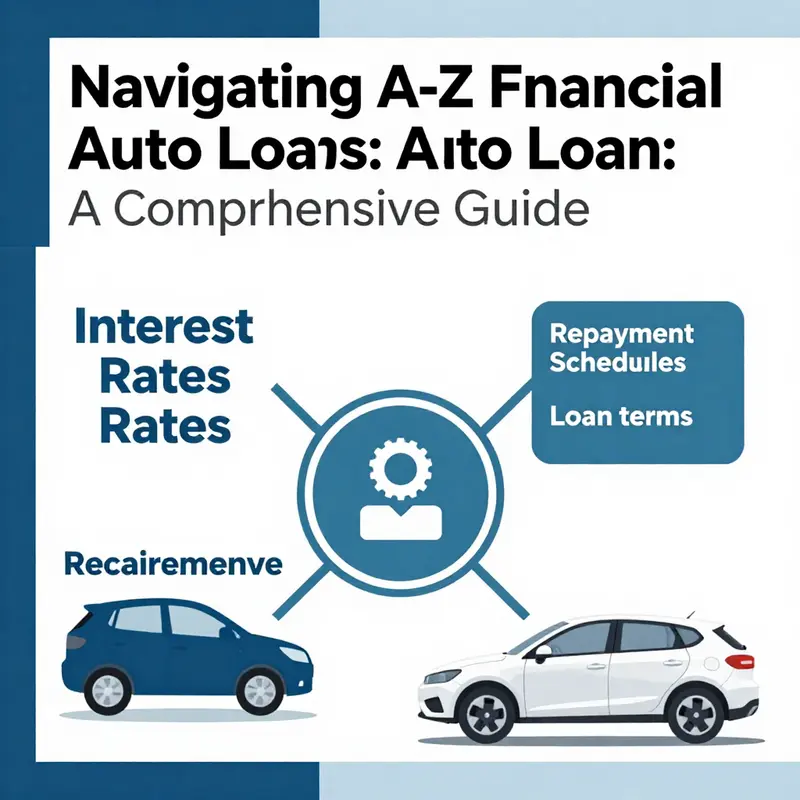
Buying a car is more than choosing a model and a color. An auto loan sits at the center of that decision, a structured agreement that translates desire into monthly commitment and, over time, into ownership. At its core, an auto loan is a secured loan. The vehicle you purchase serves as collateral, which means the lender has a legal claim to the car if payments stop. That security is what usually allows the lender to offer a lower interest rate than many unsecured loans, because the risk to the lender is reduced by the asset backing the loan. The implications of this security extend beyond the mechanics of repayment; they shape every decision you make, from the length of the loan to the size of your down payment and even the choice between a new or a used vehicle. The journey from application to payoff is a careful negotiation of prices, terms, and timing, guided by a single, often overlooked concept: amortization.
Amortization is the heartbeat of an auto loan. It is the process by which a fixed sum you pay each month is divided into interest on the outstanding balance and a reduction of the principal. In the earliest months, a larger slice of your payment covers interest. As you reduce the principal with each payment, the interest portion declines and more of your money goes toward shaving down the balance. This is not just a mathematical curiosity; it is the practical reason why your balance and payoff date behave the way they do. Consider a typical scenario: borrowing twenty-five thousand dollars over six years at a 10 percent annual percentage rate. The monthly obligation lands around four hundred sixty dollars. At first, nearly half of that payment might appear as interest, with a smaller amount chipping away at the principal. Over time, the balance shrinks, and the payment acts more aggressively to reduce what you owe. This shift is the essential logic of amortization: you are paying a debt that is gradually less costly to finance, even though the total amount paid over the term increases with a longer term or a higher rate.
The length of the loan term is a primary lever in shaping your monthly payment and, by extension, the total cost of financing. Shorter terms—say 36 months—carry higher monthly payments but fewer cumulative interest dollars. Longer terms—such as 72 months or more—lower the monthly burden but spread interest over a longer period, leading to a higher total interest expense. The trade-off is straightforward: affordability versus total cost. It is easy to be drawn to a low monthly stake, especially if cash flow is tight. Yet, the longer horizon can keep you financially tethered to a car that depreciates faster than your loan balance in the early years, a situation known as being upside down or underwater. These dynamics are a reminder that a loan is not just a debt instrument but a reflection of how you value present comfort against future obligation.
Several factors determine the particular numbers you face. The interest rate itself is a function of market conditions and your personal credit history. A higher credit score generally translates into a lower rate, because lenders see you as a lower risk. Your down payment matters as well. A larger down payment reduces the loan amount, which lowers both the monthly payment and the total interest paid. The vehicle type and age also play a role. New cars typically qualify for better financing terms than used cars, partly because new vehicles have a longer expected lifespan and more predictable depreciation. Conversely, a depreciating asset can raise risk for the lender, potentially resulting in higher rates or stricter terms. The loan amount interacts with the term; a larger loan over a longer period compounds the amount of interest you pay, amplifying the cost of ownership over the life of the loan.
In practice, the math behind an auto loan matters as much as the car you choose. If you borrow 25,000 dollars over 72 months at 10 percent APR, the monthly payment is around 463 dollars. The exact figure is sensitive to rounding and the precise day count used by the lender, but the principle stands: a longer term reduces the monthly outlay, and the total interest accrues over a longer duration. This is why a careful comparison across lenders matters. A lender might offer the same nominal rate but with different fees or a slightly different calculation method, which could tilt the true cost in subtle ways. Every term you sign charges you for the privilege of owning a vehicle now, and the full cost will become clearer only as you watch the amortization schedule unfold month after month.
The choice to put money down up front cannot be overstated. A larger down payment reduces the amount financed, which lowers each monthly payment and the total interest, sometimes significantly enough to shorten the term without changing the payment amount. It also creates an immediate equity cushion. In times of rapid depreciation, especially with new cars, that cushion can prevent the uncomfortable scenario of owing more than the car is worth in the early years of ownership. The equation becomes broader still when you consider taxes, fees, and any extended warranties or add-ons that lenders may wrap into the overall loan. While these elements do not change the interest rate by themselves, they extend the finance amount and can change the apparent affordability of the deal. The emphasis remains on the down payment as a strategic tool you control to shape both your monthly budget and your total cost of financing.
What about prepayment and penalties? Some lenders reserve the right to impose penalties if you pay off a loan early. The idea is straightforward: lenders earn interest over the term they agreed to, and an early payoff shortens that revenue window. A common example might involve a penalty if the loan is settled within a year or within the first 18 months, unless the original term was 18 months or less. The practical effect is that a borrower who plans to pay extra or retire the loan ahead of schedule should first verify whether any prepayment penalties apply and how they are calculated. In some cases, the penalty may be modest, while in others it could materially reduce the financial benefit of paying early. Understanding these terms is part of the due diligence that keeps a borrower from inadvertently incurring extra costs in pursuit of debt freedom.
Amortization schedules themselves are invaluable tools. They lay out exactly how much of each payment goes to interest and how much reduces the principal across the entire term. When you watch the schedule month by month, you see a quiet but powerful story: the balance declines, the interest portion dwindles, and the principal share grows. This visualization helps you understand how even small changes to your plan—such as adding 50 dollars to a monthly payment or applying a larger down payment—reshape the payoff timeline and the total interest paid. A modest extra payment can shave months or even years off a typical 60 or 72-month loan, resulting in hundreds or thousands of dollars in interest savings. The math rewards discipline, especially once the car has moved beyond the initial few years of ownership and depreciation stabilizes the value you hold in the asset.
For readers seeking a more interactive grasp of how these pieces fit together, the literature on auto loan mechanics often includes tools and examples that bring amortization to life. These resources illustrate how a fixed monthly commitment translates into a dynamic balance and how different choices—down payment size, loan term, and rate—alter the trajectory. The broader lesson—one that remains consistent regardless of the exact numbers—is that the loan you sign is a plan for a period of time during which the car remains your asset and your responsibility. Your job as a borrower is to understand the plan well enough to adjust it when circumstances change, rather than letting the plan dictate your finances without awareness.
In the wider landscape of personal finance, the auto loan sits at an intersection. It is both a consumer credit instrument and a tool for asset acquisition, with a direct and visible impact on cash flow, credit scores, and long-term financial flexibility. The mechanics—secured collateral, amortization, interest, term, and down payment—work together to determine not just the monthly payment, but the total price paid for the car over the life of the loan. It is a reminder that the true cost of ownership extends beyond sticker price or monthly payment; it is the sum of all payments, plus the quality of the decision-making that preceded them.
As you prepare to navigate the market, consider the language of the loan as you would the language of any contract. Look beyond the headline rate and examine the amortization schedule, the term you can responsibly manage, and the possibility of extra payments without penalties. Ask about down payment options and whether there are fees that could shift your effective rate. And remember that a car is a depreciating asset whose value changes with time. The loan should align with how you plan to use the vehicle and how long you intend to keep it. If you begin with a clear sense of your budget, your anticipated ownership horizon, and your willingness to adjust the plan as life changes, you will position yourself to make a loan that serves you rather than defines you.
To explore how these concepts translate into practical budgeting and decision making, consider consulting a knowledge resource that compiles core concepts and practical tools. knowledge offers a curated view of the fundamental ideas behind auto financing, including amortization concepts, the impact of down payments, and strategies for managing loan terms. While each lender operates within its own framework, the underlying mechanics of amortization and the trade-offs among payment size, term length, and total cost remain consistent across credible offerings. The ability to translate those mechanics into a personal plan is what turns a loan into a pathway to ownership rather than a source of ongoing financial strain.
For a broader, external perspective on auto loan mechanics that complements this chapter, a detailed, real-time exploration of amortization concepts can be found in an established consumer finance resource. This external resource walks through how each payment is allocated between interest and principal, how the balance evolves over time, and how different scenarios—such as larger down payments or shorter terms—alter the payoff curve. Access to such an example can deepen understanding of how your choices today influence your financial trajectory tomorrow: https://www.nerdwallet.com/article/loans/auto-loans/how-auto-loans-work
Chapter 2 Reframed: The A–Z of Auto Financing—Reading the Terms That Drive Your Car Purchase
A single decision shapes every car you buy: how you finance it. The A–Z of auto financing isn’t a random alphabet soup; it’s a practical map that reveals how lenders assess risk, price the loan, and shape your monthly obligations. When you read the terms aloud—from APR and fees to prepayment penalties and title status—you begin to see how each piece influences total cost, equity, and the freedom you have to negotiate. This chapter isn’t about chasing the lowest number in isolation. It’s about understanding the pressure points so you can compare offers with clarity and ask the right questions before you sign. In that spirit, let’s walk through the essential terms in a narrative that connects the mechanics of a loan to the everyday choices you’ll face when buying a vehicle, while keeping an eye on stability, predictability, and long-term value. If you want a primer to complement this discussion, you can explore a broader knowledge resource from the linked knowledge hub. Knowledge.
APR sits at the center of the auto loan conversation. The Annual Percentage Rate represents the total cost of borrowing, including interest and fees, expressed as a yearly rate. When lenders advertise a rate, you’re not just looking at interest; you’re looking at the all-in cost that allows you to compare offers fairly. A practical example helps: borrowing $25,000 over 72 months at 10.00% APR would yield a monthly payment of $463.15. That number includes interest payments and any standard fees rolled into the loan. Because APR embeds costs, it’s the most reliable compass for shopping, even when lenders present different fee structures or add-on products. The goal is a single figure that reflects what you’ll actually pay over the life of the loan, not just the sticker price.
The borrower shoulders primary responsibility for repayment, but the dynamics of who qualifies aren’t always one person. A borrower is the individual or entity applying for the loan and agreeing to repay it. Applications may involve a co-applicant who shares responsibility for the debt, which can improve approval chances or yield better terms when the co-signer’s stronger credit supports the application. The shift from single to joint borrowing matters because it expands the pool of income and credit history the lender can consider. Yet it also means both parties’ credit profiles ride on the same loan as long as obligations remain outstanding. The practical takeaway is straightforward: if you’re considering a co-signer or joint application, ensure all parties understand the long-term impact on credit scores and the shared accountability that comes with responsibility for repayment.
Collateral, in the auto loan arena, is a cornerstone, because the vehicle you purchase serves as security for the loan. A secured loan reduces risk for the lender, often translating into lower interest rates than unsecured equivalents. If you fall behind, the lender has the right to repossess the car—the collateral—so the lender can recover unpaid amounts. For the borrower, the trade-off is a cost of financing that typically improves with stronger credit and longer-standing employment. This secured relationship also influences underwriting. Lenders monitor the vehicle’s value relative to the loan amount, ensuring they don’t advance more than the car is worth. In many markets, this dynamic protects both sides, creating a balance between affordability and financial resilience.
Debt consolidation is a strategy some buyers consider, especially when low, stable payments across a single loan could simplify finances. An auto loan can, in theory, replace several higher-interest debts with one secured obligation. The appeal is clear: fewer accounts, more predictable payments, and a single interest rate. But consolidation isn’t free money. It transfers risk from unsecured to secured credit while tying a valuable asset to other obligations. If the new loan falls behind, the vehicle remains at risk, and the borrower could end up with less liquidity and equity than before. The prudent path is to weigh whether the new rate and term truly reduce total interest, allow for a sustainable budget, and preserve or improve overall financial health.
Eligibility criteria set the minimum bar for approval and vary by lender product. Most lenders evaluate credit history, income stability, employment status, and debt-to-income ratios, along with the loan-to-value ratio of the vehicle. The process is designed to identify whether you can responsibly repay while considering the asset’s risk. Veterans Affairs, banks, credit unions, and non-traditional lenders may apply distinctive criteria, so shopping across options is wise. Understanding these thresholds helps you set expectations and avoid applying to lenders whose standards are out of reach. In practice, a stable income, a reasonable DTI, and a vehicle with a sensible loan-to-value ratio work together to tilt the odds in your favor.
Finance charges are the dollars that accompany the APR to tell you the total cost of financing. While APR is the yearly rate, the finance charge is the precise dollar amount paid over the life of the loan, including interest and all fees. This distinction matters because two loans can display similar APRs yet differ in finance charges if their fees diverge. Reading both figures side by side helps you understand the actual burden of financing and identify opportunities to negotiate or declutter fees that inflate the total you’ll repay. In a world of quick quotes and digital offers, taking the time to separate interest from fees can save a surprising amount over the term of the loan.
A co-signer or guarantee can alter the arc of your application. A co-signer with strong credit can improve approval odds or secure more favorable terms, but they assume equal responsibility for repayment. If one party misses payments, the other’s credit score bears the impact. This dynamic can be beneficial when a borrower’s credit history is short or challenged, yet it introduces a serious obligation for the co-signer. Considerations include whether the co-signer can withstand the potential credit consequences of missed payments and how the arrangement affects long-term financial plans for all involved.
Hard inquiries occur when a lender pulls your credit report during the application process. Each inquiry can have a temporary impact on your score, though multiple inquiries within a short window are often treated as a single inquiry by many bureaus if they occur within a defined period, typically ranging from 14 to 45 days. The key takeaway is timing. If you’re shopping for financing, try to group your applications into a focused period to minimize credit score disruption while still allowing you to compare opportunities. Understanding this nuance helps you balance the need for competitive offers with the strategic management of your credit profile.
Interest rate is a central lever, influenced by creditworthiness, the loan term, and general market conditions. A borrower with strong credit typically secures lower rates, while a weaker or riskier profile faces higher costs. This relationship underscores the importance of building and maintaining good credit before applying for a loan, as even modest improvements in score can translate into meaningful savings over the life of the loan. The interest rate sits within the broader price tag of financing, interacting with term length and total debt to shape monthly payments and total outlay.
Joint applications broaden access to credit by combining incomes and histories, which can be helpful for couples or business partnerships purchasing a vehicle. Both applicants are evaluated, and both are legally liable for repayment. While this approach can unlock financing that would be unavailable to a single borrower, it also means both parties bear the consequences of any misstep in repayment, which can complicate personal finances if relationships shift or one party experiences a drop in income. The decision to pursue a joint application should align with overall financial planning and mutual understanding of risk and responsibility.
A repayment term defines how long you have to repay the loan. Common terms span from 24 to 84 months. Longer terms reduce monthly payments but increase the total interest paid over the life of the loan. The choice of term is not merely a convenience; it is a strategic decision about affordability, equity, and risk of negative equity—owing more than the car is worth at certain points in the loan’s life. The best approach is to balance monthly cash flow with the goal of maintaining adequate equity as the vehicle ages and mileage accrues.
The concept of a secured loan reflects the repeatable pattern in auto financing: the asset itself guarantees the loan. The vehicle’s title acts as collateral, and the lender holds the lien until full repayment. This structure lowers risk for lenders and tends to yield more favorable terms for borrowers, particularly those with moderate or average credit profiles. Once the loan is fully paid, the lien is released, and the borrower gains full, unequivocal ownership of the title. The security framework thus reinforces a clear sequence: purchase, finance, monitor, repay, and finally own.
An unsecured auto loan, though rare, would not rely on the vehicle as collateral. When lenders extend unsecured financing, they typically demand higher interest rates and impose stricter qualification standards. The absence of collateral increases risk for the lender, and borrowers should expect a premium for that flexibility. In practice, if your goal is to minimize outlay, the secured path remains the preferred route, provided you’re comfortable with the asset-backed structure and the consequences of default.
Vehicle information becomes the factual backbone of the application. Details such as make, model, year, mileage, and overall condition are essential inputs. For used vehicles, a VIN check and a vehicle history report are common to verify title status and depreciation risk. Lenders want confidence that the asset value aligns with the loan amount and that there are no hidden claims, flood history, or odometer inconsistencies that could complicate recovery in a default scenario. This diligence protects both sides and informs the underwriting decision with tangible asset data.
The workflow of a loan—from submission to final approval—has become increasingly digital. Borrowers upload documents, sign disclosures, and compare offers through online portals. This streamlined workflow enables faster decisions and clearer disclosures, but it also reinforces the importance of careful reading. Each offer may come with its own nuance in terms of fees, prepayment terms, or early payoff conditions, and a digital process does not replace the need for careful review.
To the untrained eye, the set of terms can feel like an esoteric lexicon. Yet the X factor sits behind the curtain: a borrower’s unique circumstances—irregular income, recent job changes, or unusual credit patterns—that underwriting teams weigh alongside standard metrics. These idiosyncrasies can tilt decisions even when traditional criteria seem solid. The language here is not a riddle but a reminder that underwriting is both art and data science, blending quantitative scores with qualitative assessments to gauge risk.
Macro conditions also shape auto loan pricing. The yield curve, a line that tracks interest rates across different maturities, informs lenders about the cost of capital over the term of a loan. When the yield curve rises, APRs tend to drift higher, nudging monthly payments upward across many loan terms. While borrowers seldom control macroeconomic tides, awareness of these forces can help you time purchases or align expectations with prevailing rates, rather than chasing a fleeting quote.
Finally, the option of zero down payment lurks as an extreme end of the spectrum. Some lenders advertise no-down-payment options, but these often come with steeper interest charges or a higher risk of negative equity. Zero down can make sense in tight budget periods, provided you’re prepared for higher monthly payments later, or for a longer path to full ownership. It’s essential to consider the broader picture: the car’s depreciation trajectory, insurance costs, maintenance, and the opportunity cost of tying up cash in a down payment that could be used elsewhere.
The journey through A to Z is not a simple memorization exercise but a deliberate approach to financing that respects the asset, respects your budget, and honors the commitments you’ll make to repay. The chapters ahead will continue to build on these ideas, connecting them to practical steps—how to prepare, how to compare offers effectively, and how to use pre-approval and offers as negotiation leverage. In practice, you’ll begin by evaluating your eligibility, gathering the necessary documents, and running through a few loan scenarios to see how changes in APR, term, and down payment alter the monthly obligation and the total cost. You’ll also learn to monitor the impact of the loan on your credit profile, especially if you anticipate other major purchases or credit needs in the near future.
As you move from theory to practice, keep in mind that the goal isn’t simply to minimize the monthly payment. It is to optimize total cost, preserve equity, and maintain financial flexibility. If you plan to trade in or sell the vehicle before the loan ends, monitor how depreciation interacts with your loan balance. If you expect to stay with the vehicle for its full term, focus on securing terms that minimize the total finance charge and prevent surprises, such as prepayment penalties that erode the benefits of paying early.
For readers who want to dive deeper into the landscape of auto financing and the terms that continually surface in offers and disclosures, the knowledge resource linked earlier provides a broader context and practical examples. It can serve as a companion reference as you prepare to compare offers, negotiate with lenders, and map a financing strategy that aligns with your broader financial goals. And as you navigate the field, remember that the right loan structure supports not just the purchase but the ongoing responsibility of ownership—fuel, maintenance, insurance, and the long arc of repayment that shapes your financial health for years to come. External resources can further illuminate these concepts, including authoritative automotive financing guides and consumer protection guidance, which you may consult as you refine your choices and confirm terms before you sign.
External resource for further context: https://www.bankofamerica.com/auto-loans/
Collateral and Confidence: Navigating Secured and Unsecured A-Z Financial Auto Loan Options
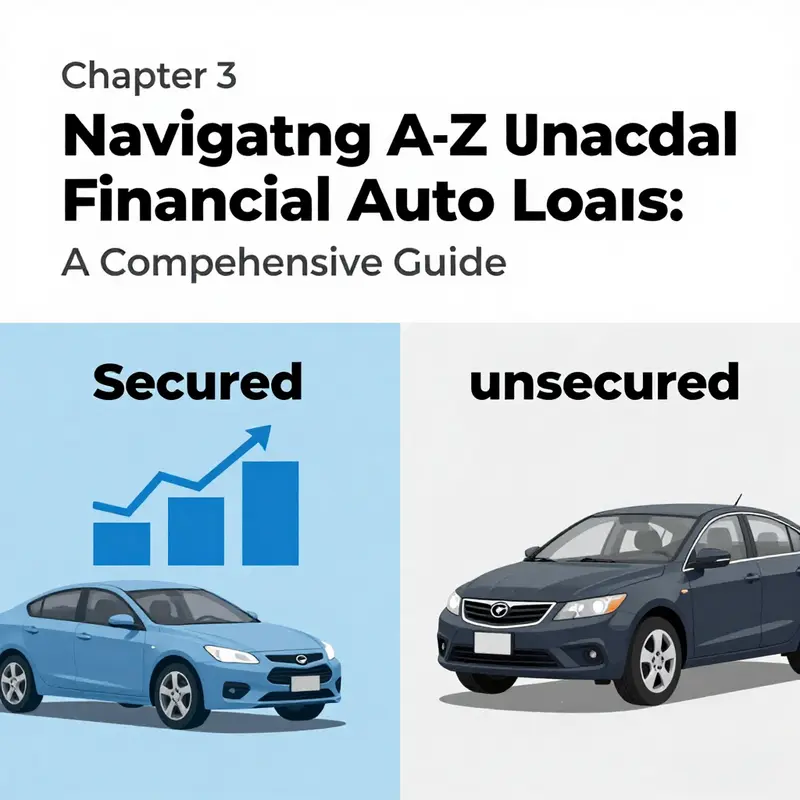
When you set out to finance a vehicle, you are choosing not just a car but a financing structure that shapes how much you pay, how easily you can qualify, and what happens if life throws a curveball. In the realm of auto lending, the two broad categories you will encounter are secured and unsecured loans. The distinction is more than academic. It determines interest rates, loan terms, monthly payments, and the level of risk you carry as the borrower. As part of the larger topic of A-Z financial auto loans, understanding these options helps you chart a course that matches your credit profile, your budget, and your long-term financial goals. A secured auto loan uses the car itself as collateral, giving the lender a lien on the title until you finish paying. An unsecured auto loan, by contrast, relies on your creditworthiness and income rather than any asset backing the loan. The difference sounds simple, but the implications ripple through every payment, every line of the contract, and every decision you make about the vehicle you intend to buy.
Consider the mechanics of a secured auto loan first. Because the lender has a legal claim on the vehicle, the risk to the lender is reduced. This reduced risk typically translates into more favorable terms for you. In practical terms, secured loans often carry lower interest rates. The rate is not a given, but the collateral acts as a cushion that makes lenders comfortable with a broader spectrum of credit profiles. If your credit history shows some blemishes or gaps, a secured loan can still be within reach because the collateral lowers the lender’s exposure. This is especially helpful for borrowers who are purchasing a car with a price tag that sits at the upper end of their comfort zone. The lien on the title serves as the safety valve that keeps the lender engaged through a longer repayment horizon. Flexible payment options may be more common with secured loans because the lender’s risk is mitigated by the asset pledged as collateral. In a real-world scenario, a consumer might secure a loan for a modest down payment, lock in a comfortable monthly figure, and still enjoy a term that stretches to six years or more. A representative example from typical market terms shows how the math plays out: borrowing $25,000 over 72 months at a 10.00% APR would result in a monthly payment of approximately $463.15. That figure is not a universal rule, but it demonstrates how rate, term, and loan amount interplay to shape cash flow. When you prioritize stability and predictability, secured financing often feels like the safer harbor, particularly if your credit history has minor imperfections. The vehicle serves as collateral that protects the lender while enabling you to secure a competitive rate and manageable payments.
Unsecured auto loans tell a different story. Without collateral, lenders rely solely on your credit score, your income, and your overall financial picture to decide whether to extend credit. This makes unsecured loans more sensitive to changes in your financial standing and market conditions. For the borrower, the upside is a reduction in the risk to the vehicle itself. You can decide to walk away from a financing arrangement if the terms become unfavorable, because there is no lien tying the car to a debt obligation. Yet the absence of collateral comes at a price. Lenders view unsecured loans as riskier, and they reflect that risk in higher interest rates. Qualification criteria are typically stricter, and lenders may demand higher credit scores, steadier income, and a cleaner debt-to-income ratio. In some markets unsecured auto loans also come with additional fees or stricter prepayment terms. The practical upshot is that while an unsecured loan can offer speed and flexibility for borrowers with strong credit, it can also be more expensive over the life of the loan if your rate rises in response to risk factors. The trade-off is clear: no collateral means more risk for the lender and, correspondingly, higher costs for the borrower. For many high-credit-score borrowers, unsecured financing may be a convenient path to financing that does not expose the car to risk, but it often comes with a premium that reflects the risk premium attached to the debt.
The decision between secured and unsecured is rarely only about the label. It hinges on your credit history, your confidence in your future financial standing, and your tolerance for risk. If you have a solid credit score and you want to preserve the option to sell or trade the car without encumbering assets, an unsecured loan can be appealing. You may also appreciate the possibility of faster approval and less friction at the dealership, since the collateral is not the focal point of the lender’s decision. On the other hand, if your credit is less than stellar or if you want to maximize your chances of securing a lower rate, a secured loan can be the smarter route. Collateral lowers lender risk and, in turn, typically lowers the interest rate, which directly reduces the total cost of financing. In practical terms, secured loans are often the default choice for many buyers who value long payment horizons, favorable terms, and a diminished risk of debt service becoming unmanageable.
The financing landscape for auto purchases is not limited to whether the loan is secured or unsecured. It also includes how the funding is obtained. Direct financing from a bank or credit union is one path, while dealer-arranged financing is another. Each route offers distinct benefits. Bank or credit union financing can provide transparency and a clear budgeting framework, with terms negotiated before you step onto the lot. Dealer financing, conversely, can offer convenience, potential promotions, and the ability to bundle the loan with the vehicle purchase in one place. The collateral aspect in secured loans interacts with both channels. For secured deals, the lien remains on the vehicle regardless of whether the loan originates from the bank or the dealer. The choice of channel often comes down to a balance between price, speed, and the experiential convenience of closing the deal in a single sitting. It is essential to read the fine print: some secured loans may come with flexible repayment schedules, several payoff options, and specific prepayment terms. You may encounter prepayment penalties that apply if you close the loan early, especially within the first 18 months. For example, a $150 penalty fee could be assessed unless the original loan term was 18 months or less. Understanding such conditions prevents unpleasant surprises and helps you plan a payoff strategy that aligns with your financial trajectory.
In the broader framework of A-Z Financial Auto Loan options, the distinctions between secured and unsecured extend into the details of the contract. The lien in a secured loan is not merely a technicality; it is the legal mechanism safeguarding the lender’s interest and shaping the entire risk-reward calculus for both parties. The presence of collateral interacts with your credit profile in ways that can influence not only the rate but also the length of the term you can realistically secure. For borrowers in the middle of the credit spectrum, the secured option often unlocks a pathway to affordability that might be denied with an unsecured loan. Conversely, borrowers with excellent credit may discover that unsecured loans offer the speed and simplicity they desire, along with terms that reflect their strong financial position. In every case, the economics of the loan—monthly payments, total interest, and total cost—will respond to the combination of loan amount, term, and rate. Those three variables are the engine of auto financing, and understanding how they interact helps you avoid overpayment and keeps you aligned with your long-term goals.
Beyond the numbers, the decision about secured versus unsecured touches on your personal risk tolerance. A secured loan commits you to the vehicle and the debt, but it can be a more forgiving option if your income fluctuates or if you anticipate a future improvement in credit. If you valued peace of mind over the possibility of lower payments, you might be drawn to the predictability of a secured loan with its typically lower rate and longer term. An unsecured loan, while potentially more expensive, offers the freedom to walk away from a debt that no longer serves your needs, provided that the terms allow such flexibility. Either path remains a viable avenue under the umbrella of a well-reasoned financial plan. The critical step is to compare offers with discipline: scrutinize the annual percentage rate, the loan term, the required down payment, any fees, and the exact nature of penalties for early payoff. In doing so, you can build a financing arrangement that does not just fit your budget this month but travels alongside your broader financial strategy.
As you evaluate offers, the concept of loan-to-value comes into play. This ratio compares the loan amount to the appraised value of the vehicle. With secured loans, a low loan-to-value ratio often translates into more favorable terms and stronger negotiating leverage at the dealership. For unsecured loans, the lack of collateral means that the pricing is anchored almost exclusively to your credit score and income stability, which can make the ratio concept less relevant but the risk more acute if your financial situation worsens. A practical approach is to set a target monthly payment you can afford and then work backward to the amount you will borrow, the rate you can secure, and the term that makes sense. Don’t forget the cost of ownership beyond the loan payment. Insurance, maintenance, fuel, and potential depreciation should be weighed alongside the financing charges to understand the true affordability of the car you choose.
To anchor these concepts in guidance, it helps to tap into reliable information resources that explain how borrowing works, how interest is calculated, and what responsible borrowing looks like. For foundational concepts and updates on loan types and responsible borrowing strategies, you can explore the knowledge page for broader context and definitions knowledge page. In practice, this chapter is part of a larger narrative about A-Z financial auto loans, where secured and unsecured options form essential chapters that connect to the broader landscape of financing vehicles across market conditions, borrower profiles, and policy environments. The Bank of Canada’s consumer information page provides additional context about borrowing practices, loan calculations, and consumer rights as you compare offers across lenders and channels. For readers seeking deeper institutional guidance, this external resource can complement the practical insights discussed here. Bank of Canada consumer information page: https://www.bankofcanada.ca/consumer-information/.
In the end, the decision between secured and unsecured auto financing hinges on clarity, discipline, and a clear-eyed assessment of your current and projected financial health. Both options are legitimate routes to getting behind the wheel, and neither choice should be made in a vacuum. By understanding how collateral affects rates, how prepayment penalties can reshape payoff timing, and how the loan structure interacts with your overall budget, you position yourself to minimize costs and maximize value. Your credit story matters, but so does your plan for repayment. A well-chosen loan aligns the loan term with your horizon, your payoff strategy with your cash flow, and your risk tolerance with the realities of life after purchase. When you treat the process as a structured decision rather than a race to close the deal, you turn a financial obligation into a strategic tool that serves your longer-term goals rather than a short-term convenience. This approach embodies the spirit of A-Z financial auto lending: a comprehensive, thoughtful path through the maze of loan types, terms, and protections to help you drive with confidence and control.
Chapter 4: Weighing Costs and Shaping Repayment in Auto Financing
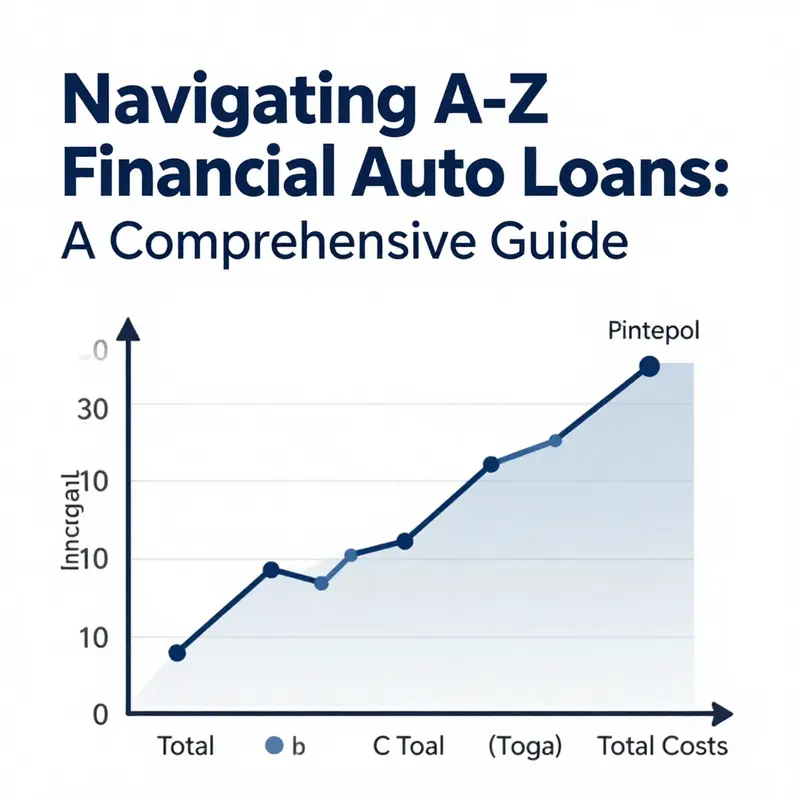
Costs and repayment are the heartbeat of any auto loan decision. They are not abstract numbers tucked away in a terms document; they are the daily realities that shape a household budget, influence long-term financial health, and determine whether a new set of wheels remains a practical tool or becomes a source of stress. When you approach an auto loan with a clear eye for cost, you move from reactive shopping on monthly payments to proactive planning that aligns loan terms with your income, your goals, and your tolerance for risk. The core idea is simple but powerful: the rate you see at signing is only part of the story. The total cost of borrowing is a composition of principal, interest, fees, and the pace at which you repay. Understanding that composition helps you compare offers across lenders and avoid the traps that can silently inflate the price of financing a vehicle.
At the center of the cost calculation is the principal—the price of the car, minus any down payment or trade-in credits you apply. But the principal is only the anchor. The interest you pay over the life of the loan is what turns a modest, manageable debt into a long-term obligation. The annual percentage rate, or APR, is the tool that reveals the true cost of borrowing by combining the interest rate with any fees charged by the lender. APR is the single number that lets you compare loans on a like-for-like basis, even when the contracts differ in structure or in the way they itemize costs. A lower APR generally means lower overall costs, but the relationship is nuanced. The APR may be lower because the lender includes smaller upfront fees, or because the loan has a shorter term. Conversely, a very low-interest rate offer can be offset by higher origination fees or a longer repayment period that piles more interest onto the balance over time.
To visualize how these pieces fit together, consider a common scenario: borrowing twenty-five thousand dollars over six years (72 months) at an APR of 10 percent. The math becomes tangible in the form of a monthly payment around four hundred sixty-three dollars. This figure is only part of the story. If you look at the total amount paid over the life of the loan, that payment multiplies by the number of months, producing a total far greater than the car’s sticker price. The more months you stretch the loan, the smaller the monthly bite, but the more interest you accumulate overall. Shorter terms tend to keep total interest lower, but they demand a higher monthly commitment. This tradeoff is the recurring tension in auto financing: monthly affordability versus long-term cost.
Every loan also carries fees beyond the interest and principal. Origination fees, processing charges, documentation fees, and sometimes optional add-ons contribute to the price of financing. Some lenders itemize these fees transparently, while others fold them into the APR or scatter them across the payment schedule in less obvious ways. Because APR is designed to reflect both the rate and these fees, it becomes the most meaningful single metric for comparison. When you review loan offers, look beyond the monthly payment and ask the lender to break down the components. What is the base rate, what are the origination costs, and how do they affect the APR? A higher-fee loan can masquerade as a favorable deal if the monthly payment is smaller, but the total cost over the life of the loan may be significantly higher.
Credit history remains a guiding force behind those APR differences. Borrowers with a solid credit profile typically access lower APRs, which translates into lower total interest paid across the life of the loan. A stronger credit score signals to lenders that the borrower is a reliable risk, and that confidence is rewarded with more favorable terms. The contrast can be striking: a borrower with excellent credit might secure a rate several percentage points lower than someone with fair or poor credit, yielding thousands of dollars in savings over the term of the loan. That gap isn’t incidental; it reflects the risk assessment that underpins every loan pricing model. Understanding this can be a powerful incentive to pay down debt, stabilize income, or avoid taking on new obligations while you’re in the process of applying for financing.
When we talk about repayment, the structure of the schedule matters nearly as much as the interest rate. Most auto loans are locked into fixed monthly payments over a set term, whether that term is 36, 48, 60, or 72 months. A fixed schedule brings predictability, which is essential for budgeting, especially for households balancing multiple financial responsibilities. As you plan, you want to ensure the monthly payment fits comfortably within your available cash flow after essential expenses. It’s not just about covering the loan; it’s about leaving room for maintenance, insurance, fuel, and unexpected costs that always arrive. A well-aligned repayment plan protects you from late fees, default risk, and potential repossession, while also preserving your ability to save and invest for the future.
Online loan portals have become more than a convenience; they’re a practical way to manage repayment with precision. They enable you to monitor payment history, review upcoming due dates, and even recalculate payoff dates if you adjust the term or make extra payments. The ability to simulate scenarios—such as paying an extra one hundred dollars a month or making a lump-sum payment to shorten the loan—can reveal meaningful savings in interest and reduce the time you carry debt. Yet, these tools also require discipline. Extra payments should be applied toward the principal, not simply allocated to the regular payment, to maximize their impact on the total cost.
One aspect of repayment that deserves careful attention is the possibility of prepayment penalties. Some lenders impose a fee if you pay off the loan early, typically within a defined window at the start of the term. For example, a loan paid off within the first eighteen months might incur a penalty as much as one hundred fifty dollars, unless the original term was already eighteen months or less. While prepayment penalties are not universal, they do exist in some financing contracts, and understanding whether such penalties apply can influence your strategy. If you anticipate the ability to accelerate payments—whether through a raise, a bonus, or a redirected monthly budget—it’s worth confirming whether early payoff would carry any cost.
A fundamental principle emerges from weighing all these factors: the most affordable loan is not always the one with the smallest monthly payment. A glance at the monthly figure can be misleading if it neglects the total amount paid over the life of the loan. A compact monthly payment may come with a longer term and a higher cumulative interest bill, eroding the short-term relief with a more expensive finish line. Conversely, a slightly higher monthly payment that reduces the term by a few years can dramatically cut the total interest paid, delivering true financial relief in the long run.
To navigate this landscape with clarity, you should approach every loan offer with a simple, disciplined framework. Start with the principal and the APR. If the APR is a more complex mix of rate and fees, ask the lender to present a clean comparison of two offers with identical principal amounts and comparable terms. Then scrutinize the term length. A six-year loan is common, but a shorter term can prevent years of additional interest charges, while a longer term will ease the monthly burden at the price of more interest. Next, examine the fees. Are there origination or processing charges? Are any of these fees waived if you accept a specific payment method or auto-debit option? In some cases, negotiating waivers or reductions in fees can tilt the calculation in your favor.
Of course, your own financial picture—the stability of your income, the amount you can comfortably set aside each month, and your long-term goals—should steer your decisions. If your objective is to minimize debt quickly and preserve long-run flexibility, a shorter term with a modest down payment and a prudent purchase price makes sense. If you must stretch for affordability due to other obligations, a careful plan to manage the higher total interest might be acceptable, provided you keep a close eye on creeping fees and the terms of prepayment. In every case, aligning the loan choice with a realistic budget is essential. It is not enough to assess a single month’s affordability; you must simulate a horizon that spans several years to understand the full impact of the financing decision.
For readers who want a deeper foundation on the mechanics behind auto loan costs and repayment, a compact primer is often helpful. It can demystify how lenders price risk, why APR matters in practice, and how to read the finer points hidden in the contract. If you’re seeking a structured resource to sharpen this understanding, consider exploring the knowledge hub of a credible financial education site. It offers practical explanations, calculators, and scenario analyses that complement the experience of negotiating with a lender. knowledge hub
As you integrate these ideas into your planning, keep in mind that the goal is not to chase the lowest monthly payment, but to secure a financing arrangement that fits your overall financial plan. A lower monthly cost today can translate into a higher cost tomorrow if it comes with an extended term or hefty fees. On the other hand, accepting a slightly higher monthly obligation today can yield significant long-term gains in the form of lower total interest and a shorter period of debt. Your choices should reflect not only the numbers on a page but also your life priorities: job security, retirement timelines, education expenses, and the flexibility to adapt if circumstances change.
In practice, the art of evaluating auto loan costs and repayment rests on disciplined comparison, transparent dialogue with lenders, and a willingness to pause and run the numbers before committing. It’s a process that rewards patience and precision. And though the process can seem daunting, the payoff is straightforward: you end up with a vehicle you need and a financing plan you can sustain, with a clear path to debt reduction and financial resilience. The clarity that comes from understanding APR, term length, and fees is not merely a technical triumph; it is a practical tool for preserving financial balance in a world where every dollar has competing demands.
External reference: https://www.consumerfinance.gov/owning-a-home/understanding-auto-loans/
Final thoughts
Understanding A-Z Financial Auto Loans is essential for making informed decisions, whether you are an individual car buyer, a dealership, or a small business fleet manager. From grasping the mechanics behind the loans, familiarizing yourself with key terms, exploring your options between secured and unsecured loans, to evaluating the long-term costs and repayment strategies, each aspect helps in crafting a financial plan that meets your needs. With this comprehensive guide, navigate your path towards successful auto financing with confidence.