

Finance charges on auto loans play a crucial role in determining the total cost of vehicle ownership, making it essential for both individual car buyers and businesses. The nuances of these charges go beyond mere interest – they encompass various fees and depend heavily on the borrower’s credit profile. This article unpacks these charges through four key chapters, addressing the basic concepts, the critical components that contribute to the overall costs, the significant influence of credit scores, and the legal requirements ensuring transparency in the lending process. As you navigate the world of auto loans, understanding finance charges will empower you to make informed decisions that align with your financial goals.
Beyond the Sticker Price: Decoding Auto Loan Finance Charges for Real Cost Clarity

When you buy a car with borrowed money, the price you see on the window sticker is only part of the story. The true cost of financing is measured by the finance charges—everything you pay to borrow money for the vehicle, not just the amount you borrow. A finance charge includes the core price of borrowing through interest, but it also encompasses a handful of fees that lenders may attach to the loan. Understanding what counts as a finance charge—and how those charges are calculated—gives you a clearer view of the total cost of ownership and a better footing when you compare offers from different lenders. It is the difference between the monthly payment and the overall price you will ultimately pay that separates a affordable loan from a costly one, and that distinction rests on your ability to read the small print, the disclosures, and the way the numbers are bundled together under an umbrella called the annual percentage rate, or APR.
At its core, a finance charge on an auto loan is the cost of using someone else’s money to buy a vehicle. The largest and most familiar piece is interest—the price lenders charge for the privilege of lending. Interest is typically expressed as a percentage of the loan principal, quoted as an annual rate. When you translate that annual rate into something you can use month to month, it becomes the interest that accrues as a debt balance sits on your dashboard each month. The exact amount of interest you pay depends on several factors: the size of the loan, the term of the loan, and your credit profile. A borrower with a strong credit history generally qualifies for lower rates, which reduces the finance charges over the term of the loan. Conversely, a borrower with weaker credit faces higher rates, and that higher rate compounds into a larger finance charge over time.
But interest is not the only component. Some lenders attach origination fees to cover the cost of processing the loan—the initial step of underwriting and setting up the financing. Processing fees, document preparation, and other administrative charges can appear as separate line items on the loan agreement or be rolled into the loan without always being obvious at first glance. Insurance-related costs can also factor in as part of the financing package. For example, some auto loans require an insurance premium that protects the lender if the borrower cannot maintain payments, or a gap insurance premium that covers the difference between the car’s value and the remaining loan balance in case of a total loss. In some cases, a lender may also advance interest to you before the disbursement of the loan, a practice known as pre-paid interest, which appears as part of the up-front finance charges. Taken all together, these items form the total finance charge that determines how much the loan will really cost beyond the sticker price.
The practical consequence of this is straightforward: two loans with the same principal and the same interest rate can carry different total costs if one includes more fees. A loan that carries a high origination fee and a paperwork charge, even if the announced interest rate is the same as a lower-fee loan, will result in a larger finance charge and a higher overall repayment. To investors and consumers alike this is not a trivial distinction. For a borrower, these charges affect decisions about whether to buy now or later, whether to lease a vehicle instead of financing, or whether a higher price tag could be justified by better terms in other areas of the deal, such as a larger down payment or a lower interest rate from a lender with more favorable underwriting criteria.
The total cost of the loan, the sum of principal and finance charges over the term, is what you pay back in the end. A classic illustration helps ground the concept: if you borrow $30,000 for a five-year loan at a nominal 5% annual rate, the interest alone over the life of the loan will amount to roughly $3,900. That assumes the rate stays constant and you make every payment on time. When you add in origination fees, processing charges, and any mandatory insurance premiums or other fees, the total finance charge climbs higher, and your overall repayment can approach or exceed $33,900. The exact numbers depend on the precise mix of fees and the payment schedule, but the underlying truth remains: the finance charge is the key to understanding how much borrowing really costs—beyond the price tag on the car itself.
A central reason for emphasizing finance charges is transparency. The Truth in Lending Act (TILA) requires lenders to disclose the finance charge and the annual percentage rate clearly before you sign any loan agreement. The APR is particularly important because it consolidates the cost of credit into a single percentage that reflects the total cost of borrowing on a yearly basis, including interest and the most significant fees that are paid over the life of the loan. The idea is to make it easier to compare offers. If one lender quotes a lower APR than another, you can reasonably expect the loan to be cheaper over time, all else equal. But the terms still matter, and there are pitfalls to watch for. Some loans advertise a low interest rate while charging higher origination fees or including expensive add-ons that aren’t necessary for your situation. In those cases, the lower rate can be illusory if the additional charges push up the true cost of credit.
The typical structure of an auto loan includes a mix of fixed components and variable elements. Interest rates are variable in the sense that they respond to the borrower’s credit profile and broader market conditions. A borrower with near-pristine credit stands with a better probability of landing a rate in the low single digits, while someone with a limited or troubled credit history may see rates that are materially higher. The difference matters. Since the interest portion compounds over the term of the loan, even a few percentage points in the rate translates into a noticeable difference in total interest paid. That is why a lower rate can translate into substantial savings over time, even if the monthly payments appear similar at first glance.
But the other fees can also influence the total cost in less obvious ways. Origination fees, once thought of as a mere administrative cost, may be negotiable in some cases. A lender might offer to waive a portion of those fees or to roll them into the loan balance, which in effect increases your principal and the total interest you will owe. The choice to roll fees into the loan can lower your upfront burden, but it raises the principal, lengthens the repayment period, and increases the total finance charges. Similarly, some lenders impose a documentation fee or a processing fee that, while seemingly small, accumulates across a multi-year loan. When you’re comparing offers, these charges deserve careful attention because they can subtly tilt the balance in favor of one lender over another, even when the headline APR looks competitive.
The presence of insurance premiums within the finance charges adds another layer of complexity. Lenders may require certain types of insurance as a condition of the loan, including gap insurance that covers the difference between your car’s market value and the amount you still owe if the vehicle is totaled, or credit life and credit disability insurance. While these products can provide valuable protection in some circumstances, they also add to the annualized cost of credit and should be evaluated for necessity and cost. If you already have comprehensive coverage or prefer alternative protection, you may have room to negotiate these charges or decline optional coverages that do not serve your financial goals. The decision to include or exclude such protections should be weighed with the same diligence you apply to interest rates and origination fees.
A practical takeaway from this is that the APR does not always capture every possible expense associated with a loan. There can be non-finance-cost-related items embedded in the contract that affect the total cost, such as extended warranties or maintenance plans that the dealer or lender markets as supplements to the loan. Even though these items can provide value, they should be evaluated on their own terms and not merely folded into the financing. Read the contract carefully, ask explicit questions about every line item, and request a detailed disclosure template that shows the exact components of the finance charge. In this way you can determine whether a loan offer is truly competitive or if it merely appears so because particular items have been presented in a way that obscures their impact on the total cost.
To bring these ideas together into a practical frame of reference, consider the dynamic between loan term length and total cost. A longer repayment period reduces your monthly payments, which can feel attractive if you are balancing monthly budget pressures. However, extending the term also increases the time during which interest accrues, and it can magnify the impact of fees attached to the loan. A five-year term might be cheaper in total cost than a seven-year term, even if the monthly price difference is modest. The inverse can also be true: a longer term can be more expensive overall but be the more affordable choice if your current income makes a higher monthly payment unsustainable. The right choice depends on your broader financial picture, including your other debt obligations, future earning potential, and risk tolerance.
This is where the Truth in Lending Act’s emphasis on clear disclosure becomes a practical tool. When you sit down with loan estimates, you should be able to see not only the stated interest rate but also the total estimated amount you will pay in finance charges over the life of the loan. Lenders must present these figures in a way that invites apples-to-apples comparison with other offers. Your job as a responsible borrower is to scrutinize those numbers, not just the monthly payment or the car’s sticker price. It’s worth asking for a loan estimate that breaks down every fee and to request that the fees be shown separately from the interest so you can see how much of the cost comes from the rate and how much from the associated charges. Where possible, seek clarity on whether any fees are negotiable and whether you can choose to finance some but not all fees.
In navigating this landscape, a strategy emerges that can keep your total cost under control without sacrificing the vehicle you need. Start with the rate first, because the rate is the engine of the finance charge. Compare offers from multiple lenders to see how different credit criteria and underwriting policies affect the APR. Then examine the fee structure itself. If one lender charges a higher rate but waives a hefty origination fee, the overall cost can end up being competitive with a lender who offers a lower rate but tacks on several nonessential fees. If possible, negotiate the fees or choose to finance only what is necessary. If you have a solid down payment, you may be able to reduce or offset some of the origination or processing costs by contributing more toward the price of the car, which lowers the loan amount and, in turn, reduces the interest component.
The broader lesson is straightforward: finance charges tell you what borrowing really costs. The car’s price sets the baseline, but the cost of credit, as reflected in the APR and the accompanying fees, determines how affordable that car will be over time. A well-informed borrower who understands that APR is a combined measure of interest and fees is better equipped to compare offers, to negotiate effectively, and to choose a loan that aligns with their long-term financial goals. It isn’t only about choosing the lowest rate; it’s about choosing the best combination of rate, fees, and term to minimize the total amount paid while preserving flexibility in the months and years ahead.
For readers seeking a practical touchstone, remember that consumer guidance resources exist to illuminate these choices. The internal knowledge base shelters a broad range of explanations and scenarios that can help you reason through your options with greater confidence. You can explore that resource to deepen your understanding of how charges are applied in practice and how to evaluate real-world loan offers. Davis Financial Advisors knowledge base.
As you move from theory to application, keep in mind the core principle: read the contract, verify the disclosures, and compare the full cost of credit—not just the monthly payment or the advertised rate. The goal is to identify the loan structure that yields the lowest total cost over the life of the loan while still fitting your budget and financial plans. When you feel uncertain, take a step back and re-express the numbers in terms of the total amount you will repay. If the sum feels manageable and aligned with your financial goals, you’re likely on the right track. If not, use that insight to renegotiate terms, adjust the loan amount, or adjust the down payment to improve the overall economics of the purchase.
External resources can offer further clarity when you want to corroborate the framework described here. For official consumer guidance on auto loan disclosures and protections, you can consult the Federal Trade Commission’s information on auto loans: https://www.consumer.ftc.gov/articles/0248-auto-loans. This external reference reinforces the importance of transparent disclosures and underscores the practical steps you can take to compare offers confidently, even when dealers or lenders present complex fee structures.
Beyond the Sticker Price: Unpacking the Hidden Real Cost of Auto Loan Finance Charges
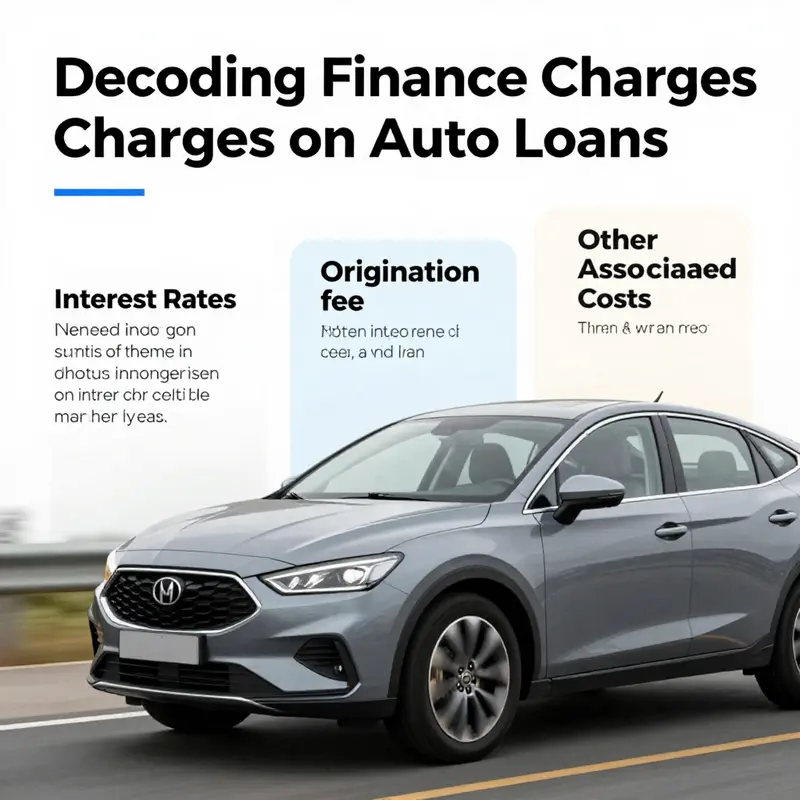
Purchasing a vehicle is rarely only about the car’s price tag. From the showroom to the financing desk, the money you end up paying over the life of the loan is shaped by a collection of charges that together constitute the finance charge. This chapter invites readers to move beyond the sticker price and into the total cost of borrowing, a figure that can dramatically alter the long-term affordability of a vehicle. Finance charges are the lender’s compensation for providing credit, and they come in more forms than many borrowers expect. At their core, the charges are composed of two broad elements: the interest that accrues over the term of the loan, and a set of fees that may be rolled into the loan or paid up front. Understanding how these pieces fit together is essential for evaluating offers, negotiating effectively, and making a borrowing decision that aligns with one’s broader financial goals.
Interest is the dominant component of most auto loan finance charges. It is the price you pay for using someone else’s money, and it is expressed as an annual percentage rate, or APR. The APR is not a single number but a synthesis that includes the stated interest rate and, in many cases, the effect of anyFees or points financed into the loan. The rate you qualify for is not universal; it shifts with your credit history, the length of the loan, and prevailing market conditions. Your credit score acts as a quick shorthand for risk: a borrower with a strong credit history generally lands a lower rate, while someone with past delinquencies or a thin credit file may face higher rates. The loan term matters too. A longer loan means the lender earns interest over more years, which can lower monthly payments but raises the total amount paid in interest. In practical terms, two borrowers can face the same car price yet end up paying significantly different total finance charges depending on the APR and the chosen term.
Beyond interest, the spectrum of fees tucked into or alongside auto loans is broad and sometimes opaque. Origination fees, which cover the lender’s initial processing of the loan, can appear as a one-time charge on the loan agreement. Documentation fees compensate for the administrative work of preparing the loan package and recording the lien on the vehicle. Application fees may be charged to review a borrower’s credit and financial information. While some lenders waive certain fees as a customer service gesture or as part of a promotional pitch, others itemize them clearly in the loan disclosures. The effect of these charges can be subtle but real: they increase the amount financed and, by extension, the total interest paid over the life of the loan, especially when fees are rolled into the loan balance rather than paid upfront.
Another layer of complexity comes from prepaid interest or points. Buyers sometimes choose to pay points at closing as a lump sum in exchange for a lower interest rate over the term of the loan. Each point typically costs one percent of the loan amount and can shave a fraction of a percentage point off the APR. The math is deeply personal: if you don’t plan to keep the car long enough to recover the upfront cost through lower monthly payments, paying points may not make financial sense. The decision hinges on the length of ownership, the loan amount, and the expected trajectory of interest rates. When evaluating whether to pay points, it helps to calculate a break-even horizon—the point in time at which the cumulative savings in interest equals the upfront payment. If you expect to drive the vehicle for many years, prepaid interest could prove worthwhile; if the car will be traded or paid off sooner, the same strategy could erode value rather than enhance it.
Service charges are another category that may appear in some loan agreements. These charges cover ongoing account management, administrative oversight, and other services tied to maintaining the loan. In practice, they can be easy to overlook because they are often embedded within the loan’s balance or described in dense disclosures. Borrowers who read the loan terms closely and ask questions about every line item can identify service charges that are negotiable or unnecessary. The same care extends to insurance-related items. Optional premiums such as credit life or disability insurance can be included in the finance charge when financed through the loan. While these protections can provide valuable security, they are not universally required for auto financing, and financing insurance premiums compounds both the total upfront cost and the ongoing interest expense. When such options are offered, it is prudent to compare the standalone cost of the policy with the bundled quote and assess whether the policy’s protection is essential given existing coverage or external alternatives.
The Truth in Lending Act (TILA) plays a crucial role in helping consumers understand what they are paying. TILA requires lenders to disclose all finance charges upfront and to present an annual percentage rate that reflects the total cost of borrowing. The APR is intended to be a single, comparable metric that aggregates interest and certain fees, enabling borrowers to compare rivals on a level playing field. However, APR is not a magic lens that reveals every detail of a loan; some fees may be charged or structured in ways that APR does not fully capture. This is why a careful review of the loan estimate and a line-by-line comparison of the items included in the finance charge matter. When a lender presents a glossy monthly payment without revealing how much of that payment goes toward interest versus principal or how much the fees add to the loan balance, a borrower may be misled about the true cost of financing.
For many buyers, the concept of collateral—here, the car itself—helps explain why auto loans often carry lower interest rates than unsecured forms of credit. Since the vehicle serves as collateral, lenders have a recourse if the borrower defaults, which reduces risk and, by extension, the required compensation. Yet collateral does not guarantee uniform affordability. Two borrowers with similar credit profiles can receive different offers depending on the vehicle’s price, the down payment, and the lender’s pricing policies. A high-priced car with modest down payment and a long tenure can escalate the finance charges quickly, even if the nominal rate appears modest. Conversely, a smaller loan with a larger down payment can shrink the overall cost despite a slightly higher rate.
The practical challenge for consumers is to translate these abstract concepts into apples-to-apples comparisons across offers. A common pitfall is focusing on the monthly payment without accounting for the loan’s total cost. A loan with a low monthly payment but a long term may require more payments and accumulate more interest than a shorter-term loan with a higher monthly payment. Another pitfall is failing to separate the price of the car from the price of the loan. The car’s price is, of course, a major input, but the finance charges determine the true affordability of financing that vehicle. In a world where lenders may bundle optional add-ons or pitch promotional financing, discerning which costs are essential and which are negotiable becomes a core financial skill.
Transparency is central to informed decision-making. The consumer’s toolkit should include requesting an itemized loan estimate that catalogs every fee, every financed amount, and the timing of each payment. If a lender will not provide clear disclosures, or if the disclosures seem inconsistent with the final contract, that signals risk and warrants further inquiry or shopping elsewhere. The route to clarity often involves asking pointed questions: Which fees will be financed into the loan? Are any of these fees waivable or negotiable? How does paying points alter the break-even horizon? Would a shorter-term loan reduce total finance charges, and if so, what is the impact on monthly payments? How much of the insurance premium, if any, is included in the loan, and is it optional or required by the lender? These questions empower borrowers to parse the true cost of financing rather than being guided by attractive but potentially misleading headlines.
To deepen understanding, readers can explore resources designed to demystify auto loans and their charges. A reliable starting point is the knowledge hub, which offers clear explanations and practical advice on how to approach auto financing with confidence. The hub presents a broad perspective on borrowing, the role of credit scores, and strategies to secure favorable terms through preparation and negotiation. For those who want to verify numbers against official guidance, the Consumer Financial Protection Bureau provides a detailed explanation of auto loan disclosures and the elements that constitute the annual percentage rate. This external reference reinforces the principle that transparency and careful calculation are the foundation of sound borrowing decisions. Readers who want a concise, practical walkthrough can consult these resources as part of their preparation before stepping onto a dealership lot or calling lenders.
In summary, finance charges on auto loans are not a single line item but a portfolio of costs that together determine how expensive a vehicle is to borrow. Interest forms the core of the charge, but fees, prepaid options, service charges, and optional insurance can all tilt the total cost. The truth-in-lending framework helps consumers see the big picture through standardized disclosures, yet the responsibility to interpret and compare remains with the borrower. By recognizing that longer terms can boost total interest even as they reduce monthly payments, and by scrutinizing every line item in the loan estimate, buyers can protect themselves from overpaying. The practical payoff is straightforward: with careful comparison, negotiation, and the use of transparent disclosures, financing a car need not be a covert transaction. It can be a deliberate, well-informed choice that aligns with long-term financial health. For curious readers seeking additional guidance, the knowledge hub offers a solid starting point for expanding financial literacy, while the external resources provide authoritative context on auto loan disclosures and the broader framework of consumer protections. And as you refine your approach, remember that the goal is not simply to secure a loan, but to secure a loan that fits your finances, your timeline, and your plans for the years ahead.
Credit Scores as Gatekeepers: How Your Rating Shapes Auto Loan Costs

The true price of financing a vehicle goes beyond the sticker price. In auto loans, your credit score acts as a gatekeeper, shaping the finance charges you pay over the life of the loan. Finance charges include the interest, origination fees, and other fees charged on the contract. The annual percentage rate, or APR, is the umbrella figure lenders disclose to capture all of these costs in one number, making it possible to compare offers side by side. Under consumer lending rules, lenders must disclose APR and the components behind it so borrowers can judge the total cost rather than chasing a lower monthly payment alone.
The mechanism is risk pricing. A higher score signals reliability and typically earns a lower rate, which reduces the total interest paid. A lower score signals greater risk and is priced into a higher rate, increasing the total cost over the loan term. Small differences in rate can compound into thousands of dollars over five years, even if the monthly payment looks similar at first glance.
Fees beyond the interest rate, such as origination charges or processing fees, also affect the true cost of borrowing. The APR is intended to reflect these costs so you can compare offers on equal footing. A low rate may be offset by high fees, while a slightly higher rate with lower fees can yield a smaller total price over the life of the loan.
Your credit story also influences which loan terms you can qualify for and which promotions or incentives a lender may offer. Strong credit can unlock favorable terms, while weak credit may limit options or require a larger down payment. To minimize the true cost, borrowers should aim to raise credit scores where possible, compare offers with an eye toward the APR and the total finance charges, and be mindful of down payment size and loan term when deciding how to borrow.
Practical takeaway: before shopping, check your credit score, address any errors, pay down debts if feasible, and prepare for a longer term only if the lower monthly payment justifies the potential extra interest. When evaluating offers, focus on the APR and the total cost rather than the monthly payment alone to understand the real price of financing a vehicle.
Seeing the True Cost: How Truth in Lending Brings Clarity to Auto Loan Finance Charges

When you buy a car with borrowed money, the sticker price is only the surface of the purchase. The true cost you will experience over the life of the loan is the sum of the finance charges—everything tied to borrowing, from interest to the various fees that may be assessed by a lender. This total tells you what your loan costs beyond the car’s price tag, and it affects how much you will owe each month as well as how much you ultimately pay when the loan ends. The way those charges accumulate is not merely a matter of math; it is a matter of fairness and clarity, which is precisely why consumer protections exist to promote understanding rather than guesswork.\n\nAt the heart of consumer protection for auto lending is the Truth in Lending Act, or TILA. This federal framework aims to level the playing field by making lending practices more transparent and by requiring lenders to disclose the essential numbers that describe how much you will pay and how that cost is calculated over time. The core idea is straightforward: when you borrow money, you deserve to know not just the payments you will make each month, but the full cost of credit in terms you can compare across offers. TILA enshrines this principle by mandating the clear presentation of critical terms such as the annual percentage rate, the total finance charge, and the term of the loan. In practice, these disclosures give borrowers a reliable yardstick for comparison so they can evaluate options side by side rather than chasing lower monthly payments at the expense of higher overall costs.\n\nA central component of TILA is the annual percentage rate, or APR. The APR is more than a single interest rate; it is a comprehensive rate that reflects the cost of borrowing on an annual basis, including interest and certain fees that are part of the loan. For a consumer, the APR provides a single figure that facilitates apples-to-apples comparisons across different lenders and loan offers. This is especially helpful in auto lending, where the principal amount, the loan term, and the borrower’s credit profile can push the sunlight of true cost in different directions. It is easy to focus on a low monthly payment and overlook what that payment represents over five years or more. The APR anchors your understanding of the long-term cost and helps you resist the lure of initial savings that may be eroded by higher total charges later in the term.\n\nAlongside the APR, TILA requires disclosure of the total finance charge. This figure is intended to capture the entire price of credit over the life of the loan, including not only interest but also other finance-related charges that the lender imposes. It is here that borrowers begin to see the broader picture of what borrowing costs about their vehicle purchase. In auto loans, as in many kinds of credit, the total finance charge can be influenced by several moving parts: the base interest rate, the loan term, and any one-time or recurring fees that the lender adds to the finance arrangement. The total finance charge is the sum that, when added to the principal, completes the arithmetic of what the car truly costs when bought on credit. For consumers, this figure serves as a guardrail against surprise costs tucked into the fine print.\n\nThe term of the loan, another key disclosure under TILA, communicates how long you will be repaying the debt. The length of the loan interacts closely with the APR and the total finance charge. A longer term can reduce the monthly payment and make a car more affordable on a month-to-month basis, which is appealing to many buyers. However, extending the term often increases the total amount paid over the life of the loan. The longer you borrow, the more interest accumulates, and the total finance charge rises even if the stated interest rate remains the same. This dynamic is a core reason why TILA’s emphasis on transparent terms matters; it helps borrowers weigh the trade-offs between lower monthly costs and higher overall costs. It also clarifies how longer terms can affect resale value and equity in the vehicle, influencing another dimension of cost that buyers should consider.\n\nThe disclosures under TILA are not merely symbolic or optional. Lenders provide standardized notices that spell out the critical terms of the credit arrangement. These disclosures are designed to empower consumers to compare offers from different lenders and to understand the true cost of credit before signing. The purpose is twofold: to enable consumers to make informed choices and to deter deceptive practices that could exploit a borrower. While the specifics of disclosure forms can vary by loan type and jurisdiction, the overarching commitment remains consistent—the numbers should be presented clearly, consistently, and early enough to influence decision-making. This clarity helps prevent the situation in which a borrower signs a deal without recognizing the full cost embedded in fees or the way the term length interacts with the rate to shape the total amount paid.\n\nAs a practical matter, the way this transparency manifests in auto lending includes not only the APR and total finance charge but also the explicit identification of any origination fees or processing charges. Origination fees are one-time costs charged by some lenders to process and set up the financing. Documentation fees or processing charges may appear in some offers as well. While not every lender imposes these charges, their presence has a direct impact on the total finance charge and, consequently, on the true cost of the loan. A borrower who sees a low advertised rate may still face a higher finance charge if substantial origination fees or other fees are rolled into the loan. This reality underscores the importance of looking beyond the surface numbers and asking specifically about any upfront or hidden charges that can affect the bottom line.\n\nThe topic might seem dry, but it is anything but incidental to financial health. Transparency in auto loan finance charges helps consumers avoid overpaying for credit, but it also enhances the buyer’s ability to plan. When you know the true cost of credit, you can compare two offers that seem similar at first glance and determine which one minimizes your total outlay. For example, a lender may advertise a rate that looks attractive for new car purchases. Yet when you factor in fees, the APR could be higher than another offer with a slightly higher nominal rate but lower or no origination charges. The difference in these two scenarios can amount to hundreds or even thousands of dollars over the life of the loan. The key is to evaluate the full package: the APR, the total finance charge, the loan term, and any ancillary fees. Only then can you understand the real price of financing your vehicle.\n\nCreditworthiness plays a pivotal role in the cost of auto credit. The research material notes that borrowers with excellent credit can secure favorable rates, while those with lower credit scores confront higher rates, which translate into higher finance charges over the life of the loan. This reality ties back to the protective intent of TILA: it ensures that borrowers can compare offers on a fair field and prevents lenders from exploiting gaps in information. It also means that your credit health not only influences your monthly payment but also your eligibility for the most favorable terms. Borrowers who take steps to improve credit scores before purchasing a vehicle may find substantial savings in the long run, as lower APRs reduce the total finance charge and shorten the time it takes to reach ownership with equity.\n\nTo illustrate, consider a scenario in which a borrower is shopping for a new car loan. If their excellent credit yields an APR around 4.88 percent for a certain loan amount and term, the monthly payment will reflect that rate, and the total payments over the life of the loan will align with the 4.88 percent APR when fees are included. If the same borrower has a lower credit score, the APR can climb noticeably, and the resulting monthly payments may be higher or the total finance charge greater even if the term remains the same. In practice, this means that two borrowers could walk away from the same dealership with nearly identical cars but end up paying substantially different totals due to the interplay among APR, fees, and term. The moral is simple: know your numbers, understand the components, and recognize that every percentage point in APR interacts with fees and term to shape the final price.\n\nAnother layer of complexity—and yet another reason for the value of transparency—concerns how long you intend to keep the loan and how that interacts with your financial plan. A longer loan term might ease cash flow, but it also prolongs exposure to interest costs and increases the likelihood of owing more than the car is worth at some point during the loan, creating a scenario known as negative equity. The finance charges related to extended terms accumulate over time, so understanding the long-term implications becomes a prudent habit rather than a reaction to a lower monthly payment. TILA’s emphasis on presenting the term clearly helps you visualize this dynamic, allowing you to weigh comfort in the present against cost in the future. It is a reminder that a good deal is not simply a low monthly debit; it is a sustainable bargain that respects both your immediate needs and your longer-term financial health.\n\nDisclosures are not a one-size-fits-all feature; they reflect the specifics of each loan offer. Some lenders provide a straightforward breakdown that highlights the principal, the interest, and the fees, while others include additional line items tied to optional products or services. The risk to the consumer is clear when a disclosure emphasizes a low headline rate but hides substantial upfront costs or recurring charges embedded in the loan. This possibility underscores why the principle of transparency carries such practical significance. When the numbers are clear and consistent, a borrower can separate essential decision-making signals from marketing tactics. The outcome is a fairer shopping process, lower chances of regret after signing, and a stronger platform for financial confidence.\n\nIf you want to go deeper into the broader context of debt costs and lending practices, the knowledge page from a trusted financial advisory source can be a useful reference. It provides background that helps connect the mechanics described here with everyday budgeting and long-term planning. Knowledge page\n\nFor readers seeking authoritative guidance beyond practical budgeting and consumer education, the Truth in Lending Act is well documented by the Consumer Financial Protection Bureau. The bureau’s resources explain how APR, the total finance charge, and loan terms are designed to promote fairness and informed choice. This is especially important for auto loans, where the spectrum of terms and fees can be broad and the implications for long-term financial health are significant. The core takeaway is that transparency is not a luxury; it is a safety mechanism that protects borrowers from hidden costs and assists them in making decisions aligned with their financial goals. See the CFPB overview of the Truth in Lending Act for a foundational understanding of these principles and how they apply to auto lending in everyday practice. https://www.consumerfinance.gov/owning-a-home/truth-in-lending-act/
Final thoughts
Finance charges on auto loans encompass various factors that significantly influence the total cost of borrowing. As discussed, understanding the basics and the components involved is vital for individual car buyers, auto dealerships, and small business fleet buyers. In particular, the impact of credit scores should not be underestimated, as it can lead to substantial variations in finance costs. Lastly, being aware of the legal requirements, especially those outlined in the Truth in Lending Act (TILA), ensures that you are equipped with the necessary knowledge to make informed decisions about auto financing. Armed with this understanding, borrowers can navigate the lending landscape more effectively, paving the way for smarter financial choices.