

Understanding the finance charge on an auto loan is vital for any car buyer or dealer. This charge encompasses not only the interest paid but also various fees associated with obtaining a loan. For individual car buyers, knowing the total cost of borrowing can significantly affect purchase decisions and budget planning. Auto dealerships and franchises must also be aware of these charges to guide customers effectively and ensure transparent transactions. Meanwhile, small business fleet buyers can benefit from making informed financing decisions to optimize their operational costs. This article navigates the intricacies of finance charges in auto loans, covering key components, calculation methods, and best practices for comparing offers across lenders.
Peeling Back the Auto Loan: How Finance Charges Define the True Price of Your Vehicle
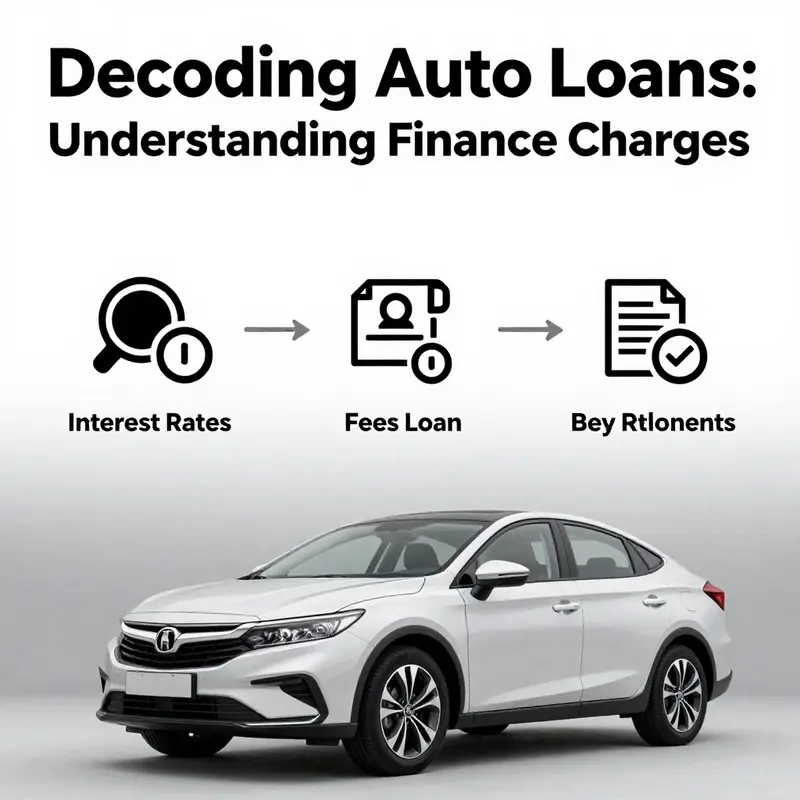
Understanding the finance charge means seeing the full price of borrowing for a vehicle. Many shoppers focus on the sticker price and monthly payment. Yet the finance charge is the sum of interest and lender fees that make the loan more expensive than the principal alone. It converts a loan into a cost you must measure, compare, and manage. This chapter walks through the parts that build that number, shows how lenders calculate it in practice, and gives clear ways to reduce it without fragmenting the discussion.
A finance charge starts with interest, but it rarely ends there. Interest is the lender’s payment for taking on risk and deferring cash. Lenders add administrative and transactional fees. Those items may include origination or processing fees, documentation charges, dealer markups, and penalties for late or early payments. When the Truth in Lending Act requires disclosure, the lender must show the finance charge and the APR. Those numbers let you compare offers. The finance charge shows what you actually pay for borrowing. The APR reflects the annual cost as a single rate. Both matter, and they are not identical.
Loan amount, APR, loan term, and fees are the core variables. Increase any of them and the finance charge tends to rise. A larger principal creates a higher base for interest calculation. A higher APR increases the interest portion. A longer term lowers monthly payments but prolongs interest accrual. Fees add a fixed lift to the total cost, and they sometimes get rolled into the loan, which raises interest on top of the fee itself. Those dynamics explain why two loans with similar monthly payments can have very different finance charges.
Creditworthiness shapes the APR. Lenders price risk to preserve returns and manage losses. A stronger credit profile typically earns a lower APR, which lowers the finance charge across the loan term. Conversely, borrowers with weaker credit pay higher rates and sometimes steeper fees. Lenders may also structure loans differently for borderline applicants, using shorter terms, co-signers, or higher down payments. Such adjustments affect the finance charge and the monthly payment in different ways.
The loan term requires more attention than most buyers give it. Extending a loan from 48 to 72 months may reduce monthly payments substantially, but it often increases the finance charge by thousands of dollars. That trade-off is not inherently bad. Lower monthly payments can make a purchase feasible. But if you can afford a shorter term, you typically save on total interest. A careful borrower balances monthly cash flow against total cost. That balance depends on priorities, other debts, and long-term financial goals.
Fees come in many forms, and they weigh heavily on the finance charge. Origination fees and dealer processing fees are common. Lenders sometimes charge title or registration processing as well. Some dealerships add markups to the interest rate when they arrange financing. Add-on products, such as extended warranties, GAP coverage, or insurance, can be included in the financed amount, raising the principal and, therefore, the total interest paid. Always ask which fees are one-time charges and which are rolled into the loan. Knowing this affects both the finance charge and your monthly payments.
How lenders build the finance charge involves a few typical calculation methods. The most common is simple interest, where interest accrues on the outstanding principal. Each monthly payment first covers interest for that period, with the remainder reducing principal. As principal drops, interest per payment falls. Another method uses the average daily balance. Lenders compute the daily principal balances across the billing cycle, average them, and apply a daily rate. Either way, interest depends on the outstanding balance and how quickly you reduce it. If fees are financed, they increase the principal and therefore increase interest costs across the loan.
Negative equity is a subtle but important contributor to finance charges. Rolling a trade-in deficit into a new loan increases the principal immediately. That added principal accrues interest for the full term. Buyers who owe more on their current vehicle than its trade-in value should be cautious. Financing that deficit inflates both monthly obligations and the total finance charge. In some cases, it may be better to pay down the old loan or accept a shorter term on the new loan to limit the extra interest.
Prepayment and penalty terms alter the expected finance charge. Some loans include prepayment penalties. Those fees discourage early payoff and can offset the financial benefit of lower interest through early repayment. Other loans allow prepayment without penalty, letting you reduce the principal sooner and lower total interest. Before signing, check the contract for prepayment language. Even without explicit penalties, timing matters. Paying extra toward principal reduces the outstanding balance and saves interest, often faster than you might expect.
Understanding the APR versus the nominal interest rate helps in comparing finance charges. The nominal rate is the periodic interest rate quoted by the lender. APR expands that rate to include certain fees and expresses the cost annually. For example, two loans with identical nominal rates can have different APRs if one charges an origination fee. The APR will be higher on the loan with the fee. Because APR reflects some fees, it offers a better comparison tool than the nominal rate alone. Still, APR may not include all discretionary add-ons, so reading the finance charge disclosure remains essential.
Dealers and lenders influence the finance charge in different ways. A credit union or bank may offer lower base rates to qualified borrowers. Dealers often source financing through multiple channels and may add a markup to the interest rate in exchange for a convenience. That dealer markup increases the finance charge in subtle ways. Always ask for the lender’s buy rate and the markup applied by the dealer. If the dealer cannot or will not disclose the markup, take the offer to another lender for comparison. Getting a pre-approved rate before visiting a dealership often gives better leverage.
Amortization schedules clarify how each payment divides between interest and principal. Early payments usually pay more interest than principal. Over time, the principal portion grows. Reviewing an amortization schedule shows the cumulative interest paid at each point. It makes the finance charge tangible. You can see how extra payments shorten the term and shrink total interest. Use that schedule to test scenarios, such as adding a small extra payment each month or making a lump-sum payment when you receive a bonus. Small changes can produce meaningful reductions in finance charges over long terms.
Consumer protections exist to keep finance charges transparent. The Truth in Lending Act requires lenders to disclose the finance charge and APR clearly. Those disclosures should appear on loan offers and contracts. They let you compare offers without hidden surprises. Yet disclosures vary in readability. Ask questions if the numbers are unclear. Request a full loan estimate that details the finance charge, all fees, the APR, and the amortization schedule. A careful review prevents unnecessary costs and reduces the chance of entering a loan with unfavorable terms.
Insurance and add-on products often increase the financed amount. Optional products may offer value, but they also raise the principal. If you choose to finance add-ons, expect to pay interest on them. Sometimes it makes sense to purchase such items outside the loan with cash or a separate line of credit. That lowers the financed amount and reduces the finance charge. Ask whether a product is mandatory. If not mandatory, compare prices outside the dealer and weigh the convenience against the long-term cost.
Refinancing provides a strategy to lower the finance charge after origination. If rates fall or your credit improves, refinancing at a lower APR can reduce interest costs. Refinancing extends the loan term or shortens it, depending on your goals. To judge whether refinancing helps, compute the break-even point: the time required for savings to offset any costs associated with the new loan. Refinancing is not free, so do the math before proceeding. If refinancing lowers the APR significantly, it can save hundreds or thousands over the remaining term.
Timing matters when buying and financing a vehicle. A larger down payment reduces the financed principal and lowers the finance charge. Timing your purchase to when you can make a substantial down payment or to when promotions reduce fees can impact the total cost. Also consider the loan start date and when payments begin. Some lenders allow a deferred first payment; others start the counter immediately. Knowing these details helps you plan cash flow and manage interest accrual.
Comparing offers requires consistent metrics. Compare the finance charge and the APR across loans of equal term and principal. If one lender charges fees upfront and another rolls them into the loan, normalize the comparison by calculating the total cost over the same term. Ask for a detailed loan estimate that breaks down interest, fees, and the final total finance charge. If one offer lacks transparency, treat it skeptically. Clear, itemized estimates let you see which lender offers the best net outcome.
Small choices add up. Opting for a slightly lower APR with a slightly longer term may reduce monthly payments but increase total interest. Conversely, a shorter term at a slightly higher monthly payment usually cuts the finance charge. Making extra payments against principal or paying biweekly instead of monthly accelerates principal reduction and lowers the total interest paid. Even modest additional payments can shift the amortization schedule meaningfully.
Practical steps to reduce the finance charge are straightforward. Shop your credit before applying. Check your credit report and correct any errors that could raise your APR. Secure pre-approval from a bank or credit union to get a baseline offer. Negotiate the vehicle price and the financing separately. Avoid unnecessary add-ons financed into the loan. Make a larger down payment if possible. Consider shorter terms when you can afford higher monthly payments. If you must take a longer term, plan for extra principal payments when feasible to reduce interest costs.
Certain scenarios merit extra caution. Subprime loans often carry high APRs and multiple fees, escalating the finance charge. If offered a subprime deal, compare it with alternative lenders and consider a co-signer. Balloon payments or deferred interest plans can obscure the true finance charge and create large obligations later. Read terms carefully and reject opaque structures that transfer risk to future dates.
For buyers who use a vehicle for business or commercial purposes, financing considerations include tax and depreciation effects. Business use can change the value proposition of a loan through tax deductions. In fleet or truck ownership contexts, finance charges affect operating cost per mile and long-term profitability. For specialized guidance on that perspective, see the resource on managing truck ownership finances. The link provides specific insight into the intersection of vehicle financing and business operations.
Calculations turn abstract terms into concrete numbers. Suppose a 25,000 loan has a 5% APR over 60 months. Monthly payments hover near 471. The finance charge, the sum of interest paid, will be roughly 3,260. That number reflects only interest. Add any origination or processing fees, and the total cost grows. Now imagine a dealer adds a 1% markup or an origination fee of 500. The APR and the finance charge increase accordingly. Seeing the math shows how fees compound across the term.
Finally, remain vigilant about disclosures. Lenders must reveal the finance charge, APR, and all required payment information. Still, good practice goes beyond accepting those numbers at face value. Request a full loan estimate and an amortization schedule. Ask questions about each fee. Compare multiple offers. Consider a credit union or direct lender as an alternative to dealer financing. If you plan to keep the vehicle for a short time, evaluate the total finance charge relative to expected ownership duration. The finance charge is more than a number. It is the story of how borrowing transforms a purchase into a longer-term financial commitment.
For deeper reading on how interest rates and loan terms affect auto loan costs, consult this guide: https://www.experian.com/blogs/ask-experian/understanding-auto-loan-interest-rates/.
Beyond the Sticker Price: Unraveling the True Cost of Auto Loans Through Finance Charges
When you shop for a car, the price tag on the windshield often grabs attention first. But the true cost of getting behind the wheel is rarely the sticker price alone. The finance charge is the broader sum of money you pay to borrow, and it can make a car far more expensive than the price tag suggests. In practical terms, the finance charge is the total cost of borrowing money over the life of the loan. It includes not only interest, the price of using someone else s money, but also a collection of fees that lenders attach to the loan agreement. Understanding this concept is more than a math exercise; it is a toolkit for comparing offers, negotiating terms, and avoiding the hidden costs that quietly inflate the price of a vehicle over time.\n\nAt the heart of the matter is interest, the lender’s charge for the risk of lending and for allowing you to use the money over a period of time. Interest is typically quoted as an annual percentage rate, or APR, which aims to normalize the cost across different loan offers. But APR is not a stand alone price tag; it encapsulates both the interest rate and certain allowable fees. This distinction matters because lenders may advertise a low nominal interest rate while tacking on fees that are rolled into the loan balance. The resulting effect is a higher APR and a larger total finance charge than the base rate alone would imply. The Truth in Lending Act, TILA, exists to shine light on these calculations. It requires lenders to disclose all finance charges clearly so consumers can see the full cost of borrowing before signing. In practice, that disclosure is a line item in the loan contract or a separate statement that itemizes interest and each fee that becomes part of the loan. The logic is straightforward: a transparent disclosure reduces the chance of a borrower being blindsided by costs that seem invisible at first glance.\n\nConsider a concrete example that sits at the core of everyday decision making. If you take out a 25,000 auto loan with a 5 percent annual percentage rate over a 60 month term, your monthly payment will hover around 471.20 per month. When you multiply that payment by 60 months, you arrive at roughly 28,272 in total payments. The difference between that total and the original loan principal—the 28,272 minus the 25,000—gives a finance charge in the neighborhood of 3,272. That figure represents the true cost of financing beyond the amount borrowed. It is a tangible reminder that the car’s price is only part of the cost story; the financing terms can add thousands of dollars to the amount paid over the life of the loan. It is this bottom line figure—the finance charge—that makes a longer loan term seem more affordable in the short term while potentially increasing the total cost of ownership over time. In other words, a lower monthly payment can come with a steep cumulative price tag if the loan’s term is long or if additional fees are piled on.\n\nMost auto loans use an amortized payment schedule, the standard approach that most borrowers encounter. Under amortization, each monthly payment includes both principal and interest. In the early years of the loan, a larger portion of the payment covers interest, while a progressively smaller share goes toward reducing the principal. Over time, this means your outstanding balance diminishes, and the interest portion of each payment declines as well. The mathematics behind the fixed monthly payment is precise: the payment is determined by the principal, the monthly interest rate, and the total number of payments. The commonly cited formula for a fixed rate, amortized auto loan expresses the payment as a function of those variables, ensuring a predictable, uniform installment each month. Although the exact arithmetic can be left to a calculator or a loan officer, the intuition is simple: the lender earns interest monthly on the outstanding balance, and as that balance falls, the interest portion declines. This is the heart of how the finance charge accrues over time, not as a single lump sum at the end, but as a stream of payments that gradually increases the borrower’s equity in the vehicle.\n\nIn practice, however, the price of financing rarely rests on interest alone. Fees attach themselves to the loan in a variety of forms, and each adds to the total cost in its own way. An origination fee is a one time charge for processing the loan, often expressed as a percentage of the loan amount or as a flat fee. A documentation fee covers the administrative work of preparing the loan documents. A processing fee may be levied to cover similar administrative costs. Then there are more dynamic charges, such as a prepayment penalty; an optional fee charged if you pay off the loan early. Although less common today, the possibility remains that a lender will penalize you for reducing the balance ahead of schedule. There can also be guarantee or assurance fees tied to certain loan structures, or ongoing service fees that appear as line items on monthly statements. Each of these charges typically becomes part of the finance charge because they increase the total amount repaid over the life of the loan. The accumulating effect of these fees, when added to interest, can substantially raise the total cost of financing a vehicle.\n\nA crucial distinction in this landscape is the difference between the finance charge and the monthly payment. The monthly payment is a function of the loan terms how quickly you repay the principal. The finance charge is the broader cost of borrowing, taking into account both interest and every fee that contributes to the total you repay. The monthly payment can be lower or higher depending on the term length, the borrower’s credit, and the structure of the loan, but the finance charge captures the cumulative price of financing the purchase. When shopping for a car, this distinction matters because you can be lured by a low monthly payment while overlooking a high overall cost. A loan with a longer term might reduce monthly obligations but will generally result in a larger finance charge, because interest accrues over more payments. Conversely, a shorter term often means a higher monthly payment but a smaller total finance charge, since the balance is paid off more quickly and for a shorter period.\n\nThe way lenders price a loan, and the way borrowers experience it, is shaped by creditworthiness and market conditions. A borrower with strong credit typically secures a lower interest rate, which directly reduces the finance charge. A weaker credit profile can trigger higher rates, increasing the total cost of borrowing even if the monthly payment is manageable. Moreover, the vehicle itself acts as collateral. Secured loans, such as auto loans, come with lower risk to lenders than unsecured loans, often resulting in lower finance charges. Yet this still leaves room for variation across lenders. The loan term, or length, also plays a significant role. A longer term reduces the monthly burden but spreads the principal repayment over more time, allowing interest to accumulate for a longer period and boosting the total finance charge. Shorter terms curtail how long interest can accrue but demand larger monthly payments, which some borrowers may struggle to meet. The practical implication is clear: the best financing package balances affordable monthly payments with a reasonable total finance charge, all while meeting the borrower’s long-term budget and vehicle ownership goals.\n\nTransparency, mandated by law, remains a critical ally for borrowers. The Truth in Lending Act requires lenders to provide a clear disclosure of the finance charge, the APR, and the total amount financed. A finance charge disclosure statement should itemize interest and fees in a way that makes it possible to compare offers on a like-for-like basis. This is not a bureaucratic formality; it is a decision-making tool. When the disclosures are complete and legible, a consumer can see not only how much money will be paid each month but how much of that payment is due to the cost of borrowing itself and how much reflects the incidental costs of arranging the loan. The importance of these disclosures cannot be overstated. They empower borrowers to evaluate offers with clarity and to recognize when a lender is packaging additional charges into the loan in ways that might be difficult to notice at first glance. In a market where offers proliferate from dealerships to banks to credit unions, the finance charge disclosure stands as a common reference point, enabling apples-to-apples comparisons rather than an accumulation of scattered numbers that require mental gymnastics to reconcile.\n\nFor anyone assessing options, the practical takeaway is to treat the finance charge as a central metric in the decision process, not an afterthought. When you request a loan, ask for the full finance charge disclosure and for a breakdown of every notable fee. Review the numbers against the principal and the term of the loan. Consider how the structure affects the total cost. If a lender offers a lower stated rate but a larger origination or processing fee, the overall finance charge may still be higher than a competing offer with a modest fee load and a slightly higher rate. The real question is this: over the life of the loan, what will you actually pay? The answer is not captured by a single figure such as the monthly payment. It is the sum of principal, interest, and every fee the total you will repay to own the car outright.\n\nTo deepen the inquiry, it is useful to connect with resources that synthesize these concepts into practical guidance. A centralized repository of knowledge can be a valuable companion as you evaluate offers. For a deeper dive into related financial planning concepts and decision-making, see the knowledge hub. This resource aggregates insights on loans, budgeting, and the broader financial landscape, helping readers translate the terminology of finance charges into concrete, actionable steps. By linking to a trusted knowledge base, you not only anchor your understanding in reliable information but also create a pathway to ongoing learning as market conditions evolve and new lending practices emerge. For example, knowledge hub: https://davisfinancialadvisors.net/knowledge/\n\nBeyond the numbers, there is a behavioral dimension to negotiating auto loan terms. Borrowers often encounter a tension between monthly affordability and long-term cost. Dealerships can present loan terms in a way that makes the monthly payment appear appealing, while the finance charge sits behind the scenes in the fine print. This is why it pays to slow down, to request the full disclosure for every offer, and to compare offers not just on the monthly payment but on the total cost of credit. A prudent approach is to obtain several formal offers and to compare them using a common yardstick: the total finance charge over the life of the loan. In practice, this means translating each offer into a single figure that captures the sum of interest and all fees; then, present the offers side by side to see where the real savings lie.\n\nThe regulatory landscape reinforces this approach. The CFPB offers guidance on auto loans, including tips for understanding disclosures and recognizing potentially predatory terms. The regulation is not merely about compliance; it is about equipping consumers with the knowledge to make informed, responsible financial choices. Borrowers who educate themselves about the components of the finance charge, what constitutes interest, what counts as a fee, and how each item influences the total amount repaid, are less likely to be misled by opaque pricing structures. The emphasis on disclosure supports a consumer’s ability to evaluate trade-offs: you might opt for a loan with a slightly higher rate if it comes with a lower, more straightforward fee schedule; or you might choose a longer term if you can secure a robust plan to pay down the balance early without penalties.\n\nTo summarize the practical implications: the finance charge is the comprehensive price of borrowing for an auto loan. It captures both the interest paid for the use of money and the various fees that lenders may attach to the loan. The amortized structure of most auto loans means that the balance decreases over time as you make payments, and the portion of each payment that goes to interest declines as well. Yet the finance charge is not just the sum of the interest payments; it aggregates the additional charges that can significantly inflate what you end up paying. Knowledge of these elements empowers you to shop smarter, compare offers more accurately, and negotiate terms that align with your long-term budget and ownership goals. As you prepare to engage with lenders, remember that the most informative question you can ask is not merely what is my monthly payment but what is my total finance charge and what fees are included or excluded from that calculation. The clarity you seek will enable a financially healthier path to vehicle ownership, one that respects both your short-term needs and your long-term financial well being.\n\nFor a broader understanding of how these costs fit into the larger picture of lending, regulatory guidance, and consumer protections, consult official resources that outline auto loan disclosures and practice standards. External resources you can review include the Consumer Financial Protection Bureau’s guide on auto loans, which offers detailed explanations of disclosures, pricing, and consumer rights: https://www.cfpb.gov/consumers/money-and-banking/loans-and-mortgages/auto-loans
Behind the Price Tag: Decoding the True Cost of Auto Loans and the Finance Charge

When you shop for a car, the price tag often grabs most of your attention. The monthly payment, the sticker price, the down payment—these are the numbers you weigh, test-drive, and compare. Yet lurking behind those figures is a quieter, more powerful cost that shapes the long-term affordability of your purchase: the finance charge. Understanding what the finance charge includes, how it’s calculated, and how it can vary from one lender to another is essential for anyone who wants to borrow responsibly and avoid end-of-term surprises. The finance charge is not merely interest on the principal; it is the total price you pay to borrow money over the life of the loan. It encompasses interest and a collection of mandatory fees that lenders may impose as a condition of credit. In practical terms, the finance charge is the difference between the total amount you repay over the loan and the amount you actually borrowed up front. It is the cost of financing your vehicle, and recognizing it early helps many buyers tell a true cost story instead of settling for a headline rate that hides its true impact. The topic matters because the finance charge directly affects the total affordability of the vehicle and can influence whether a loan is sustainable for your income, your other obligations, and your longer-term financial goals. The Truth in Lending Act (TILA) formalizes this by requiring clear disclosures so consumers can see the whole picture before signing. When lenders lay out the numbers in a transparent way—showing the finance charge, the annual percentage rate, and the total of payments—you gain the power to compare offers on a like-for-like basis, not just on the apparent interest rate. To grasp the practicalities, it helps to unpack the components, the math, and the behavioral choices that drive cost over time. At its core, a loan is a promise: you borrow a principal amount, you repay it in installments, and you compensate the lender for the risk, the opportunity cost, and the administrative work of processing the loan. The finance charge is the monetary ledger that records that compensation. It is a way to translate the risk the lender takes and the services they provide into a single, comprehensible figure. Because cars are large-ticket items and auto loans are often structured with relatively long terms, the finance charge can accumulate to amounts that are surprising if you only watch the monthly payment. This is why lenders frequently present both the finance charge and the annual percentage rate in disclosures. The APR is the more useful lens for comparison, because it consolidates both the interest rate and the mandatory fees into a single percentage that reflects the true cost of borrowing over the loan term. In a sense, the APR is a translator between the lender’s pricing language and the consumer’s understanding of total cost. Yet even APR can be misunderstood if a borrower looks only at the number without examining the underlying structure of the loan: the term, the size of the fees, and which costs are financed into the loan versus paid upfront. The difference matters. It matters when you consider that a lower advertised rate might come with higher origination fees, higher processing costs, or mandatory add-ons that inflate the total price. It matters when a longer repayment period lowers monthly cash flow but increases the total interest paid and the overall finance charge. And it matters when a borrower signs without fully understanding the disclosure, only to discover that the ‘easy’ plan ends up costing far more than anticipated. To illustrate, consider a straightforward example that mirrors common real-world choices. Suppose you borrow $25,000 to buy a car. The loan carries a 5 percent annual percentage rate (APR) and runs for 60 months. The math isn’t complicated, but the implications are meaningful. The monthly payment on such a loan is typically around $471, give or take a few dollars depending on rounding and the exact terms offered by the lender. If you multiply that monthly payment by the 60 months of the loan, you arrive at a total of about $28,260 in payments. Subtract the original principal of $25,000, and you get a finance charge of roughly $3,260. This figure—about three thousand two hundred sixty dollars—represents the total cost of borrowing over the life of the loan beyond the amount financed. It is not merely interest; it includes other fees that were financed, and it reflects the cost of the lender’s risk and services that facilitated the loan. It also underscores the notion that the lowest monthly payment is not the sole path to affordability. A finance charge that is high because of fees can eclipse the savings offered by a slightly lower interest rate if those fees are not accounted for in the total cost. The practical takeaway is simple: look past the monthly bill and look at the full cost of financing the vehicle. The APR provides a comprehensive yardstick for comparison, but you must read the disclosure carefully to understand what is included and what is not. The disclosure should spell out the APR, the finance charge, the amount financed, and the total of payments. In this framework, the “amount financed” is not always the same as the loan principal; it represents the amount of credit extended after certain up-front credits or prepaid items, such as down payment, prepaid interest, or certain fees deducted from the loan proceeds. The “finance charge” is the sum of all interest and all mandatory charges paid to obtain the loan, over the entire term. The “total of payments” is the sum of all periodic payments owed under the loan, including both principal and finance charges. When you think about it this way, the line between price and financing becomes clear. A car’s price remains fixed, but the way you finance it can make the effective cost move up or down by a substantial amount. A lender can have a low headline rate but inflate the overall cost with fees that are rolled into the loan. A lender can also offer a higher rate but keep the total finance charges modest by keeping the fees low and the term shorter. Either path can yield a similar total cost, but you won’t know until you calculate the APR and examine the full disclosure. This is precisely why the borrowing experience under TILA hinges on transparency. The disclosures are not mere formalities; they are a guardrail against hidden costs and predatory practices. When you carefully review the finance charge disclosures, you can see how much of the total cost is driven by interest and how much by fees. You can also assess the risk and the value offered by the loan structure itself. For example, some auto loans include origination fees, processing fees, and documentation charges. Some of these fees are mandatory and non-negotiable, while others might be negotiable or optional. Some lenders also offer optional add-ons, such as extended service contracts or certain insurance products, which can be financed into the loan and included in the finance charge. In practice, this means that a loan with a lower nominal interest rate might require you to pay larger upfront or financed fees, which can push the APR higher than another loan with a slightly higher rate but lower total fees. Understanding this nuance is critical because it informs the decision you make about which offer to accept. The core habit for responsible borrowers is to request and compare the full APR across multiple lenders, not just the advertised rate. This practice helps to level the playing field and reveals which combination of rate, term, and fees truly minimizes the cost of credit. It also helps to guard against predatory lending practices that rely on complex fee structures to mask the real price of borrowing. A practical step in this process is to gather pre-qualified offers from several lenders. Pre-qualification is typically a soft inquiry, meaning it does not usually impact your credit score. It yields indicative terms and estimated APRs, which you can compare side by side in an apples-to-apples fashion. If you approach the shopping process with a clear framework, you can separate the signal from the noise: APR as the primary comparator, term as the lever you adjust to balance monthly payment against total cost, and all fees as the additional texture that either inflates or reduces the total borrowings. The total cost of financing is not a static figure; it is sensitive to the terms you choose and the fees the lender requires. Consider the term length as a major determinant of total cost. A 36-month loan will usually have higher monthly payments but lower total interest than a 60-month loan. The savings on interest can be substantial, resulting in a smaller finance charge overall. Conversely, a longer term reduces monthly payments and improves cash flow, but the extended exposure to interest accrues more finance charges over time. This dynamic helps explain why the same loan amount can yield very different total costs when offered with different terms. It also clarifies why a borrower who focuses only on the monthly payment might end up paying more for the car in the long run. Fees are another axis along which the total cost can be shaped. Some lenders charge a separate origination fee, usually a fixed amount or a percentage of the loan. Others impose a processing fee or a documentation fee, which can add hundreds of dollars to the cost. Some auto loans may even include mandatory insurance premiums or service contracts that are financed into the loan, increasing both the principal and the finance charge. It is essential to identify which costs you must pay and which costs—if any—are optional or negotiable. When you review the contract, check the line items carefully. Ask questions about any fee you do not understand, and request a version of the disclosure that clearly separates interest from fees. In many cases, borrowers will discover that a seemingly attractive rate is accompanied by fees that offset the advantage of that rate. The overall message is straightforward: the true cost of a loan is the APR, which blends rate and fees into a single, comparable metric. If you stick to the APR and the total of payments, you can compare offers without getting tripped up by seemingly favorable headlines that do not reflect the full price of credit. The internal clarity that comes from understanding the finance charge is not just a numerical exercise. It also informs a borrower’s broader financial health, including how much risk they are taking on, how much liquidity they retain after the purchase, and how the monthly obligations fit within a realistic budget. For instance, if your income is tightly allocated to essential expenses, you might favor a shorter term with a modest finance charge, even if the monthly payment is higher. If you have flexibility and want to preserve cash flow for other needs, a longer term with a lower monthly payment might be tempting, but you should do the math to ensure it does not lead to unaffordable total costs over time. A practical approach to guardrails and best practices is to view the disclosure as a budget tool, not merely a legal requirement. When you plan ahead, you can anticipate how the cost of financing interacts with other financial goals, such as saving for emergencies, paying down higher-interest debts, or investing for the future. The process of shopping for a car loan as a cost-of-credit exercise becomes a form of financial literacy. It is not about defeating the loan system or exploiting loopholes; it is about making informed choices that align with your values and your life plan. To support this understanding, you can turn to trusted educational resources that lay out the mechanics of auto loan costs in accessible terms. For a broader primer on calculating true borrowing costs and navigating common pitfalls, consider exploring more in the knowledge domain of consumer finance. The Knowledge hub offers practical explanations and templates you can use to compare offers more effectively. Knowledge hub. For a structured, reader-friendly breakdown of how to compute the true cost of your auto loan, the resources linked above can complement the guidelines here and help you translate numbers into confident decisions. If you want a concrete, step-by-step method to compare deals, the following external resource also provides actionable calculations and cautions about hidden costs that can creep into loan offers: https://www.nerdwallet.com/article/loans/auto-loans/how-to-calculate-the-true-cost-of-your-auto-loan. This external guide aligns with the core principle of pursuing the lowest true cost, not just the lowest advertised rate, and it reinforces the importance of reading every line of the final agreement before you sign. In closing, the finance charge is a practical compass for borrowers. It points toward transparency, careful calculation, and disciplined shopping. It reminds us that the money we commit to borrowing is more than a monthly figure: it is a long-term financial obligation that shapes how we allocate resources, plan for the future, and build a resilient financial life. By focusing on APR, total of payments, and the true cost embedded in the loan structure, you can approach auto financing with clarity rather than conjecture. You can separate the smooth rhetoric of marketing from the actual price of credit and keep your eyes on sustainable choices that serve your short-term needs and long-term aspirations. This thoughtful approach aligns with the broader goal of informed financial decision-making and reinforces the idea that the right loan terms, chosen with care, can keep your car affordable without compromising your financial stability.
Final thoughts
A thorough understanding of finance charges is essential for making informed borrowing decisions when financing an auto purchase. By recognizing the components of these charges, how they are calculated, and the importance of comparison among lenders, car buyers, dealerships, and small business fleets can enhance their negotiating power and secure favorable terms. Knowledge is the key to minimizing costs and maximizing the value of vehicle financing.