

Securing auto financing with bad credit poses significant challenges, yet there are various viable paths for potential car buyers. Understanding your options can empower you to make informed decisions. This article delves into specialized lenders, innovative online platforms, community-focused credit unions, and dealership financing avenues. Together, these insights will guide individual car buyers, dealerships, and small businesses in navigating the auto financing landscape effectively, ensuring access to reliable transport solutions.
Opening Doors to Car Ownership: Navigating Specialized Auto Lenders for Bad-Credit Financing

When a blemish on your credit report feels like a barrier to getting behind the wheel, it’s easy to assume a car loan is out of reach. Yet bad credit does not automatically close the door to transportation. A class of specialized auto lenders and finance companies has built its business around helping people who don’t have pristine credit obtain a vehicle. These organizations look beyond a number on a report and try to assess the real-world ability to repay a loan. They consider job stability, income, and the value of the car you want to buy. What changes is not your need for a car but the path by which you secure financing. If you approach this path thoughtfully, you can gain access to a vehicle while laying groundwork to improve your financial standing over time.
At its core, the appeal of specialized auto lenders is practical. Traditional banks and some large finance arms of car dealerships place heavy emphasis on credit scores, histories of missed payments, or other risk signals. Specialized lenders, by contrast, often emphasize the borrower’s current income, employment history, and the consistency of earnings as a predictor of future repayment. They understand that life happens—unexpected medical bills, a layoff, or a shift in hours—and they try to evaluate whether you still have the capacity to repay the loan even if your credit history tells a more complicated story. The result is that a borrower who has faced credit problems may still qualify for a loan when a standard lender would say no. This can be a meaningful step forward for someone who needs reliable transportation to keep a job, attend classes, or manage family responsibilities.
The trade-off is clear: along with the expanded access comes higher risk for the lender, and that risk is reflected in the terms of the loan. Interest rates can be higher, and the overall cost of borrowing can be greater than what you would see with borrowers who have excellent credit. Loan terms may be shorter, the required down payment may be larger, and there can be stricter conditions on repayment. The shift in risk assessment means you should enter the process with a clear plan and a careful eye on affordability. A loan can help you move forward, but it should never squeeze your budget so tightly that you miss payments or fall behind, which would undermine your longer-term goal of rebuilding credit.
One of the most important steps when pursuing financing through specialized lenders is to be meticulous about the documentation you bring to the table. Even though these lenders may look beyond a low credit score, they still want to confirm your ability to repay. Expect to provide proof of steady income, recent pay stubs or tax returns, recent bank statements, and a list of monthly obligations. Demonstrating a stable source of income and a reasonable debt load reassures lenders that you can manage a car payment alongside your other bills. Banks for the general public often require a longer history of employment and higher savings, but for a borrower with bad credit, the job you hold today and the consistency of that job can carry significant weight.
Down payment remains a central part of the equation. A meaningful down payment—often in the 20 percent range or higher, depending on the lender and the vehicle—reduces the lender’s risk. A larger down payment lowers the loan-to-value ratio, increases the likelihood of approval, and can translate into more favorable terms within the constraints of a higher-risk loan market. If you can pull together a substantial down payment, you not only improve your chances of securing a loan but also reduce the amount you borrow against the car’s value. This is especially true if you’re buying a used vehicle, where the value tends to depreciate quickly in the first months of ownership.
Beyond traditional down payments, the option to include a co-signer can dramatically improve your odds when credit is a weakness. A co-signer shares responsibility for the loan, which reduces lender risk. This can be a practical route for a student stepping into the job market, a borrower rebuilding credit after a setback, or someone who has recently changed jobs but possesses a steady income. The co-signer’s credit history can balance the risk profile, increasing the likelihood that the loan is approved and that the terms are fairer. It is, however, a serious commitment for the co-signer, who becomes equally responsible for the debt. Before pursuing a co-signer, have an open discussion about repayment plans, potential consequences for both parties, and how promptly you intend to address any issues that arise.
Another strategy is to work with online or digital platforms that incorporate alternative data into their underwriting. Instead of relying solely on a credit score, these lenders look at employment history, income stability, education, and other indicators of financial behavior. For some borrowers, this broader lens can produce a viable loan even when the credit score sits in the lower ranges. In addition, some programs from online lenders emphasize tools that help you improve credit over time, such as structured repayment guidance and reporting that highlights positive, timely payments to major credit bureaus. This approach aligns with a longer-term goal: transform a difficult credit situation into a stepping stone toward better financial health.
Credit unions offer another viable path in many communities. These member-owned institutions often have more flexible lending criteria than larger banks. They may take a more holistic view of your financial situation, considering not just income but savings, stability, and your overall financial behavior. What often distinguishes credit unions is the willingness to work with members on reasonable terms and to provide personalized service. If you’re eligible to join a local credit union, you may access lower interest rates and more favorable repayment structures than you’d find with some traditional lenders. The key is to inquire about membership requirements and to be prepared with the same documentation you’d bring to any lender: proof of income, identification, and a clear plan for how you will manage payments.
In some circumstances, borrowers explore vehicle-only secured loans, sometimes referred to as car-title loans, when other options are exhausted. These loans use the equity in a vehicle you already own as collateral. They are generally easier to qualify for if you have very poor credit, but they carry high interest rates and fees and can put the car at risk if you default. Because the stakes are high—the loss of transportation and the cycle of debt that can follow—a car-title loan should be regarded as a last resort rather than a first choice. If you consider this route, proceed with extreme caution, compare total costs, and have a clear, affordable plan to repay promptly to avoid losing your vehicle.
Dealerships themselves often offer financing programs, sometimes labeled as in-house or buyer financing. For buyers with imperfect credit, dealership financing can be a practical option that helps you secure a vehicle now, particularly for a used car where the loan amount is smaller. However, the trade-off is that in-house programs can carry higher interest rates than the market average, and the terms may be less flexible. It’s essential to read every term carefully, watch out for add-on products that inflate the total cost, and compare the offer against other financing routes. A key approach is to shop around even within dealership options. If a dealer can offer three financing paths—one through a traditional bank, one through a credit union, and one through an in-house program—you can compare which path yields the lowest total cost and most reasonable monthly payment. A thoughtful comparison helps you avoid being locked into a higher-cost option just because it’s convenient in the moment.
With any of these routes, the car you choose matters as much as the financing. A vehicle with a price that aligns with what you can responsibly borrow is essential. A conservative strategy is to target a car with a lower purchase price or to buy a certified pre-owned vehicle that offers a balance between reliability and cost. A smaller loan, coupled with steady payments, makes it easier to stay on track and begin rebuilding credit through timely reporting of your payments. If you can, consider setting a monthly budget that allocates 10 to 15 percent of take-home pay to car expenses, including insurance, fuel, maintenance, and the loan payment. This discipline helps ensure you do not stretch your finances too thin while the loan is active and your credit is still recovering.
An important dimension of the process is the careful examination of terms before you sign anything. Even when a lender is more flexible than a bank, you should scrutinize the APR, the loan term, the total amount financed, and any origination fees. Ask about prepayment penalties and what happens if you miss a payment. Prepayment, if permitted, can save you money over the life of the loan by reducing interest charges, so it is worth knowing whether you can pay off the loan early without penalties. Read every line of the contract, and if anything seems unclear, request a plain-language explanation before committing. The goal is to secure financing that not only gets you into a car today but also creates the conditions for better credit behavior tomorrow.
Education remains a powerful ally. Even as you pursue financing, take steps to understand how discrimination and predatory lending can appear in the auto-loan market. Knowledge helps you recognize red flags—like aggressively high-pressure sales tactics, terms that shift costs onto you after closing, or promises of guaranteed approval without a truthful review of your finances. A prudent borrower will verify that the lender reports payment activity to the major credit bureaus, as this determines the impact of on-time payments on your credit profile. Not all lenders report, and if you end up with a loan that does not appear on your credit file, you miss an opportunity to demonstrate responsible behavior that can lift your score in the months ahead.
If you want more context on responsible borrowing and how to navigate these options, you can explore additional resources that discuss credit health and debt management. For readers seeking structured guidance, the knowledge hub from a trusted financial advisory resource offers foundational articles on credit and budgeting that complement this discussion. Davis Financial Advisors knowledge hub
As you start the process, remember that specialized auto lenders and finance companies are not a monolith. They vary in policies, requirements, and practices. The common thread is their willingness to consider more than the numerical score when evaluating your loan. They recognize that the need for reliable transportation intersects with real-world earning patterns and a history of financial responsibility. Your task is to present a credible plan: demonstrate stable income, show a meaningful down payment, consider a co-signer if appropriate, review offers carefully, and choose a vehicle that aligns with what you can responsibly borrow. If you approach financing with clarity and restraint, you can secure a loan that gets you moving today while you work toward stronger credit tomorrow.
Finally, keep your eyes on the long view. A successful auto loan for someone with bad credit is not merely about getting behind the wheel; it is about choosing a path that fosters better financial habits and, over time, a stronger credit profile. Timely payments, mindful budgeting, and ongoing financial education build momentum. In the months that follow, you may see your credit score slowly improve, which can expand your options and reduce borrowing costs in future purchases. The experience itself can become a turning point, a concrete reminder that a broader set of financing possibilities opens when you balance immediate transportation needs with the discipline of responsible borrowing. As you continue reading, the next chapter will translate these concepts into practical steps for comparing offers, negotiating terms, and planning for credit recovery, ensuring you stay on a path that aligns with your budget and your future goals.
External resource: For information on consumer protections and responsible borrowing, consult the Consumer Financial Protection Bureau at https://www.consumerfinance.gov.
Digital Avenues to Auto Financing with Bad Credit: Navigating Online Lenders, Co-Borrowing, and Down Payments to Drive Now
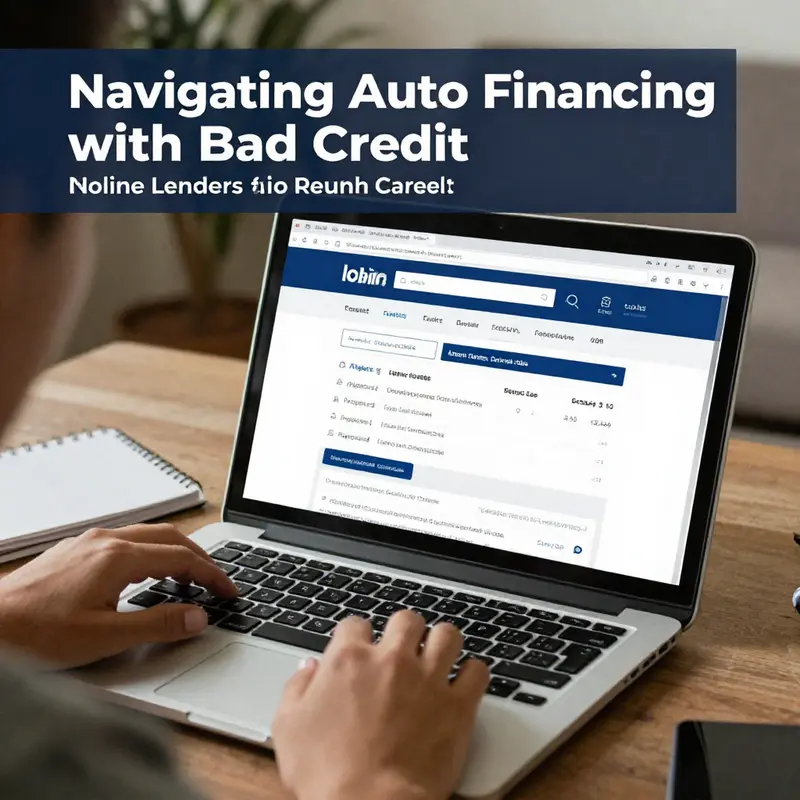
Finding a way to finance a car when your credit isn’t pristine can feel like navigating a floating harbor in a storm. Yet the digital lending landscape has evolved to provide options that prioritize your ability to repay over a perfect credit history. Online lenders and platform-based financing have become a credible route to vehicle ownership for many buyers who would have been shut out by traditional banks. The core idea is straightforward: lenders controlled by data-driven models want to see a coherent plan for repayment, not a flawless credit file. For people who need reliable transportation to get to work, school, or caregiving duties, these online avenues can be more than a stopgap. They can be a doorway to a stable loan, a consistent payment history, and a chance to rebuild credit over time, all while getting behind the wheel of a car that meets practical needs rather than just aspirational ones. The challenge is to understand how these online paths work, what to watch for, and how to position yourself so that your application is evaluated on the full picture of your finances, not just a solitary number on a report.
What sets online lenders apart is not merely speed but a willingness to look at the bigger financial story. These platforms deploy algorithms that weigh a broader set of data points beyond the traditional credit score. They may consider your current income, job stability, and recent earnings trends, as well as your education and even the trajectory of your debt payments. This broader lens can be especially meaningful if you have made timely payments on your rent, utilities, or student loans, or if you have a resilient income stream despite a lower score. In practice, this means the approval decision might hinge on a stabilized income and a coherent budget that demonstrates you can cover not just the loan payment but the ongoing costs of car ownership—fuel, insurance, maintenance, and registration. A crucial part of the process is transparency: reputable online lenders will provide a clear view of what factors influenced their decision, and they will offer a reasonable explanation if a loan is denied.
Another hallmark of these platforms is flexibility in how you apply. Some lend through a digital application that guides you through income verification and identity checks with minimal friction, while others may request a few more documents to corroborate your earnings. Importantly, many platforms perform soft credit inquiries during pre-qualification, meaning your credit score won’t take a hit just to see what terms you might qualify for. If you decide to proceed, a hard inquiry may be performed at funding, but you will still have the chance to compare offers and choose the terms that fit your budget best. The experience can be smoother than you expect, especially when you prepare in advance: gather recent pay stubs, tax returns if necessary, proof of residence, and information about any other debts you carry. Bringing this documentation to the table helps the lender verify your capacity to manage new debt and reassures them that the loan aligns with your financial reality.
Despite the potential for speed and accessibility, a careful approach is essential. The very promise of quick approval can tempt borrowers to lock in a loan without a full understanding of the cost. Here, the emphasis should be on comparing terms rather than chasing the lowest monthly payment alone. The annual percentage rate (APR), the length of the loan, and any fees matter as much as the sticker price of the vehicle. Shorter terms usually carry higher monthly payments but lower total interest, while longer terms reduce monthly costs but can lead to more interest over the life of the loan. It’s also crucial to assess any prepayment penalties or charges that apply if you pay off the loan early. Predatory practices exist in every corner of the market, especially online, where aggressive marketing can blur the line between helpful financing and exploitative lending. A responsible borrower remains skeptical of claims like guaranteed approval or no credit checks, and instead seeks lenders who commit to a transparent, documented process.
From there, a practical strategy emerges: leverage co-borrowing to broaden the pool of approved applicants while sharing the responsibility of repayment. A co-borrower brings a separate income and credit profile into the mix, which can reduce the perceived risk to the lender and broaden access to financing. This approach often improves both approval odds and, in some cases, the interest rate. It is important, however, to choose a co-borrower with a solid, dependable payment history and a realistic plan for how the loan will fit into both parties’ budget. The dynamic can be especially powerful for buyers who are younger, newer to credit, or balancing multiple financial obligations. When a co-borrower is involved, lenders see a more balanced risk, and you may discover opportunities that would not be available with a single-applicant approach. If you are rebuilding credit, a co-borrower who has a reliable income and a track record of on-time payments can provide the stability lenders want to see, while still allowing you to gain access to a vehicle that supports your daily responsibilities.
The down payment remains a potent lever in this landscape. A larger initial payment reduces the loan-to-value ratio, which lowers the lender’s risk and can translate into better terms. For many buyers, a 20 to 30 percent down payment is a practical target, not just a magical threshold. In effect, the down payment acts as a sign of commitment and a cushion against depreciation. Cars lose value quickly, and a meaningful down payment can help ensure that you don’t owe more than the vehicle is worth should you need to sell or trade in the near term. When cash flow is tight, you can still strengthen your position by negotiating the price of the vehicle and selecting a model that retains value and has affordable ongoing costs. A thoughtful combination of a reasonable down payment, a stable income, and a realistic loan term can create a financing scenario that feels manageable, not overwhelming, and it can contribute to smoother credit rebuilding as you demonstrate consistent payment behavior over time.
It’s also worth acknowledging the role of traditional, member-owned financial institutions in this arena. Credit unions, particularly those with a local footprint, can offer a bridge between online platforms and more familiar lending practices. They often evaluate an applicant’s overall financial health rather than focusing solely on a numeric credit score. If you are already a member or can become one, a credit union application might open doors to reasonable rates and a straightforward underwriting process. The result can be a balanced mix of online speed and in-person accountability. The combination of digital openness and personal service—in other words, the best of both worlds—can be especially compelling when you’re navigating imperfect credit. For many, the path includes an online pre-approval that lays out the likely terms and a subsequent in-person visit to finalize the loan under a policy that feels fair and transparent.
It bears repeating that the decision to finance a car with bad credit should be pursued with a clear, written plan. Do not let the lure of fast approval distract you from building a sustainable monthly budget that accounts for fuel, insurance, maintenance, and potential repairs. A vehicle is not merely a loan; it is a gateway to opportunity, but it also represents a significant ongoing financial obligation. In this light, the best online lenders and platforms are those that couple clear cost disclosures with patient customer service, a transparent amortization schedule, and a sincere willingness to discuss how various payment scenarios will affect long-term financial health. If you walk away with a solid understanding of the total cost, realistic monthly payments, and a credible plan to maintain and eventually improve your credit score, you have achieved more than a temporary means to borrow—you’ve secured a vehicle that can support a broader financial rebound.
As you continue your search, a practical way to deepen your understanding is to consult resources that connect lending to vehicle ownership in a broader sense. A well-regarded external resource explores how owners manage vehicle finances and ownership over time, offering context for how a responsible loan plan can coexist with ongoing improvements in credit and overall financial well-being. For broader context, you can review this example of online lending platforms and their approach to risk and repayment. External resource: https://www.upstart.com
Finally, to connect this discussion to practical planning within your broader finances, consider how a path that combines online options with traditional strategies can fit your situation. If you want to explore how these finance options intersect with the realities of owning and maintaining a vehicle in daily life, you can also consult internal resources that discuss long-term ownership finances and related considerations. For a related discussion, see this internal guide on managing truck ownership finances: managing truck ownership finances. This resource can help you frame a loan that supports your transport needs while you strengthen your financial foundation for the future.
Lifelines on the Lot: How Credit Unions Open Auto Financing Doors for Borrowers with Bad Credit
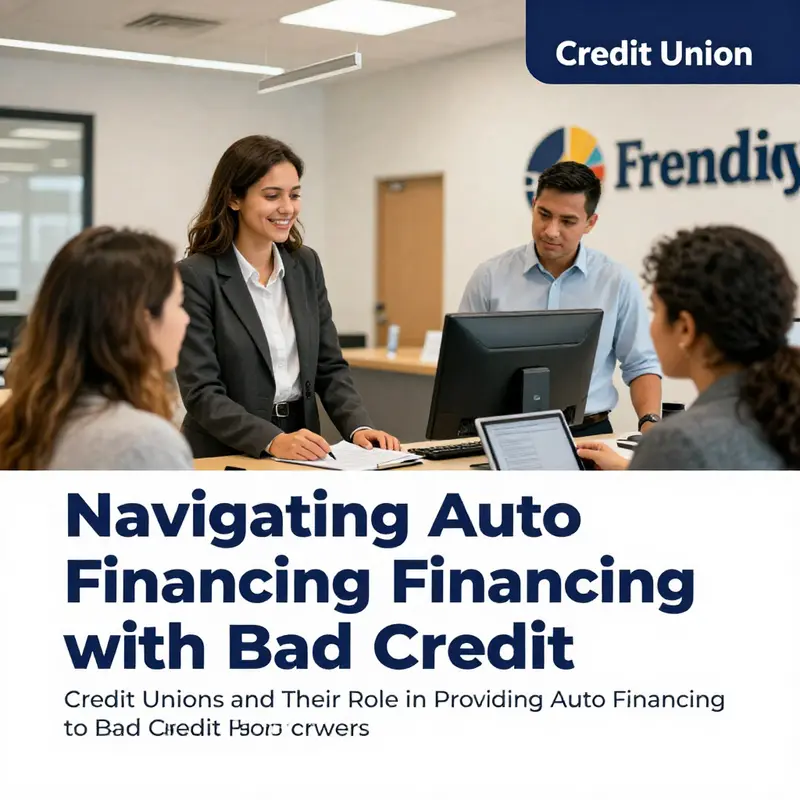
Credit unions stand out in auto financing because they are not-for-profit, member-owned cooperatives that exist to support members’ financial health. When a borrower has bad credit, this difference can translate into practical advantages on the lot. Rather than relying on a single number, credit unions tend to evaluate the whole person: income stability, savings, and the strength of the relationship you already have with the institution. This holistic approach matters because car ownership is a long-term financial commitment, not a one-time transaction.
The underwriting approach at a credit union prioritizes cash flow and affordability. A loan officer may consider income, employment history, savings, and recent payment behavior in addition to credit history. As data shows, credit unions often report lower default rates on auto loans than many banks, reflecting prudent risk management and strong member support.
For borrowers with bad credit, credit unions can offer more flexible pathways, such as secured auto loans that use the vehicle as collateral, or credit-builder products that help rebuild a score through regular payments. These options are designed to align financing with real-life budgets rather than punish a past misstep with punitive terms. Membership itself—often requiring a small savings balance and a local connection—can open access to education resources and budgeting tools that help keep a loan on track.
Qualifying is typically straightforward: provide proof of income, residency, and any savings; demonstrate a stable employment history; and show active participation in the credit union’s programs. A loan officer will look at the full financial picture and the borrower’s commitment to improving credit over time, not just a single credit score.
The payoff is a loan that fits within a family’s budget and a lender that remains a partner beyond the purchase. Education and ongoing support—from budgeting workshops to debt-management advice—help members stay on course, improving the likelihood of on-time payments and better terms in future financing. The result is more accessible vehicle ownership and a financial path forward that emphasizes responsibility and resilience.
If you are considering auto financing with imperfect credit, start by identifying credit unions that serve your community and invite a consultation. Bring proof of income, residency, and savings, and be open about your goals and any past challenges. A patient, collaborative process can lead to a reliable loan and a clearer route to car ownership without compromising long-term financial health.
null

null
Final thoughts
Successfully obtaining auto financing with bad credit requires a strategic approach. By leveraging specialized lenders, online platforms, community-centered credit unions, and dealership financing opportunities, borrowers can find suitable solutions to suit their needs. Each avenue offers unique benefits that cater to different financial situations, enabling a smoother path to vehicle ownership. Encourage proactive measures, such as improving credit scores and understanding loan features, to ensure a positive financing experience.